Category Archives: Medical Tourism/Health Tourism

Jamaican Private Sector Urged to Boost Health Tourism

bandera-jamaicaCT05jul2014

Kingston, (Prensa Latina)

Health Minister Fenton Ferguson urged the private sector to join government strategies to promote health tourism, according to official sources.

“My view is to turn Jamaica into a center of health reference for the Caribbean and to attain this the provate sector will have to contribute by offering services to broaden the scope and depth of the offer in this sector,” said Ferguson in a communique.

He recalled that Jamaica has good healthprofessionals, as well as a good development of the tourism sector, backed by good transport connections, making health care easier and at a lower price than that offered in other countries around the world.

He also considered that the government/private sector alliance, supported by the Development Bank of Jamaica, might mean opportunities for the creation of new businesses or the expansion of existing operations.

According to experts, Jamaica is one of the favorite places of visitors from around the world that look for health tourism, lasure and adventure sports.

ef/rma/mgt/dav

Modificado el ( martes, 24 de junio de 2014 )

www.plenglish.com / Prensa Latina / Home> Kingston – June 24th, 2014

Ethiopian Capital Setting Up Medical Zone To Boost Health Tourism

Addis Ababa :

The Ethiopian North American Health Professionals Association (ENAHPA), a body formed by Ethiopian professionals in the diaspora to promote healthcare in Ethiopia, will establish a medical zone in Addis Ababa to turn the city into a centre for medical tourism.

According to Feisel Aliyi, an official of Directorate-General of Diaspora Engagement Affairs at the Ministry of Foreign Affairs, the ENAHPA and the Inter-Governmental Authority on Development (IGAD) have signed an agreement to develop the zone to become East Africa’s centre of excellence for cancer treatment to benefit member states of IGAD.

Cancer patients from East African countries, including Ethiopia, have been travelling to European countries and Bangkok to seek better medical treatment at a high cost.

Feisel said the establishment of the zone will reduce the need to travel and save hard currency, further noting that the centre will provide advanced medical treatment currently not available in this region.

ENAHPA has over 300 Ethiopian health professionals living in North America and Europe.

— BERNAMA-NNN-ENA

source: http://www.bernama.com / Bernama – National News Agency of Malaysia / Home> World> News / Addis Ababa – June 23rd, 2014

Colorado Looks To Health And Wellness Tourism

Over just two years since it was built, the $34 million University of Colorado Anschutz Health and Wellness Center has created a high-tech space for research and programs. Grace Hood KUNC

Over just two years since it was built, the $34 million University of Colorado Anschutz Health and Wellness Center has created a high-tech space for research and programs.
Grace Hood KUNC

America’s obsession with weight loss has given birth to reality shows like The Biggest Loser and Extreme Weight Loss. The latter aired the second installment of its new season with part of the episode shot on the University of Colorado Anschutz Medical Campus. The popular culture influence is reinvigorating Colorado’s image as a health and wellness destination — but with a medical twist.

When the ABC show Extreme Weight Loss pitched the idea of having contestants spend three months at the Anschutz Health and Wellness Center in Aurora, their chief strategist John Peters wasn’t sure about the idea.

“We said, ‘What are you talking about,’ and then once they explained more about what it was, once we learned it was about transformation and not about a contest, we say ‘Wow, this sounds like a great opportunity,’ ” said Peters.

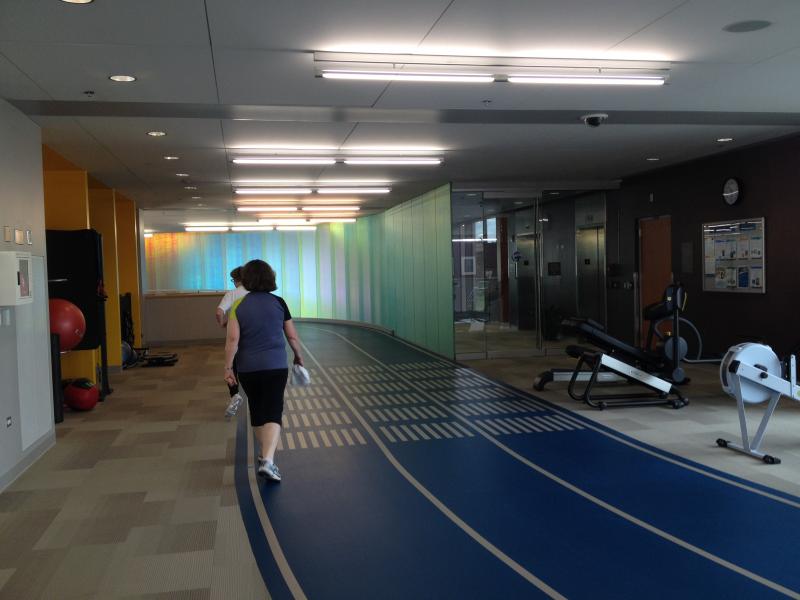
It’s an opportunity that’s created more opportunities. The Center is launching an October destination boot camp pilot program — which Extreme Weight Loss will help promote later this month. Over just two years since it was built, the $34 million Health and Wellness Center has created a high-tech space for research and programs.
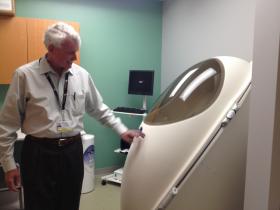
John Peters stands next to the Bod Pod, equipment that Anschutz Health and Wellness Center uses to study body composition. / Credit Grace Hood / KUNC

John Peters stands next to the Bod Pod, equipment that Anschutz Health and Wellness Center uses to study body composition.
/ Credit Grace Hood / KUNC

” We’re like an R&D center for wellness,” said Peters. “This is where we do the research, and we do the development and then we work with a multitude of partners as the distribution system.”

Colorado: Lean & Green

Even though it’s struggling with its own obesity challenges , Colorado’s image as the leanest state is translating into big money. About $3 billion is already coming in thanks to the state’s ski industry. And there could be even more.

“Globally it’s a very powerful brand,” said Ken Lund, Executive Director of the Colorado Office of Economic Development and International Trade.“People want to be part of a healthy state, a healthy environment.”

Broadly, Colorado’s $40 billion industry includes traditional and alternative health care, natural food products, health information technology, research initiatives, fitness and outdoor recreation.

________________________________________

“People want to be part of a healthy state, a healthy environment.”
____________________________________________ 

Although prevention and wellness is one of the smallest segments, a strategic action plan issued [.pdf] by Lund’s office on the industry reported it has great potential for growth.

“Things like Extreme Weight Loss are things people want to know about. We think those broadcast globally are good for Colorado’s brand that this is place that focuses on health,” said Lund.

Colorado Puts Medical Tourism On The Map

The health focus also takes away some attention around the state’s other new big industry: legalized marijuana. Then there are the jobs.

In Estes Park recently, Gov. John Hickenlooper, Mayor Bill Pinkham and Stanley Hotel Owner and Grand Heritage Hotel Group CEO John Cullen broke ground on a new 15,000 square foot health and wellness facility focused on physical fitness and weight loss. When it’s up and running, the project is expected to create as many as 70 full-time jobs.

Credit Grace Hood / KUNC

Credit Grace Hood / KUNC

Cullen said University of Colorado’s Health and Wellness Center will provide consulting and programs for Estes Park center.

“They have 150 people just in research on this topic,” he said. “It gives us a great opportunity to be their little brother, and quite frankly, put medical tourism on the map for the state of Colorado.”

The project will also include a 50-room boutique hotel. It’s a $30 million public-private partnership between Grand Heritage Hotel Group and Estes Park Medical Center.

For EPMC, CEO Brian Herwig said the project will provide a much-needed revenue boost in a world of declining insurance and federal reimbursements.

“This gives us a new service line. It’s a cash business,” he said. “We talk about it being like a guided fishing trip. You pay half down and half when you show up.”

Similar projects from Grand Heritage are in the works for Colorado Springs, Telluride and Denver.

Ultimately, John Peters at Anschutz Health and Wellness Center said the key work making wellness work in a vacation setting is integration.

“It’s bringing it to life in a way that it’s not a bolt-on thing anymore,” said Peters.

With wellness tourism expected to grow to almost $680 billion worldwide over the next three years, Colorado entrepreneurs will have plenty of details to sweat over.

source: http://www.kunc.org / Community Radio for Northern California – KUNC / Home> Health / by Grace Hood / Thursday – June 05th, 2014


“Medical tourism” on the rise as Americans shop for surgery

Indianapolis :

It is a sign of the times – Americans shopping for surgery in what is now referred to as “medical tourism.”

One 22-year-old Monticello native is doing just that. Priced out of the American market for weight loss surgery, Amanda Martincich is now looking outside of America and to fellow Hoosiers for help.

Amanda Martincich is considering surgery options out of the country.

Amanda Martincich is considering surgery options out of the country.

“As you can see, I have always been kind of heavy,” Martincich said as she looks through pictures from her childhood.

She feels as though she is fighting a losing battle. Weight loss programs are not working. Family insurance, since her stepfather is self-insured, does not cover gastric bypass surgery, so she made a decision.

“In the U.S., it costs $25,000-40,000. So if insurance doesn’t cover it, it’s too much to come up with,” she said, sitting in her parents Indianapolis home.

So she started shopping for surgery online. That led her to a company called Medko, which matched her up with surgery program in Chile.

“I am willing to try anything unless something stands out that says that is not safe or not legit,” she added.

Medkohealth is a program designed to match people with less expensive surgical options elsewhere in the world. Frustration has led her to this point.

“People are like, ‘Get a job, save money.’ People won’t hire people who are overweight,” Amanda admitted.

So, living in America, she is looking to South America for help.

“If this country was so great, then me being able to find insurance would not be so difficult,” she said.

Amanda wants to get a degree in criminal justice, but first things first. That means setting up a website to help raise the money she needs.

“46 people have viewed it, but only one has donated,” she noted as she looked at her fundraising website.

To her, the situation she finds herself in is criminal, but it is what it is.

“I’m going to go with medical tourism. I don’t have any choice. I will just have to come up with the money,” she noted.

Amanda had hoped to leave for surgery this week, but obviously, funding is still a big problem. She has two options, one in Mexico and the other in Chile, which is where the company Medko is based. She says the surgery that would cost her up to $40,000 here in America will cost up to $13,000 in this program. She believes she will be able to use her primary care physician here in Indianapolis for follow up following the surgery.

If you decide to shop around – whether its inside the country or outside – medical experts recommend you first “check with your insurer.” Don’t make a big bill even larger by shopping for care outside your health insurer’s network.

Also, press for details. Make sure you have the full picture of potential bills you may face from the surgeon, anesthesiologist and the surgery center.

Finally, think hard about quality. Don’t weigh just price. Consider the surgeon’s experience or the hospital’s infection and re-admission rate.

source: http://www.wthr.com / Wthr.com – Indiana’s news leader / by Kevin Rader , Indianapolis / June 03rd, 2014

Indian doctors come home to medical tourism hub

Chennai :

One of the multitude of Indian emigrant doctors, Paul Ramesh moved to Britain in the 1990s, keen to get the best surgical training and earn a generous pay packet.

Today he is still treating Westerners — but in hospital beds back in Chennai, his south Indian hometown in Tamil Nadu state.

(In Chennai, known as India's…)

(In Chennai, known as India’s…)

“When I came back it was quite exceptional to return. Now it’s the rule,” the 46-year-old told AFP at the city’s Apollo hospital, soon after performing a heart transplant on a woman from the United States.

In Chennai, known as India’s healthcare capital, medical workers describe a “reverse brain drain” as homegrown doctors return from the US and Europe — at the same time as the city develops as a top budget destination for medical tourists.

While the number of Indian doctors abroad remains substantial, Apollo staff say their national hospital chain now gets 300 applications annually from those working in Britain alone, encouraged by improved living standards and better medical technology at home.

Traditionally drawn to the West to boost their expertise and earnings, doctors also cited tightening salaries under Britain’s National Health Service and increasingly tough US healthcare regulations as factors luring them back.

“The trend is reversing,” said M. Balasubramanian, president of the Indian Medical Association in Tamil Nadu.

“More corporate hospitals are coming up, especially in Chennai. Now (doctors) have an opportunity to use their expertise in their own place… and pull the patients from abroad also,” he said.

Inside the Apollo, with a lobby bustling more like a marketplace than a typical hospital, K.P. Kosygan has just carried out a double knee replacement on an elderly Kenyan patient.

The consultant orthopaedic surgeon came back from Britain in 2011 and said there was “a regular stream of doctors coming back”.

“Certainly when I left India there were not many joint replacement centres or surgeons in India who could train us,” he said.

Now doctors want to “share our experience we have gained across the globe,” he said — adding that many were also pulled back to look after ageing parents, in a country where family ties are paramount.

As well as treating Indians, Kosygan said he now treats patients “from almost every corner of the world” who are drawn by the cheap costs.

Patients Beyond Borders, a US medical travel resource, says the cost of certain Indian medical procedures can be up to 90 percent lower than in the United States, making it one of the cheapest places for treatment.

While most patients come to India from the Middle East, Africa and other parts of Asia, interest from America is growing, said Patients Beyond Borders CEO Josef Woodman.

“On a heart operation they can save $50,000 to $70,000,” he said. Among those to make such a saving was Doug Stoda, who travelled to Chennai from the United States for a specialised hip procedure by an Indian surgeon who learnt the technique in Britain.

Stoda’s wife Ann said it was a “big deal” for them to travel to India, having never previously been outside North America, but she said they had “a very good experience”.

“We just had to get to the airport in Chennai and they had everything set up,” she told AFP by telephone from their home in Wisconsin.

At Apollo, a dedicated “international patients” area has clocks on the wall showing times in various cities including New York and Tokyo while various translators are present to deal with foreign arrivals who number about 70,000 a year, the hospital says.

Country-wide, the medical tourism industry is expected to see a more than 20 percent annual growth rate between 2013 and 2015, according to global consultancy firm RNCOS.

Many patients come from countries “where they do really require quality expertise at a more affordable price,” said Anto Sahayaraj, 42, who returned from New Zealand in 2012 to work at the Frontier Lifeline Hospital in Chennai.

Speaking to AFP after performing a heart procedure on a one-month-old baby from Bahrain, the specialist in paediatric cardiac surgery said foreign patients were encouraged by Indian doctors’ overseas experience.

“They see a lot of Indians in Western countries and they realise that some of us do come back. With us technology comes back, so they have increasing confidence.”

For all India’s advances on the global stage, doctors emphasised ways in which the country’s healthcare system is still sorely lagging.

N. Ragavan, a consultant uro-oncologist specialising in prostate cancer, returned to India from Britain last year and pointed out the “million-dollar difference” between the two countries.

While Britain enjoys universal healthcare coverage, many Indians struggle to pay for quality private treatment, while public services are poorly funded and governed.

“Financial affordability is the biggest problem that India faces,” said Ragavan, 41, who hopes the country’s low health insurance cover will grow substantially over the next decade.

He said the benefits of working in one of India’s corporate hospitals include speedy medical investigations and hardly any waiting lists, but the lack of working directives means he is now at the hospital for up to 17-hour days.

“Working in India is a double-edged sword,” he said. “It’s never organised here. What I’m going to do next week is not sure, and what I’m going to do this week is very chaotic.”

source: http://www.articles.economictimes.indiatimes.com / The Economic Times / Home> Healthcare / AFP – June 12th, 2014