Category Archives: Reports,Features, Statistics

Culture, medical sector to help boost Taiwan tourism

Thousands of Chinese tourists are visiting Taiwan this weekend for the traditional Dragon Boat Festival holiday, one of the most important days in the ethnic Chinese world.

Although this increase of mainland visitors is driven by the soaring number of direct flights between the two sides of the Taiwan Strait and the launch of self-guided tours to Chinese tourists, the government should continue its efforts to highlight both the nation’s traditional culture and high-tech medical sector.

With regard to the available medical facilities, hotels and transportation, a growing number of Chinese tourists are already seeking health and wellness in Taiwan. By promoting medical tourism during traditional holidays, Taiwan’s top medical centers could successfully attract more visitors.

If you have made use of local medical facilities, you can also attest to Taiwanese hospitals’ commitment to quality and affordable medical care. The U.S.-based Joint Commission International (JCI) has even accredited several local centers as having international-level medical facilities.

The JCI accreditation indicates a visible commitment to top-quality medical care; it ensures a safe environment and demonstrates the hospitals’ continuous efforts to reduce risks to patients and staff.

Taiwanese hospitals are indeed at the forefront of the health care industry. Both the private sector and the government devote billions of New Taiwan dollars each year to developing one of the world’s most comprehensive health care systems.

Considering the high standard and cost effectiveness of Taiwan’s medical care available for foreigners, it is little wonder that Chinese patients travel across the Strait for surgical and other forms of specialized treatment.

In recent years, mainlanders’ perception of medical services has been changing, though the quality of such services in China has yet to reach the level seen in Taiwan. At the same time, the continuous rise of health care costs in China and around the globe is putting larger financial burdens on patients, sparking demand for less expensive alternatives. The resulting change from a patient-centered system to a consumer-centered one is creating new opportunities for local medical centers.

Many Taiwanese believe that medical care is a service industry, like the catering and hotel industries. This makes local hospitals even more attractive than their rival medical institutions in China.

Tourism officials and travel agents recently said that the number of cross-strait visitors going both ways between Taiwan and mainland China could reach 10 million by 2014, mainly thanks to the soaring number of mainland tourists visiting the island.

With the support of the government, Taiwan could further be known in the ethnic Chinese community for its world-renowned medical and health care sector; by granting more medical visas to Chinese citizens, there would a great potential in appealing to high-end Chinese tourists to visit to the island for medical purposes.

As the country looks forward to the arrival of an estimated 6.8 million tourists from all over the world next year, a new policy that went into effect in January 2012 allows hospitals to apply for visas for groups of up to 30 mainlanders seeking medical treatment, health care services and cosmetic procedures.

Accordingly, there is no doubt that Taiwan will soon become one of the biggest attractions for mid- to high-income Chinese tourists. Even though other countries such as India, Thailand and Japan are all targeting China for medical tourism, Taiwan is the best choice for Chinese tourists because — aside from the absence of a language barrier — the cost is reasonable and there is a sense of warmth and brotherly familiarity between Chinese and Taiwanese people.

source: http://www.chinapost.com.tw / The China Post News staff / Monday, June 25th, 2012

8 ASCs in the United States Embracing Medical Tourism

Here are eight ambulatory surgery centers that have embraced medical tourism in the United States and attract patients from other countries.

Red Rock Surgery Center (Las Vegas). Red Rock Surgery Center reaches out to its Las Vegas community as well as patients from around the world with their medical tourism branch. The surgery center was founded more than 10 years ago and surgeons perform approximately 1,000 procedures there annually. The center includes three operating rooms and one minor laser procedure room, allowing surgeons to perform a multitude of cases at the ASC. Medical staff at the center includes ophthalmologists, plastic surgeons, pain management physicians, hand surgeons, general surgeons and podiatrists. Red Rock Surgery Center is accredited by the Accreditation Association for Ambulatory Health Care and owned by David Malitz, MD.

The Surgery Center at Doral (Doral, Fla.). The Surgery Center at Doral includes interventional pain management, urology, general surgery and hand and upper extremity surgery. Alejandro Badia, MD, founded Badia Hand to Shoulder Center which works with the International Orthopedic Group to serve inbound medical tourist patients, who have their surgeries at The Surgery Center at Doral. The surgery center has three operating rooms, arthroscopic equipment and family waiting room. After traveling for their surgery, patients are able to stay at a hotel located near the center for recovery, often accompanied by a recovery room nursing staff. The patients are able to have rehabilitation and follow up visits while staying for a few days in the area.

Legacy Neurosurgery Spine & Brain Specialists Outpatient Surgery Center (Little Rock, Ark.).
Legacy Neurosurgery Spine & Brain Specialists has served patients who travel across the country to have their surgery performed at a lower cost than it would be at their local hospital. They often serve cash-pay or high deductible patients traveling long distances. Led by Scott Schlesinger, MD, the team of neurosurgeons performs minimally invasive spine surgery as well as non-operative pain management procedures. The brain disorders they treat include brain tumors, aneurysms and arterial venous malformations. Additional services at the center include physical therapy.

Orthopedic Surgery Center of Orange County (Newport Beach, Calif.).
The Orthopedic Surgery Center of Orange County is owned by the Orthopedic Specialists of Southern California and Hoag Hospital. It is a medical tourism facility associated with Patients Without Borders and has been an accredited ambulatory surgery center since 1999. Surgeons perform several procedures at the center, including ACL reconstruction, meniscus repair, shoulder surgery and spine surgery. The center is contracted with major insurance companies and will bill non-contracted payors.

Surgery Center of Oklahoma (Oklahoma City).
Surgery Center of Oklahoma is a 32,535-square-foot facility that is owned and operated by surgeons and anesthesiologists in central Oklahoma. The facility has been accredited by the Accreditation Association for Ambulatory Health Care since 1998 and includes prices for their services on the ASC website to attract patients of self-pay, self-insured or high-deductible plans. Surgeons at the ASC perform orthopedics, general surgery, ophthalmology, and ENT procedures. There are multiple lodging areas near the surgery center for patients to stay after their procedures. According to the ASC’s website, they are able to offer lower prices since they don’t have to process claims and there is no risk of non-payment.

Concord (N.H.) Ambulatory Surgery Center.
Concord Ambulatory Surgery Center is accredited by the Accreditation Association for Ambulatory Health Care and provides ENT, orthopedics, plastic surgery, general surgery and pain management procedures. The facility has two operating rooms, four bed preparation areas and eight station recovery areas. Concord Ambulatory Surgery Center provides complete coordinated care to Canadian patients, which includes scheduling appointments, travel, accommodation and transportation to the facility. The procedures offered to medical tourism patients include knee arthroscopy, ACL reconstruction, liposuction, tonsillectomy and rotator cuff repair.

Loveland (Colo.) Surgery Center.
Kenneth Pettine, MD, spine surgeon and co-owner of Loveland Surgery Center, noticed that patients were traveling to India and Germany to pay cash for procedures such as lumbar artificial disc replacement, which some insurance companies do not cover, although the technology is cleared by the FDA and surgeons in the United States can perform them. He felt he could provide these patients the same quality procedure at Loveland Surgery Center at a lower price if the patients were willing to pay cash. The cash price includes implant, surgeon, facility and anesthesia fees. Loveland Surgery Center is a Joint Commission-accredited facility.

Squaw Peak Surgery Center (Phoenix).
Squaw Peak Surgery Center was founded in 1998 by Anthony Yeung, MD, and has two operating rooms. The surgeons perform endoscopic spine surgery and a dorsal endoscopic rhizotomy surgery invented and developed by Dr. Yeung. The surgery center can accommodate cash pay patients and Dr. Anthony’s practice, Desert Institute for Spine Care, offers to coordinate care for medical tourists. The surgery center also has negotiated discounted rates at area hotels for their patients. The surgeons are team spine surgeons for several professional athletes, including the Arizona Diamondbacks, Colorado Rockies, Kansas City Royals, Seattle Mariners, Los Angeles Dodgers and Cincinnati Reds

source: http://www.beckersasc.com / Becker’s ASC Review / by Laura Miller / June 21st, 2012

Medical travel to reinforce record numbers of GCC travellers to Germany

New official numbers confirm not only that the popularity of Germany is continuously on the rise among international travellers but all the data and projections point to medical travel as the real “rising star” of the tourist industry.

According to figures from the Federal Statistical Office, the number of overnight stays by visitors from abroad in the period from January to March 2012 rose by over 10% compared with the same period in 2011. Overall, almost 12.3 million overnight stays by international visitors were recorded between the start of the year and the end of March, with significant increases in the major source markets.

Among these markets, a special position is occupied by the GCCregion, whose nationals are increasingly heading to Germany to benefit from the outstanding quality of the medical sector. For the first time, the mark of one million overnight stays by travellers from the Arabian Gulf region was outdone in 2011. Yet, during the first three months of 2012 a further increase of 15.5% was registered as compared to the previous year, with 185.074 overnight stays by GCC travellers from January to March 2012 against the 160.237 overnight stays during the same trimester of 2011.

According to all the estimations, an expanding share of international patients is expected to visit Germany for health reasons in the coming years. Figures from the German Federal Statistical Office and the Bonn-Rhine-Sieg University of Applied Sciences indicate that treatments were provided to over 77,000 inpatients from 178 countries in 2010, nearly 10% more than in the previous year. For the Euro Canada Consumer Index, the German healthcare system occupies the second place in Europe and ranks among the most progressive and innovative healthcare systems in the world.

“Health is a tourism megatrend with one of the global fastest growth; its increase in value sales is expected to reach 5.5% yearly in the period from 2010 to 2015,” said Antje Roeding-Boudier, Director of the Marketing & Sales Office for the Gulf Countries at the German National Tourist Office (GNTO) in Dubai, the local affiliate of the German National Tourist Board (GNTB)for the GCC countries.

“Given the unparalleled level of collaboration between science, research, industry and hospitalsas well as the provided high level in medical infrastructures, staff and technologies, the medical sector in Germany enjoys an outstanding reputation, with patients arriving from all over the world,” she continued.

The Arab Gulf States are among the main source markets, also according to the records of hospitals and clinics across Germany. Hospital discharged statistics show that German hospitals treated nearly 4,200 from the Arab Gulf States in 2010. These guests choose Germany not only because of its excellence in the medical sector but also for the several specialised services offered by the medical structures to international patients.

As medical travel represents a global success story for the GNTB,a cross-media campaign centred on this theme was initiated in 2011 to further raise the profile of Germany as international destination for health related tourism. Part of this campaign is the print and online version of the brochure ‘Medical Travel’ available in Arabic and other 26 languages. The content of the e-brochure is available at germany.travel/medizin, the special section of GNTB’s official website dedicated to health related tourism. In addition, after many successful events carried out across the GCC countries under the ‘Medical Travel’ theme year in 2011, the GNTO will organize new initiatives, directly engaging the travel industry in the region. Therefore, medical workshops featuring different activities centred on health related travel will be held in Kuwait City, Doha and Abu Dhabi between 30 September and 2 October 2012.

source: http://www.ameinfo.com / Home> News> Company News> G: GNTB / posted by Rana Mesbah / June 21st, 2012

Growing interest in medical tourism

With long wait times, may British Columbians are heading abroad for surgery

VANCOUVER (NEWS1130)

We told you earlier this week that the province has plans to upgrade two Lower Mainland hospitals, but the improvements to Royal Columbian and St. Paul’s won’t be seen for years.

Long wait times for surgery will likely continue until the upgrades happen, meaning some people are making the decision to have their surgery abroad.

It’s hard to track the exact numbers, but SFU’s Jeremy Snyder, who studies trends in medical tourism, says thousands of British Columbians do it every year.

“For some of these people who are in pain and they are being told they have to wait six months, two years for treatment or even for a diagnoses, you can certainly understand why they’re willing to pay out of pocket,” explains Snyder.

He believes the number of people heading abroad will just continue to grow.

“The baby boom generation is moving through and demanding care, and it may be the case that resources being put into the system aren’t able to keep up [with the demand].”

Snyder adds some people are choosing to go abroad because other countries have experimental treatments not found in Canada, and often you’ll find lower costs for the procedures.

source: http://www.news1130.c0m / News> Local / by Joanne Abshire / June 17th, 2012

KPJ making healthy strides

KPJ Healthcare Bhd is on overdrive in its search for perfect-fit acquisitions as well as building new hospitals. “The name of the game is expansion. The private healthcare industry in Malaysia has been coming up very strongly. KPJ and other players are on the expansion mode. The demand is there because of the affluent society and good economy,” managing director Datin Paduka Siti Sa’diah Sheikh  Bakir tells StarBizWeek.

She says the catalyst that pushed healthcare in Malaysia is insurance. “Companies, employers and individuals buy insurance. Those are the catalysts. People are investing in their health. They are willing to buy health insurance. They know that if something happens to them, they are covered. So that’s why the business is growing.”

Siti Sa’diah says KPJ grows about 10% to 15% annually and opines that the private healthcare industry is growing more or less at that rate as well.

Siti Sa’diah: ‘We hope to conclude at least one local acquisition and one abroad by year-end.’

A study by Deloitte South-East Asia reveals that private healthcare across South-East Asia is expected to see higher growth as a result of the region’s robust economies, urbanisation and aging population.

KPJ, which is celebrating its 30th anniversary, is currently the country’s largest private healthcare group operating 21 hospitals locally with two hospitals in Indonesia and a retirement and age-care resort in Australia.

“We became aggressive (with the expansion plan) in 2004 and 2005 because of our Al-‘Aqar Healthcare Real Estate Investment Trust (REIT), which allowed us to unlock the value of our assets. The money that came in from the REIT has allowed us to reinvest, and thus, we become an asset-light company,” she says.

Despite its extensive network, Siti Sa’diah says KPJ is keen to build on its extensive network and is currently assessing some offers, locally and internationally.

“We hope to conclude at least one local acquisition and one abroad by year-end.”

She did not reveal the size of the acquisitions. She adds that KPJ has been looking for potential acquisitions continuously. ”We’re ready for two acquisitions a year and also to build two hospitals a year.”

“We are keen on acquisitions… not greenfield. We are more interested in Asean. We have learning curves from Dhaka, Bangladesh and some experience in Bangkok, so we know what the markets are like.”

Additionally, Siti Sa’diah says local standalone hospitals are also potential targets. She said these standalone hospitals could leverage on KPJ’s extensive network as well as cost savings benefits because training and procurement would be centralised.

The healthcare group has earmarked more than RM1bil to set up nine more hospitals throughout the country in its effort to widen its healthcare services.

The nine projects are at different stages of development and they include the five projects listed under the healthcare sector of the Economic Transformation Programme (ETP).

The five projects announced under the ETP will involve initial investments of about RM760mil and will add 822 beds to KPJ’s existing capacity of more than 2,600 beds.
“We’re currently assessing the bidders for the hospital tender in Pahang. The Perlis hospital will be tendered out soon. We’re also waiting for approval of our plan for Johor Baru’s Bandar Dato Onn hospital.”

By 2015, KPJ will have 30 hospitals from the current 21.

Besides the new hospitals, KPJ is also adding capacity to existing hospitals and relocating its facility in Sabah.

“We are building two additional floors to accommodate 50 beds at the Tawakal hospital and another 50 beds at the Damansara hospital. We have 2,600 beds now and it will increase to 3,000 once the expansion is completed,” she adds.

Occupany rates at the group’s hospitals are averaging above 65% .

“Some hospitals have a higher occupancy rate and some slightly lower. But on average it is above 60%. I am happy with the performance.”

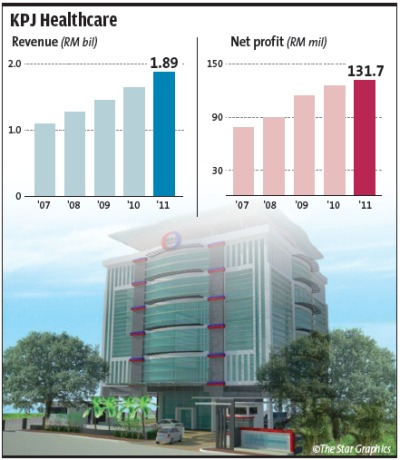
In the past few years, KPJ’s financials have remained resilient even in the recent economic downturn. For the financial year ended Dec 31, 2011 (FY11) KPJ’s net profit grew 10.8% to RM131.7mil while its revenue increased 14.5% to RM1.89bil.

Siti Sa’diah sees KPJ registering 10% to 15% growth in revenue this year as it has been performing in the past.

Despite its rapid expansion, KPJ did not need to raise any cash, she says adding that it has commercial papers and medium-term notes of RM250mil which could be utilised if necessary.

She says the group’s model of being asset-light by injecting its building and land into Al-‘Aqar KPJ REIT has also helped to unlock its value.

“These commercial papers and REIT must be planned in such a way that our cash flow is good,” she says.

Through the REIT, KPJ has managed to offload its borrowings, enabling it to consider wider options for future growth.

“That’s why our (net) gearing is low at 0.3 time,” she said. As at Dec 31, KPJ has cash and cash equivalents of RM177.3mil.

She explains that when a new hospital becomes operational, it may not become profitable immediately.

“Revenue may be there but it will be loss making for two to three years,” she says.

“Investors love us,” she says, referring to its consistent dividend payout. KPJ spent about RM200mil in capital expenditure on hospitals and RM100mil to RM150mil on hospital equipment per annum.

“We’re constantly upgrading the business.”

In a report, AmResearch said it liked KPJ’s defensive earnings profile. “Also, a step-up increase in bed capacity via a pipeline of seven new hospitals would accelerate earnings momentum to achieve our conservative three-year CAGR of 17%.

Faster-than-expected patient admission growth, coupled with a one-year hiatus from hospital expansion, has led to shrinking ready capacity. The current occupancy rate of 70% to 75% is a tad below over-crowded thresholds of 85% to 90%.

The research house adds that with a sizeable 22% market share, KPJ is Malaysia’s largest private healthcare provider with a national footprint and growing scale.

It is well-placed to capitalise on the booming and lucrative health tourism, with the doubling of the strategic existing hospital chain in Johor a focal area slated to become the primary destination for tourists.

KPJ has also seen competition intensifying in the private healthcare industry. Like KPJ, other players are also diversifying their respective offerings and expanding their networks.

“Competition is good. With the Asean Free Trade Agreement, there would be free flow of goods and services and healthcare industry is part of it. ,” Siti Sa’diah says.

Separately, KPJ is also gearing itself for medical tourism. “There are two aspects to medical tourism. First, those who come know they can get the service at competitive prices in Malaysia. Secondly, the quality is better. Of course, they don’t have to wait either. For example cardiac surgery in the United States costs US$60,000 compared with RM40,000 in Malaysia,” she says.

Medical tourism currently contributes about 5% of the group’s revenue but it is growing.

“It is more structured now. We have also signed up agents instead of waiting for individuals to come. The Malaysia Healthcare Travel Council was set up two years ago and (healthcare tourism) became part of a national key economic area.

On the 1Care healthcare plan, she says: “If the Government can put a good framework (to it) and nobody is penalised, it is a good concept. It is like a national healthcare plan. We have been waiting for it for a long time.”

Apart from its hospitals, KPJ is also looking at expanding its education arm KPJ International University College of Nursing and Health Sciences which complements its hospital operations. It hopes to achieve university status by 2016.

KPJ has a long-term plan to diversify into new markets and businessed including retirement villages and aged-care services.

“We are moving into age-care locally and have identified two sites. We are already doing acute care, so doing this for the elderly will not be so difficult,” Siti Sa’diah says.

KPJ made its foray into age-care two years ago with the acquisition of a 51% stake in Jeta Gardens, which owns and operates a 25.6ha retirement village in Queensland, Australia. While earnings contribution is minimal, KPJ sees tremendous potential.

Siti Sa’diah says the group’s age-care service in Australia is performing well.

“They are adding more facilities. There are 108 beds now and the government just approved 70 more.

“There are 32 retirement villas and we will be adding 28 more. This will come in phases. We’ll do it progressively,” she says, adding that it was also looking at re-developing the 64-acre property in Australia to include a hospital and a college.

On the setting up of age-care operations in Malaysia, she says that “the timing is right.”

“It is more acceptable now. We are currently studying two sites for our age-care business. We want to look at one site in Johor, where our hospital is so that we can attract Singaporeans.

“We are also looking at a site near our hospital in Ampang. But we have not finalised anything yet,” Siti Sa’diah says.

Currently, overseas contributions to group revenue remain below 10%.

KPJ also intends to grow its business in Indonesia where it currently operates two hospitals – RS Medika Permata Hijau and RS Bumi Serpong Damai in Jakarta.

“We want to grow in Indonesia and possibly in other parts of Asean. One hospital (in Indonesia) is performing well and Bumi Sepong Damai aims to break even by year-end. It’ll need a two to three-year gestation period,” she says.

source: http://www.biz.thestar.com.my / Home> Business / by Leong Hung Lee, hungyee@thestar.com.my / Saturday, June 16th, 2012
