
Category Archives: Reports,Features, Statistics

Philippines Joins Medical Tourism Parade

The Doctor will see you now

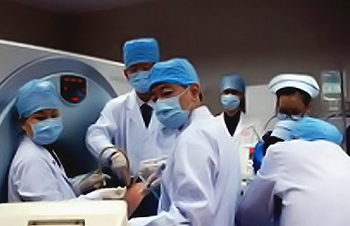
The Philippines, having become a major player in the business process outsourcing, is preparing to take on other countries across Asia in a new field ? medical tourism, a plan that makes sense since the country is a major supplier of medical personnel to the west.
doctorsCT30mar2013

Maybe we get to stay home

In February, Tourism Secretary Ramon Jimenez held a briefing to announce that his department is cooperating with the Department of Health to identify what medical services could be offered. In doing so, Jimenez and other officials are betting into such well-established health providers as Thailand, Singapore, India and Malaysia, hoping to combine access to Filipino beaches as well as hospital services.

There is huge demand for orthodontics or dentistry, cancer and retirement, cataract laser surgery and other medical procedures at costs a fraction of those overseas, Jimenez said, adding that medical services are among the tourism products the Philippine government wants to promote.

Despite well-trained medical staffs and first-rate facilities, the Philippines is well behind other countries in the region in trying to draw health tourists. The government says it is seeking to counter that lag by working on bilateral government-to-government agreements focusing on medical health exchanges and hospital-to-hospital partnerships with foreign institutions as well as working with foreign referral companies and doctors to draw patients,. Its target market is overseas Filipinos in the US and Canada, the Australian market, the island states, Japanese and Koreans, of whom nearly 1 million are already in the country.

Despite the drawbacks, the plan dovetails with a sense that the Philippines is finally getting moving after the years of paralysis from a long series of crooked or ineffective administrations. The government of Benigno S. Aquino III has taken on the Catholic Church and pushed through a birth control program that the church is nonetheless still fighting furiously and has “put in place what we consider its greatest economic achievement, the most sweeping changes in public procurement procedures in the last 50 years, if not longer,” according to a report on the country by the Hong Kong-based Asianomics financial analysis firm. ” This anti-corruption, anti-graft focus has transformed public expenditure in the Philippines, as well as the participation in the procurement bidding process by some of the most efficient and cleanest companies in the country.”

The competition for health dollars is keen. Given the cost of health care in the advanced countries, more than 50 countries across the planet have identified various forms of health tourism as a national industry, unfortunately with widely varying standards of accreditation and health quality. It is a lucrative field, both for health care and tourism as many patients combine the two. India and Thailand in the region have been identified particularly as destinations ? Thailand for its beaches and other attractions as much as for its medical care, which is deemed to be first-rate. India has been in the medical tourism game for more than a decade and at last count had welcomed 150,000 people to the country. The industry, growing 30 percent annually is expected to bring in US$2 billion a year by 2015.

Thailand is equally if not more advanced than India, particularly in cosmetic surgery including nose jobs and breast augmentations. One hospital alone took in 150,000 patients in 2006 and the industry has grown rapidly since.

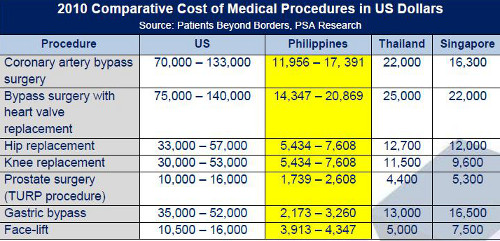
Prospective patients are usually seeking elective surgeries including joint replacement such s hips or knees, prostate surgery or coronary bypasses (see chart). The Philippines is strongly competitive in most of these, with dramatic differences in cost with the United States, the world’s most expensive place for medical care, far above at the top of the list.
graphCT30mar2013

Source: PSA

GRAPH
The campaign to attract medical tourists “comes at a time when Filipino doctors and medical facilities are gaining greater recognition for providing health care services that are on par with international standards, according to a report by Pacific Strategies and Assessments, a country risk firm headquartered in Manila. Many of the basic components needed to expand medical tourism are already thus in place. The Philippines, according to the PSA report, “boasts several state-of-the-art medical centers that provide advanced medical procedures such as stem-cell therapy by western-educated Filipino doctors.”

The drawbacks, according to the PSA report, are rooted in many problems that traditionally have plagued the Philippines; shambolic infrastructure, a hostile climate to foreign investment, a rigid labor structure and inability to put in place government policy to accommodate western interests. Medical centers in India, Thailand and Singapore in particular have lucrative partnerships with international insurance companies that find it in their interest to act as clearing houses for the treatment of policyholders, allowing them to save significant amounts of money for payouts to medical providers.

In the Philippines, however, “Partly due to the country’s lack of accreditation with larger insurers, experts on medical tourism say that the dearth of international private insurance in the Philippines is intentionally designed to protect the local insurance industry.” That puts roadblocks in the way of international insurance companies trying to save money on medical care, and denies the Philippines a lucrative and relatively prestigious source of income as well as populating its beaches with foreigners recuperating from their nose jobs and breast implants and eager to show them off.

The other problem is that while the Philippines trains vast numbers of doctors and nurses, they often depart for the west, where salaries are so much better than an individual trained as a physician at a Filipino medical school can make more money as a nurse in the United States than he can as a doctor in his own country. The hospitals in the United States, particularly in California, are filled with huge numbers of Filipino medical personnel, not to mention Indians and residents of many other countries. A prosperous medical industry in the Philippines would go a long way toward keeping its diaspora at home.

source: http://www.asiasentinel.com / Home> Economics/Business> Philippines / by Asia Sentinel’s Correspondent / Wednesday, March 13th, 2013


Taiwan broadens the range of its health tourism sector

The government announces the possibility for foreigners to use the full range of hospital services. This growth area saw revenues rise fourfold between 2011 and 2012.

Taipei (AsiaNews) :

taiwanCT29mar2013Taiwan’s health care system is a source of pride for islanders. Even if reconciling affordable prices with high quality care is often hard to do, services are open to both locals and outsiders.

Having set up special economic zones (自由 经济 示范 区, SEZs) to attract big foreign companies, like the three major industrial parks in Hsinchu, Taichung and Kaohsiung where local and foreign companies can enjoy logistical, economic and tax advantages that create jobs for the local population, now the Taiwan government wants to open up its health care sector to foreigners.

The island’s Council for Economic Planning and Development (CEPD, 经济 建设 委员会) yesterday announced a proposal to give foreign tourists full access to medical facilities located in SEZs . In a press conference, Minister Kuan Chung-ming (管 中 闵) provided statistics and projections for the near future.

Taiwan’s tourism industry has come to rely heavily on the huge influx of tourists from Communist China. According to Hong Zi-ren (洪子仁), who runs one of the top hospitals in Taipei, “the quality of medical treatment in Taiwan is the main reason for the arrival of tourists from the mainland.” Now tourists from mainland China can travel on their own. Until a year ago, they had to be part of organised groups.

For an idea of the economic benefits mainland and foreign medical tourists bring to the island, it is sufficient to know that between the start of 2011 and the end of 2012, their spending rose fourfold, from one billion to four billion Taiwan dollars (about US$ 135 million). Not surprisingly, the Taiwanese government wants to increase the number of patients receiving health care treatment in Taiwan.

The combination of high quality medical facilities and trained staff, along with the lower cost of visits when compared to Europe and the United States, makes Taiwan an attractive destination for a growing number of medical tourists.

In the past, people from outside Taiwan had only access to medical check-ups and cosmetic surgery; now they have access to the whole range of medical and hospital services under Minister Kuan Chung-ming’s new approach, which he laid out yesterday.

In addition, the new plan seeks to attract medical organisations from other countries in order to serve foreign and Taiwanese patients, thus further improving the island’s high quality health care system.

source: http://www.asianews.it / Home> Taiwan / March 26th, 2013

Medical tourism-regulations

Seoul, March 26 (Yonhap) :

The number of foreign tourists visiting South Korea  for medical purposes lagged far behind global peers in 2011 due to the government’s regulations on local hospitals, data showed Tuesday.

According to the data by the Korea National Tourism Organization, the number of foreign health tourists to South Korea is estimated at 150,000 in 2012, up 25 percent from 120,000 tallied a year earlier.

The number was far outstripped by the 1.56 million visitors posted by Thailand in 2011, separate data by the Hyundai Research Institute (HRI) showed.  India and Singapore attracted 730,000 and 720,000 visitors over the cited period.

The HRI said the country’s weak performance in the medical tourism sector is mainly attributable to its excessive regulations on local hospitals.

South Korean hospitals are not allowed to have foreign patients exceed 5 percent of their capacity, and medical specialists with foreign licenses have limited leeway in working for local institutions.

The HRI said the government should make efforts to ease regulations on hospitals by allowing non-medical firms to invest in medical institutions and abolish ceilings on the portion of foreign inpatients.

Meanwhile, the market size of the global medical tourism industry is estimated at 67 trillion won (US$60 billion), the HRI added. South Korea saw its revenue of the industry reach 180.9 billion won in 2012.

<All rights reserved by Yonhap News Agency>

http://www.globalpost.com/dispatch/news/yonhap-news-agency/130326/medical-tourism-regulations

source: http://www.globalpost.com / Home> Yonhap News Agency / March 26th, 2013

The Asia Medical Travel Council and the Thai Medical Tourism Association Announce Strategic Alliance by the Signing of a Memorandum of Understanding

A momentous milestone has been reached with the signing of a Memorandum of Understanding between the Asia Medical Travel Council (AMTRAC) and the Thai Medical Tourism Association (TMTA).

Bangkok, Thailand :

The Asia Medical Travel Council (“AMTRAC”) today welcomes the Thai Medical Tourism Association (“TMTA”) into its ranks as a pioneer founding member. TMTA will make up one of five of the AMTRAC regional bloc members, the first bloc of its kind in the world, which would in time consist of four other prominent Asian countries that have demonstrated great strides towards the advancement of the medical travel industry backed by internationally accredited medical institutions and highly qualified medical specialists.

AMTRAC’s vision is to ultimately show the world that its member countries are able to offer safe and affordable medical treatment comparable to the best in the west and collectively raise the visibility of Asian medical travel destinations in an increasingly crowded medical travel market.

Ultimately, this collaborative network can only spell good news for the patient as the medical travel bloc will collectively look to allay patient concerns by discussing and addressing important and pertinent issues such as patient safety, continuity of care, standardisation of medical records, to name a few.

Founder of AMTRAC, Mr. Wilson Tan said: “This truly marks an exciting time for Asia in the medical travel space. TMTA will be a valuable member of AMTRAC as the other AMTRAC members can learn how it has succeeded in achieving the right balance of medical skills and expertise blended with its legendary Thai hospitality to succeed in promoting Thailand as a premiere medical travel destination to the rest of the world. Our two organisations have a great deal in common in our values, work ethics and vision to see Asia grow as a medical travel hub. We are proud to be able to count TMTA amongst the pioneer founding members of AMTRAC.”

The objectives of this Pan-Asian alliance are:
· To aid AMTRAC members to become recognized as top medical travel destinations.
· To help raise professional standard of medical specialists and healthcare providers.
· To provide a single platform for medical facilitators to learn, update and network with other member service providers.
· To develop a higher degree of patient confidence and awareness in medical practitioners and facilities in the Asian region.
· To facilitate a forum for the exchange of views on topical issues facing the medical travel industry in Asia.
· To achieve global recognition as the #1 medical travel event in Asia by organizing annual AMTRAC Conference & Exhibitions (1-stop shop for medical travel in Asia).
· Lastly, but not the least, to develop active corporate social responsibility and charity programs that gives back to the community.

Presiding over this momentous signing of the MoU ceremony are President of the TMTA, Dr. med Prapa Wongphaet and Founder of AMTRAC, Mr. Wilson Tan. This alliance merely marks the start of what many hope would be the driving force behind the betterment of the medical travel industry in Asia.

Internationally recognized as the front runners in the medical travel arena within the region, AMTRAC is working to include India, Malaysia, South Korea and Singapore as the remaining four founding members. Shortly after, this will be followed by an official launch ceremony in the second half of 2013.

source: http://www.PR.com  / PR from Asia Medical Travel Council (AMTRAC) / Bangkok, March 22nd, 2013

Arizona a hot spot for medical tourism

Goodyear ,  Ariz. :

More than 2,500 miles from his home in Alaska, Walter Weaver has chosen Arizona as his place to heal.

“It feels good to be here,” said Weaver, who described his trips as vacations. However, he’s also fighting off prostate cancer. He received the diagnosis last year.
“I didn’t want to wait,” Weaver said about seeking specialized care. “I have a 9-year-old, and I need to see him get through.”
Weaver said he wasn’t satisfied with his options in Alaska, so he started researching online and found the Cancer Treatment Centers of America.  CTCA’s Western Regional Medical Center is located in Goodyear.
“We end up being in an environment now where you can go to the Internet and find out what type of health care is available, not just locally, within the community, or even the region, but across the country, even worldwide,” said Dr. Ed Staren, president and CEO of Western Regional Medical Center.
CTCA estimates up to 70 percent of its patients come to the facility from out of state.  The facility is considered a medical tourism destination, along with the Valley’s renowned Mayo Clinic Hospital.
The Mayo estimates around 40 percent of its patients come from out of state.
“It’s a healing environment,” Staren said of Arizona.  “There’s no question that the beautiful environment that we have here, the warmth, the mountains, the surrounding area, just the warmth of the people who live here.”
ArizonaCT23mar2013


Weaver told 3TV his team of doctors and nurses has become like family.  He said it’s easy to forget you’re at a hospital in Western Regional Medical Center, with amenities including an organic farm, hotel rooms, musical entertainment, gourmet food and personalized care.

“You’re not coming here to die; you’re coming here to get well, to get better, and that’s what you do here,” Weaver said.
source: http://www.azfamily.com / Home>  News Headlines – Top Stories / by Natalie Brand / March 22nd, 2013