
In the latest of our country guides, we look at medical services in India – a country with a growing reputation for cheap treatment
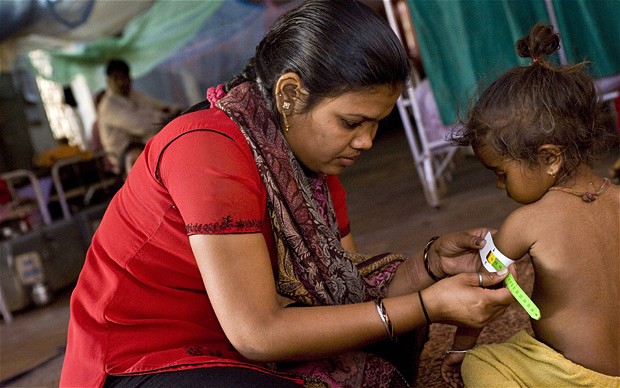
A child undergoes a mid-upper arm circumference test, which measures the extent of malnutrition, at a hospital in India. The country has been criticised for not doing more to tackle child deaths Photo: Nick Cunard/CHI-Photo/Rex Features
Ties between Britain and India remain something of a wonder. While relations with some of Britain’s former colonies have grown weak, or disintegrated, the bond with the world’s biggest democracy flourishes. Perhaps it’s the cricket. Perhaps it’s the large Indian population in Britain, many of whom – doctors, nurses and others – keep the NHS afloat.
But how is health provision in the subcontinent?
“Mixed” is the kindest answer. For while India has skilfully promoted itself as a medical tourism centre, attracting patients from the Middle East, Africa and Europe, services for the majority of the billion-plus population are poor. The smart private hospitals are out of reach.
Only a quarter of the population can afford Western medicine, with the rest relying on traditional remedies or alternative treatments, such as acupuncture and Ayurvedic medicine (which can at least boast fewer adverse reactions).
Eighty-one per cent of health care across India is paid from private funds, mainly individual pockets. To compound the problem, the booming economy has attracted millions into the cities and away from the country’s rural network of hospitals.
According to the Organisation for Economic Co-operation and Development, in 2009 lower-income groups in India had less access to health care than 15 Asian countries surveyed, where, on average, only 55 per cent of health care is paid from private funds.
Infants at risk
India has come under criticism for not doing more to tackle the problem of infant deaths, the chief marker of the efficacy of a country’s health care system.
Unicef, the children’s charity, pointed out that of all deaths of children aged under one across the globe in 2008, a quarter occurred in India.
At 47 deaths per 1,000 live births, on the latest figures, infant mortality is 10 times that in the UK. However, only three years ago, the toll was 57 deaths per 1,000 live births. So progress is being made. It’s not as if funds are tight. According to PricewaterhouseCoopers, Indian health care has grown recently at a compound annual rate of 16 per cent. The accountants put the total value of the sector in 2009 at $34 billion. This translates as $34 per head, or roughly 6 per cent of GDP. The estimate for the current value of India’s health care sector is thought to be $40 billion.
For comparison, the annual budget enjoyed by the NHS is £110 billion (taking some 9 per cent of GDP) and serving a very small population relative to India.
Outstripping China
There is no questioning the need for a hugely expanded health care sector. By 2050, India’s population is projected to hit 1.6 billion, overtaking China as the world’s most populous nation.
The growth projection is not just based on fertility in India’s population. Life expectancy is fast moving to Western levels. Government drives against hepatitis and polio in the young will give another twist to the population spiral.
The number of inhabitants aged 60-plus is estimated to reach 189 million by 2025 – three times the 2004 total.
Alongside the population spurt, India’s economy can be expected to grow by at least 5 per cent a year for the next 40 years, according to Goldman Sachs, the bank.
Factors behind the forecast include urbanisation, an expanding middle class, and a rapid increase in the number of well-educated women entering the labour market.
But India has much to do. A quarter of the population is below the national poverty line. Some 300 million live on less than $1 a day.
What’s the government doing?
A drive to increase rural health care provision began in 2005. The rural health mission is aimed at improving primary care in the countryside so that fewer patients overwhelm specialist services in the cities. To that end, general practitioners have been trained in basic surgery.
Another Indian initiative is the government-run health insurance plan. The Government Insurance Company has the greatest slice of a market that in total attracts only some 11 per cent of the population. Premiums exceed $120 a year. Policyholders do not benefit from direct settlement, as in many Western schemes. Instead, customers pay from their pocket and apply for reimbursement. That can take months.
Health tourism
If the medical tourist wants to go “cheap”, few countries beat India. Reports from various sources point to huge price differences:
Heart surgery is typically priced at $50,000 in America, $14,200 in Thailand and $4,000 in India.
For liver transplants, it’s $500,00 (America), $75,000 (Thailand) and $45,000 in India.
For bone marrow transplants, prices are closer – $62,500 in both America and Thailand. In India, the bill is roughly halved.
Clearly, with some of the treatment costs a fraction of the American rates, flights and a week or two staying in a top hotel are minor factors.
India has quickly developed a lively trade, despite the known hazards of medical tourism – variable infectious-disease rates, different medical-accreditation standards for staff, and exposure to organisms against which the patient has no built-in resistance.
This last point is a particular hazard for people in fragile health. Dysentery and mosquito-borne diseases such as malaria, dengue and chikungunya fever are widespread and could derail recovery. Long flights in cramped airliners are a known risk for circulatory problems.
Most of the possible risks do not apply to established expats, who have a range of Western-level hospitals to pick from. Staff speak English, have the most modern equipment and direct links with Western hospital chains.
One such, Wockhardt Hospitals Group, is partnered by Harvard Medical International. Hospitals in this group, based in Mumbai and Bangalore, are among the best. The 400-bed Bangalore unit specialises in cardiology, orthopaedics, neurosciences and women/child care.
Wockhardt Mumbai claims very high diagnostic facilities among the usual range of services, including orthopaedics. It advertises total hip replacement at $6,500 (compared with about £12,000 in a private hospital in UK). A total knee replacement also costs $6,500.
Dr Sneh Khemka, medical director of Bupa International, knows the country well. “There are medical centres in the cities that really are truly excellent, especially Mumbai, Chennai and New Delhi.” Other cities with top-class hospitals include Hyderabad and Bangalore. But there are not enough new facilities outside the urban centres.
One exception is the Rajiv Gandhi Super Specialty Hospital, a public-private partnership, opened in 2000. It involved the Apollo Hospitals Group and the government of Karnataka, with support from the Opec fund for international development.
Dr Khemka said: “The tier-one cities are world class, with international patient clientele, and the tier-two – the Hyderabads and so on – are certainly able to cope with their metropolitan communities. But clinics and hospitals are still underinvested by government and are a massive problem.
“Sometimes the uninformed perception is that India is a dirty place and there is a higher rate of infection. But if you look at outcome data – and we’ve done quite a few inspections of hospitals in India – you’ll see they have much better outcome records than many places in Western Europe. They have meticulous attention on quality and safety.”
Bupa International has close ties with the Max hospital chain in India. Newly qualified consultant surgeons in such hospitals were about a third more experienced than their European counterparts because they were not hampered by the EU’s working time directive, Dr Khemka said. And “hotel” services in leading hospitals were outstanding.
Medical insurance
The Foreign & Commonwealth Office urges Britons going to India to buy holiday or international medical cover. It states: “You should take out comprehensive travel and medical insurance before travelling. Check exclusions, and that your policy covers you for all the activities.”
The FCO adds: “Local medical facilities are not comparable to those in the UK, especially in more remote areas. In major cities private medical care is available, but expensive. For psychiatric illness, specialised treatment may not be available outside major cities. ”
International premiums
The insurer Aviva comes out well in a list of insurers recommended by brokers Medical Insurance Services of Brighton. Aviva International Solutions, a comprehensive plan but with reduced outpatient cover, costs £715 a year for a 25 year-old in India (£643 budget).
AxaPPP comprehensive with a £100 excess costs £866 for the same person (£670 budget), while Medicare International is £1,203 (£912 budget).
For a couple (aged 34 and 31), the Aviva scheme is again cheapest at £1,615 (£1,450 budget). Again, outpatient caps apply – but no two schemes are fully comparable, as with all medical insurance plans.
Hazards
Usual hygiene advice applies strongly. The FCO says: “Take care with your water and food hygiene. Drink or use only boiled or bottled water and avoid ice in drinks. If you suffer from diarrhoea seek immediate medical attention.”
Bird flu outbreaks have occurred most recently in the north-eastern states of West Bengal and Assam. “As a precaution avoid visiting live animal markets, poultry farms and other places where you may come into close contact with domestic, caged or wild birds,” says the FCO. “Ensure poultry and egg dishes are thoroughly cooked.”
Prevalence of HIV/Aids is greater in India than in the UK: 0.3 per cent of the adult population as opposed to 0.2 per cent in Britain.
Patchwork
Europeans in rural India are unlikely to find health care to Western standards. But Indian cities are very different. As Bupa’s medical director puts it: “If you are going for elective or emergency treatment, it is absolutely fine to go to the centres in the big cities.”
This article was originally published in The Telegraph Weekly World Edition
source: http://www.Telegraph.co.uk / Home> Health> Expat Health / by Peter Pallot / Sunday, February 19th, 2012
