
KPJ making healthy strides

KPJ Healthcare Bhd is on overdrive in its search for perfect-fit acquisitions as well as building new hospitals. “The name of the game is expansion. The private healthcare industry in Malaysia has been coming up very strongly. KPJ and other players are on the expansion mode. The demand is there because of the affluent society and good economy,” managing director Datin Paduka Siti Sa’diah Sheikh  Bakir tells StarBizWeek.

She says the catalyst that pushed healthcare in Malaysia is insurance. “Companies, employers and individuals buy insurance. Those are the catalysts. People are investing in their health. They are willing to buy health insurance. They know that if something happens to them, they are covered. So that’s why the business is growing.”

Siti Sa’diah says KPJ grows about 10% to 15% annually and opines that the private healthcare industry is growing more or less at that rate as well.

Siti Sa’diah: ‘We hope to conclude at least one local acquisition and one abroad by year-end.’

A study by Deloitte South-East Asia reveals that private healthcare across South-East Asia is expected to see higher growth as a result of the region’s robust economies, urbanisation and aging population.

KPJ, which is celebrating its 30th anniversary, is currently the country’s largest private healthcare group operating 21 hospitals locally with two hospitals in Indonesia and a retirement and age-care resort in Australia.

“We became aggressive (with the expansion plan) in 2004 and 2005 because of our Al-‘Aqar Healthcare Real Estate Investment Trust (REIT), which allowed us to unlock the value of our assets. The money that came in from the REIT has allowed us to reinvest, and thus, we become an asset-light company,” she says.

Despite its extensive network, Siti Sa’diah says KPJ is keen to build on its extensive network and is currently assessing some offers, locally and internationally.

“We hope to conclude at least one local acquisition and one abroad by year-end.”

She did not reveal the size of the acquisitions. She adds that KPJ has been looking for potential acquisitions continuously. ”We’re ready for two acquisitions a year and also to build two hospitals a year.”

“We are keen on acquisitions… not greenfield. We are more interested in Asean. We have learning curves from Dhaka, Bangladesh and some experience in Bangkok, so we know what the markets are like.”

Additionally, Siti Sa’diah says local standalone hospitals are also potential targets. She said these standalone hospitals could leverage on KPJ’s extensive network as well as cost savings benefits because training and procurement would be centralised.

The healthcare group has earmarked more than RM1bil to set up nine more hospitals throughout the country in its effort to widen its healthcare services.

The nine projects are at different stages of development and they include the five projects listed under the healthcare sector of the Economic Transformation Programme (ETP).

The five projects announced under the ETP will involve initial investments of about RM760mil and will add 822 beds to KPJ’s existing capacity of more than 2,600 beds.
“We’re currently assessing the bidders for the hospital tender in Pahang. The Perlis hospital will be tendered out soon. We’re also waiting for approval of our plan for Johor Baru’s Bandar Dato Onn hospital.”

By 2015, KPJ will have 30 hospitals from the current 21.

Besides the new hospitals, KPJ is also adding capacity to existing hospitals and relocating its facility in Sabah.

“We are building two additional floors to accommodate 50 beds at the Tawakal hospital and another 50 beds at the Damansara hospital. We have 2,600 beds now and it will increase to 3,000 once the expansion is completed,” she adds.

Occupany rates at the group’s hospitals are averaging above 65% .

“Some hospitals have a higher occupancy rate and some slightly lower. But on average it is above 60%. I am happy with the performance.”

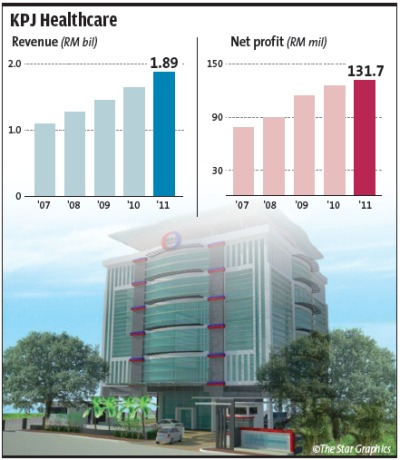
In the past few years, KPJ’s financials have remained resilient even in the recent economic downturn. For the financial year ended Dec 31, 2011 (FY11) KPJ’s net profit grew 10.8% to RM131.7mil while its revenue increased 14.5% to RM1.89bil.

Siti Sa’diah sees KPJ registering 10% to 15% growth in revenue this year as it has been performing in the past.

Despite its rapid expansion, KPJ did not need to raise any cash, she says adding that it has commercial papers and medium-term notes of RM250mil which could be utilised if necessary.

She says the group’s model of being asset-light by injecting its building and land into Al-‘Aqar KPJ REIT has also helped to unlock its value.

“These commercial papers and REIT must be planned in such a way that our cash flow is good,” she says.

Through the REIT, KPJ has managed to offload its borrowings, enabling it to consider wider options for future growth.

“That’s why our (net) gearing is low at 0.3 time,” she said. As at Dec 31, KPJ has cash and cash equivalents of RM177.3mil.

She explains that when a new hospital becomes operational, it may not become profitable immediately.

“Revenue may be there but it will be loss making for two to three years,” she says.

“Investors love us,” she says, referring to its consistent dividend payout. KPJ spent about RM200mil in capital expenditure on hospitals and RM100mil to RM150mil on hospital equipment per annum.

“We’re constantly upgrading the business.”

In a report, AmResearch said it liked KPJ’s defensive earnings profile. “Also, a step-up increase in bed capacity via a pipeline of seven new hospitals would accelerate earnings momentum to achieve our conservative three-year CAGR of 17%.

Faster-than-expected patient admission growth, coupled with a one-year hiatus from hospital expansion, has led to shrinking ready capacity. The current occupancy rate of 70% to 75% is a tad below over-crowded thresholds of 85% to 90%.

The research house adds that with a sizeable 22% market share, KPJ is Malaysia’s largest private healthcare provider with a national footprint and growing scale.

It is well-placed to capitalise on the booming and lucrative health tourism, with the doubling of the strategic existing hospital chain in Johor a focal area slated to become the primary destination for tourists.

KPJ has also seen competition intensifying in the private healthcare industry. Like KPJ, other players are also diversifying their respective offerings and expanding their networks.

“Competition is good. With the Asean Free Trade Agreement, there would be free flow of goods and services and healthcare industry is part of it. ,” Siti Sa’diah says.

Separately, KPJ is also gearing itself for medical tourism. “There are two aspects to medical tourism. First, those who come know they can get the service at competitive prices in Malaysia. Secondly, the quality is better. Of course, they don’t have to wait either. For example cardiac surgery in the United States costs US$60,000 compared with RM40,000 in Malaysia,” she says.

Medical tourism currently contributes about 5% of the group’s revenue but it is growing.

“It is more structured now. We have also signed up agents instead of waiting for individuals to come. The Malaysia Healthcare Travel Council was set up two years ago and (healthcare tourism) became part of a national key economic area.

On the 1Care healthcare plan, she says: “If the Government can put a good framework (to it) and nobody is penalised, it is a good concept. It is like a national healthcare plan. We have been waiting for it for a long time.”

Apart from its hospitals, KPJ is also looking at expanding its education arm KPJ International University College of Nursing and Health Sciences which complements its hospital operations. It hopes to achieve university status by 2016.

KPJ has a long-term plan to diversify into new markets and businessed including retirement villages and aged-care services.

“We are moving into age-care locally and have identified two sites. We are already doing acute care, so doing this for the elderly will not be so difficult,” Siti Sa’diah says.

KPJ made its foray into age-care two years ago with the acquisition of a 51% stake in Jeta Gardens, which owns and operates a 25.6ha retirement village in Queensland, Australia. While earnings contribution is minimal, KPJ sees tremendous potential.

Siti Sa’diah says the group’s age-care service in Australia is performing well.

“They are adding more facilities. There are 108 beds now and the government just approved 70 more.

“There are 32 retirement villas and we will be adding 28 more. This will come in phases. We’ll do it progressively,” she says, adding that it was also looking at re-developing the 64-acre property in Australia to include a hospital and a college.

On the setting up of age-care operations in Malaysia, she says that “the timing is right.”

“It is more acceptable now. We are currently studying two sites for our age-care business. We want to look at one site in Johor, where our hospital is so that we can attract Singaporeans.

“We are also looking at a site near our hospital in Ampang. But we have not finalised anything yet,” Siti Sa’diah says.

Currently, overseas contributions to group revenue remain below 10%.

KPJ also intends to grow its business in Indonesia where it currently operates two hospitals – RS Medika Permata Hijau and RS Bumi Serpong Damai in Jakarta.

“We want to grow in Indonesia and possibly in other parts of Asean. One hospital (in Indonesia) is performing well and Bumi Sepong Damai aims to break even by year-end. It’ll need a two to three-year gestation period,” she says.

source: http://www.biz.thestar.com.my / Home> Business / by Leong Hung Lee, hungyee@thestar.com.my / Saturday, June 16th, 2012

‘Medical tourism growing, but national strategy needed’

Amman:

The Kingdom’s medical tourism sector is expected to grow significantly this year but could achieve better growth with more strategic planning, a sector representative said on Saturday.

Zuhair Abu Faris, president of the Jordan Hospitals Association (JHA), said that due to its stability, security, and high-quality medical services, the Kingdom has been ranked by the World Bank as the top medical tourism destination in the region and fifth in the world.

Since the second half of 2011, he added, 170,000 patients from across the world have come to Jordan for medical care. Of the total, 50,000 were from Libya.

“Now Jordan provides medical services for Arab countries such as Libya, Iraq, Yemen, Sudan, Algeria, Palestine and the Gulf states, and we are looking to expand these services to Europe, America and some African countries,” Abu Faris told The Jordan Times on Saturday.

However, he noted, the various institutions representing the Kingdom’s healthcare sector need to cooperate more closely in developing medical tourism.

“We should formulate a national strategy for marketing Jordanian medical services and establish a national entity with representatives from all concerned sectors,” Abu Faris said, adding that the healthcare needs of foreign countries should be studied in order to tailor the Kingdom’s medical tourism packages to meet the market’s demand.

According to JHA figures there are 20,000 physicians, 22,000 nurses and some 102 hospitals in Jordan, 30 of which are operated by the Ministry of Health, 11 by the Royal Medical Services, 59 by the private sector and two by universities.

Around 180,000 patients came for treatment in the Kingdom’s hospitals in 2011, compared to around 220,000 the previous year, according to Private Hospitals Association (PHA) figures.

In a previous statement to The Jordan Times, PHA President Fawzi Hammouri said the sector was particularly hard hit by the conflicts in Libya and Yemen earlier in 2011, but witnessed growth in the second half of the year when patients from these countries came to the Kingdom for treatment.

source: http://www.jordantimes.com / Homepage> Local> Article Details/ by Khetam Malkawi / June 09th, 2012

BHB mulls Ford-style drug clinic

Hospital chiefs are considering creating a private “Betty Ford-style” rehab clinic on the Island for celebrities and other wealthy patients.

The idea of an exclusive drug and alcohol rehabilitation facility is being looked at by a Bermuda Hospitals Board (BHB) committee set up to explore opportunities for medical tourism.

Committee chairman Michael Winfield told The Royal Gazette yesterday: “It’s one of many potential ideas. We think there is merit in a number of ideas. The stage we are at is examining possibilities and ideas and trying to match that with both expertise and facilities.

“[We are] asking ourselves the question: can we do it in a way that matches the hospital’s standards of excellence and, as that progresses, what partnerships are needed?”

Mr Winfield, who is also chairman of BHB’s governance committee and owner of Cambridge Beaches, said the medical tourism committee was set up under the direction of the Health Minister and the Business Development and Tourism Minister and had been in existence for several months.

Its aim, he explained, was to identify opportunities for generating revenue, particularly in terms of capitalising on the new $247 million hospital, which is due to open in 2014.

Other committee members include BHB’s chief of staff Dr Donald Thomas and Reefs owner David Dodwell, as well as several other hoteliers.

Before she became Premier, Paula Cox told this newspaper that medical tourism could boost the Island’s economy.

She suggested patients from North America would fly to Bermuda for treatment or recovery in the same way they travel to Europe to avoid long waiting lists or high costs.

King Edward VII Memorial began offering a prostate cancer treatment unavailable in the US called High Intensity Focused Ultrasound (HIFU) in 2010, bringing hundreds of so-called “medical tourists” here.

Mr Winfield said “certain specialists” were also offering cosmetic and weight-loss procedures at the hospital to patients from abroad in partnership with BHB. “I think we do quite well,” he said.

He added that BHB subsidiary Healthcare Partners Limited (HPL) was offering “concierge services” for people coming in and out of Bermuda for medical treatment.

In February last year, BHB said it was “actively exploring integrating medical tourism opportunities with our current patient services”.

Mr Winfield said it was too early to talk about the specifics of the rehab clinic idea or speculate on how much money it could generate.

But an overseas consultant who visited the Island in March to discuss the initiative with the medical tourism committee told this newspaper he estimated it could bring in $10 million in the first year.

David Green, of IHI Consulting International in Ontario, flew to the Island at BHB’s expense to give a presentation, but now alleges he’s been “frozen out” of the project.

Mr Green, who claims he had a verbal agreement with Dr Thomas to launch the clinic and is still owed money from BHB in consultancy fees, sent a 14-page proposal to the chief of staff in February which suggests “platforming Bermuda as a viable surgical tourism destination, promoted on the international stage”.

It refers to consideration of a “specialist rehabilitation/addiction treatment facility” which would be run in partnership with a “local Bermuda tourism board, BHB and a local resort complex to site/host the treatments for overseas-originated patients and cater for trailing vacationing dependents”.

Mr Green said his role would have involved promoting the “Betty Ford-style” clinic to overseas patients, using his contacts in the health sector and beyond, including organisations such as the US-based Screen and Actors’ Guild.

Asked about the clinic idea, a BHB spokeswoman said in an e-mail that the board followed a “strict business process” when considering expansion and “an appropriate level of due diligence is involved to develop a full business case for board approval”.

She added: “Currently there are no strategic initiatives approved to proceed to a full business case development.”

In reference to Mr Green, another BHB spokeswoman said: “Mr Green is demanding payment for work which is not substantiated by any signed contract, nor written request that BHB is aware of.

“BHB has a strict procurement policy in place specifically to ensure a robust and fair tendering and contractual process.

“For any payment to be made by BHB to a vendor or consultant, an invoice has to be submitted with a description of activities undertaken against previously agreed and contracted work.

“This ensures an audit trail, required as part of our fiscal responsibility, and clearly protects BHB against fraudulent claims.

“Mr Green has informed BHB this matter is in the hands of his lawyer and, as such, this is now part of a legal process, so we cannot comment further.”

This newspaper requested an interview with Dr Thomas yesterday but did not receive a response.

Useful website: www.bhb.bm.

source: http://www.RoyalGazette.com / by Sam Strangeways / June 06th, 2012

A Halal hospital in Chennai

Halal hospital. Sound strange? Could be because the word Halal generally precedes food items or can go with hotels and restaurants, at least in our part of the world. But there has come up now a Halal hospital here. Global Health City, Chennai is said to be the first hospital in India to achieve Halal certification.

A world class tertiary multi super specialty hospital, Global Health City has received the Halal certification for its hospital services by Halal India – an independent Halal certification body registered with government of India and recognized by IHIA (International Halal Integrity Alliance, Malaysia), a partner of the Islamic Chamber of Commerce and Industry (Kingdom of Saudi Arabia).

The certificate of being Halal (permitted in Islam), hope owners of the hospital, will further help in boosting medical value travel from Muslim countries particularly from SAARC, Middle East, North Africa and South East Asian Region which constitutes around 75 percent share of patient traffic to the hospital.

Dr. K. Ravindranath, Chairman & MD, Global Hospitals Group, said “With about two billion Muslims worldwide and a major number of international health travellers coming to Global Health City from the Islamic nations, we see Halal Certification as a form of approval that boosts our patients’ trust and confidence in our range of hospital services. To earn the certification, Global Health City had to meet strict Islamic guidelines dealing with hygiene & dietary regulations of global standards.”

TCN contacted Halal India to know how they check that food items (for example meat) provided there are Halal, and what kind of items/services covered by the Halal certificate.

On whether the Halal certification to Global Health City hospital cover only food or other services as well, like medicines and other treatments, Mohammad Noman, General Manager (operations), Halal India said: Halal Friendly Medical Tourism services include Food, Prayer Hall, Qibla Direction mark, Payer mate, copies of Quran, for woman patients woman doctor’s appointments (based on request).

These services are provided at the Chennai hospital also. The hospital provides a prayer room and holds Friday prayers also. Besides, there are customized cuisine and Arabic TV channels in the patient rooms.
On medicines, he said: “Still this market is not matured in India unlike other countries like Malaysia, Singapore. We need to educate Muslims to seek Halal Certified medicines in future (Lot of capsules in India made with gluten (Pig or Beef).”

How do you check that meat, for example, served at the hospital is Halal? “We do the site audit and ensure that meat supplier MUST follow the Shariah Compliance based on Malaysian Standards. (Halal India got approval from Malaysian Govt to adopt Malaysian Standards). Also Butcher must be practicing Muslim and undergo Halal India’s one day training and obtain the name batch and certifications.”

Animals for food are kept in very inhuman condition at slaughterhouse or butchers’ home in most parts of India. Does the Halal hospital provide some good facility to the animals? Mr. Noman said we follow the Malaysian Standards and Practice in this regard.

Mohamed Jinna, CEO, Halal India stated “We have great heritage for service and hospitality in India which also signifies that we can take good care of patients. The state of art technologies available in medical care is just perfect for overseas patients. All we need to do is understand their culture and custom so that we accommodate them well and make them feel truly at home”

“This way we can respect their values and belief and at the same time cater to this niche market in India,” he further added.

Global Health City, Chennai is a 500-bed super specialty tertiary care facility, with a capacity to expand to 1000 beds. It renders advanced tertiary healthcare services with multi-super speciality and multi-organ transplant services.

Contacts:
S. Vasanth Kumar Philip
Sr. Manager – Public Relations
Global Hospitals & Health City
Ph: 9840064530

Ms. Sheetal Bajaj
Senior Business Development Manager
HALAL INDIA Direct: 9952041640
E-mail: sheetal@halalindia.co.in
Website: www.halalindia.org

source: http://www.TwoCircles.net / by Mumtaz Ahmed Falahi / June 01st, 2012

Dhofar gears up for tourist season: Oman

Dhofar Governorate is busy making preparations for the tourist season with the summer (Khareef) set to begin from June 21 and run till September 21.

Public and private agencies, the Office of the Minister of State and Governor of Dhofar, represented by Dhofar Municipality, are in the middle of preparations.

Dhofar Municipality is also developing the main road network in Salalah city.

Dhofar Governorate is also witnessing rapid development in infrastructure projects such as the Heart Unit, the expansion of Salalah Airport, power and water desalination plant, the new Sultan Qaboos Hospital and the development of Hasik city.

Other projects to be implemented soon include expansion of the general cargo terminal at Salalah Port, developing Al Mughsail Beach and Al Hafah area, and water games park in Salalah.

The medical city project includes tourist and treatment services, besides diagnostic centres, organ transplant, haemodialysis centre, rehabilitation centre, college of medicine, nursing college, research and studies centre, alternative medicine health centre, hotel apartments and staff accommodation.

Investment projects under way include the first stage of the Salalah Beach Resort and Alsodah Island Resort (one of Al Halaniyat Islands) and the 27-million rial Tourist Commercial Mall in Al Wadi area.

Projects also include the integrated tourist project in the Niyabat of Al Shuwaimiyah and the tourist complex in Aftalqoot area.

The Zahrat Al Khareef project in Salalah, on 29,000sqm, includes 586 units that are offered for freehold by Omanis and GCC nationals.

Royal Oman Police is providing guidance, assistance and creating awareness to ensure smooth traffic on public roads. It also operates patrols on Nizwa-Thumrait road, plains, mountains and tourist sites. Al Juwairah Hotel, the latest five-star hotel that began soft operation recently, will be opened in August. It has 65 rooms, including 21 suites overlooking the sea, besides restaurants and recreation facilities.

International hotels such as Crowne Plaza, Hilton and Marriot have lined up programmes for their guests during summer. Hotels, hotel apartments and villas, too, are doing it. Work is under way at Salalah Beach Resort to build five-star hotels, such as Rotana Hotel (400 rooms) Club Meed (365 rooms) and Mevenpick (395).

There were 339,579 Salalah Khareef visitors during 2011, up 29.5 per cent from 2010.

The twenty-eight-day long Salalah Tourism Festival is a key tourism activity in the Sultanate in general and Dhofar governorate in particular.

source: http://www.omanet.com / Home> News Details / Sunday, June 03rd, 2012