Gujarat to push medical tourism

With Gujarat emerging as one of the preferred healthcare destinations in the county, the government is looking to promote the medical tourism concept in the state.
To begin with, it will send copies of a booklet, ‘Gujarat medical tourism’, to all embassies with the aim of attracting maximum “medical tourists” to the country.
A major reason behind the medical tourism gaining prominence in India, especially in Gujarat, is the high cost of medical treatment in the US and Europe.
The National Health Survey in the UK said the waiting list period in various specialities in the UK for both in-patients and out-patients is between three weeks to one year.
The cost of medical treatment in India is about one-third of that in the UK or the US. The hospital industry in the country, which is growing at a fast pace, is pegged at Rs one lakh crore.
Gujarat alone contributes to between 25 and 31 per cent of this figure, said officials of Apollo hospital, Ahmedabad, which has partnered with Vedic India, to promote medical tourism in the county.
Over 80,000 NRIs, a majority of whom are from Gujarat, visit India every year to get medical treatment. The medical tourism industry has been growing annually at 30 per cent and is estimated to be at Rs 1,500 crore.
Mukesh Shah, MD, Krishna Heart Institute, a super speciality hospital in Ahmedabad, said, “Ahmedabad is fast emerging as a preferred destination for cardiac healthcare in the international map.”
Shah said earlier, Chennai and Mumbai were the preferred destinations, but now Ahmedabad and Gujarat are very popular. Over 70 per cent NRGs in the US, the UK and even the Gulf countries are aware of Krishna Institute, he said.
Dinesh Patel, managing director of Sterling Hospital in Ahmedabad, said non-resident Gujaratis formed a sizable chunk of all NRIs,until a few years ago.

source: http://www.Business-Standard.com / Home> Economy & Policy / by Meghdoot Sharon / Ahmedabad

Googling his way to breathing easily

YASIN ODEH’S first trip overseas – his first time on a plane – was not for a long-saved-for holiday, but for an operation.

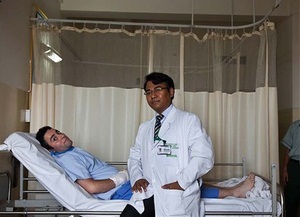
Yasin Odeh in hospital in India, with his surgeon, L.M. Darlong.

For years, the 28-year-old from the Brisbane had been troubled by shortness of breath, a constriction in his chest that left him heaving for air. He couldn’t run like his brothers, and while time in the gym had built him up it never helped his lungs.

”Sometimes I’d end up in hospital hooked up to all these machines because I was so out of breath, but the doctors would do tests on me and tell me, ‘You’re OK, there’s nothing wrong’. But I knew something was wrong.”

It was eventually concluded that his pectus excavatum, commonly known as a sunken chest, was affecting his breathing.

He investigated his options for surgery in Australia, but found the industry standard procedure was more often, and more cheaply, performed on patients his age overseas.

”Google’s pretty good. At the start, I just wanted more information. I wanted to know everything. And once I knew the right terminology, I could learn a lot more, and I could get information from all over the world. I wasn’t getting the answers in Australia, so I started looking overseas.”

The procedure Odeh needed involved having a titanium plate inserted in the side of his rib cage, underneath the depressed sternum, to keep it ”popped” out. The bar will remain in his body three years.

After weighing his options, seeking advice on internet forums, and speaking with specialists in Australia and abroad, Odeh settled on India, a country with a growing medical tourism industry, and a surgeon, L.M. Darlong, with five years’ experience performing the uncommon operation.

All told, the operation, his stay in hospital and his convalescence in a nearby guesthouse cost him $10,400, with insurance covering a significant percentage. In Australia he faced a bill of up to $25,000.

Odeh also would have been on an eight-month waiting list in Australia but within a fortnight of making his decision, he had a date with the surgeon, a visa, and a plane ticket.

‘I spoke to Dr Darlong before I came over to India, just about what the procedure was going to be and he was always keen to talk to me.”

But for all his meticulous research, nothing quite prepared Odeh for India.

”Just being on the roads, it was really dusty and everybody was yelling at each other and beeping. There were cows in the street, and in the middle part of the road, people were sleeping, that was an eye-opener. ‘I thought, ‘What have I gotten myself into? I could pull out right now’.”

He stayed. Within two days of landing in India, he was on the operating table. His 2½-hour surgery, his doctor says, was ”uneventful”.

The convalescence has been harder. A week after surgery, when The Sun-Herald first met Odeh, he was taking his first tentative steps up and down hospital corridors. Turning was slow, and he was short of breath. After another week, he was allowed outside, and could make the short walk to the local chai wallah for a cup of sweet milky tea. Relentless India, its crowds and sounds and smells, buzz all around him.

Through the discomfort, Odeh is cheerful. He flew back home last month. ”The care here has been really good, I’ve been well looked after. Hospital food, though, doesn’t change wherever you go.”

Deepak Datta, the chief executive of Medical Tourism Corporation, which organised Odeh’s surgery, says the growth in medical tourism across the globe was being driven by diverse factors.

”It depends on where people are coming from. People from Africa or the Middle East, many of them come because their home countries do not have the medical facilities. India provides a very good, cheap option, along with world-class facilities.”

The chairman of Medanta Bone & Joint Institute, Ashok Rajgopal, said patients from Western countries could often get standard orthopaedic operations – knee and hip replacements were especially common – performed for half the cost.

”Australians are also coming to us. The cohort is relatively small, but it is growing very rapidly. I would say Australia is probably the fastest growing community coming to us for medical treatments.”

Domestically, India has crippling public health problems.

For the 400 million who survive on less than a dollar a day, the hospitals international patients check into are far beyond their means. But efforts are being made to bring some of those patients into India’s burgeoning private system.

”Some of the payments that accrue from our overseas patients we use to subsidise the cost for local people who need the surgery but who are not able to afford it,” Rajgopal says.

source: http://www.caseyweeklyberwick.com.au / Home> National News> National> General / by Ben Doherty / May 06th, 2012

Gallery

Turkey stand welcomes eager crowds at this year’s Arabian Travel Market in Dubai

It’s no surprise for Turkey to command a strong presence among other international exhibitors at the tourism industry’s most popular meeting place within the Middle East – the Arabian Travel Market. This year is no different, with Turkey shining brighter … Continue reading →

Gallery

Dubai Promotes Medical Tourism

This gallery contains 1 photos.

Dubai Healthcare City (DHCC) participated in the European Medical Travel Conference 2012 in Berlin by highlighting the locality’s goal of emerging as a primary medical tourism hub in the Middle East. DHCC has been aggressively marketing the UAE as a … Continue reading →

Gallery

Global Healthcare and Medical Tourism Conference

6th   to  8th May 2012 Las Vegas, Nevada, United States of America Website: http://meditourexpo.net Contact person: Joanne Parrow This Two-Day international conference will bring together professionals from all over the world to discuss the latest trends and opportunities in medical tourism and global … Continue reading →