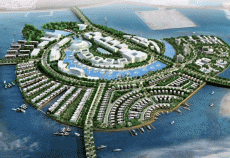
Bahrain launches $1.6b Dilmunia Health Island bids

Bahrain’s $1.6bn Dilmunia Health Island project has requested tenders for the first phase of infrastructure work and is aiming to start handover of the first units by the middle of 2014, the developer behind the project announced on Monday.

Bahrain’s $1.6bn Dilmunia Health Island project has requested tenders for the first phase of infrastructure work.

The first of four infrastructure development phases, which will include the 125 hectare island’s highways, bridges, landscaping, power, water, sewerage, drainage and telecommunications supplies has been offered to 30 contractors.

The winning firm will be appointed by the end of the first quarter of 2012 and work is due to start in the second quarter. Construction is expected to take 24 months to complete, enabling subcontractors to begin work in parallel.

source: http://www.ConstructionWeekOnline.com / Home> News / by CW Staff on Feb 15, 2012

Gallery

TAT calls Phuket businesses to tourism trade show

TAT Governor Suraphon Svetasreni and Tourism Mascot “Sook Jai” welcome Internet dance sensation Matt Harding in a gesture showing that Thailand is once again ready to welcome tourists from around the world after severe flooding. PHUKET: The Tourism Authority of … Continue reading →

Gallery

India Tourism Road Shows in Saudi Arabia

The Ministry of Tourism with the objective to tap the high end tourists from the Kingdom of Saudi Arabia (KSA) organised Tourism Road Shows in the cities of Dammam, Riyadh and Jeddah. The shows were held from 7th to 11th … Continue reading →

Hope rekindled for medical tourism industry

Local promoters have talked for a decade about creating a medical tourism industry, but have little to show for it beyond talk.

Yet another panel discussion on the topic on Tuesday night gave the concept’s backers hope that tangible progress might finally be near.

“What we did was get all the right people in the room at the same time discussing it and showing interest,” said Doug Geinzer, the CEO of the Southern Nevada Medical Industry Coalition, which sponsored the event.

However, the approximately 100 medical professionals still have widely differing ideas about what will bring out-of-town patients to Las Vegas: an extension of a big-name institution or something homegrown, a broad-based practice or individual specialties, marketing just Las Vegas or the entire state, or focusing more on Americans or foreigners.

Since becoming the dean of the University of Nevada School of Medicine in July, Dr. Thomas Schwenk noted the that the local doctors display a “certain sense of individualism and passion and a tendency to head in 20 different directions at the same time.”

Moreover, the meeting included only a handful of people from the tourism industry. In the past, they have looked at medical treatment as another avenue to fill hotel rooms and restaurants, while medical professionals view tourism as taking a back seat to their work.

Without a unified agenda, said state Sen. Valerie Wiener, D-Las Vegas, securing help from the Legislature next year would be unlikely.

One step toward medical tourism was unveiled in the form of the Las Vegas Health & Wellness Guide, co-produced by Medical Tourism Magazine and the Las Vegas Convention and Visitors Authority. Although it carries a $15.95 price, it will largely be handed out at conventions and meetings with 21 pages of clinical listings at 65 pages of hotels and attractions.

But broadcast executive Jim Rogers noted, “Tourism cannot be most of what we are going to do. It’s got to be the quality of medicine.”

He, along with some others who have looked at the issue, believe that a comprehensive medical institution is the biggest draw. People travel to places they would otherwise shun, such as Rochester, Minn., Cleveland and Baltimore to check into the Mayo Clinic, the Cleveland Clinic and Johns Hopkins. If a procedure or a checkup discovers something unexpected, the right specialist is close by; the patient doesn’t have to be sent to another side of a city.

Based on the infighting he saw during his five years as the chancellor of the Nevada System of Higher Education, he said, “I have great doubts about the ability to put a system together. We don’t have any great large medical groups here and that doesn’t sell.”

The university and University Medical Center of Southern Nevada have started down the path of closer collaboration, but that will take time.

Some individual practices have said they have been able to draw patients from elsewhere, such as the local office of the Sher Institutes for Reproductive Medicine. Others have run into trouble, such as the Nevada Cancer Institute. Once touted as a major medical tourism draw, it financially collapsed and has become a branch of the University of California, San Diego Health System.

But enough elements are in place to make the medical tourism work, Geinzer said.

“We have great health care in this town,” he said. “But we don’t do a great job of marketing it.”

Contact reporter Tim O’Reiley at toreiley@reviewjournal .com or 702-387-5290.

source: http://www.lvrj.com / by Tim O’Reily / Las Vegas Review Journal / February 02nd, 2012

Wellness & Travel: 2012-2020 Forecast

Los Angeles, CA, January 28, 2012 –(PR.com)– The first global report from WTW, the 4WR: Wellness for Whom, Where and What? Wellness Travel 2020 Full Report is a research report presenting the biggest opportunities in wellness tourism (including international and domestic travel) over the next 10 years. 4WR collected information from 140 visionaries representing stakeholders from wellness, tourism, spa and healthcare industries in over 50 countries worldwide.

Wellness tourism is one of the fastest growing forms of international and domestic tourism. This trend is not expected to change in the coming 5-10 years. There is one major risk, however: the globalization of standardized and uniform products and services. Key findings of the 4WR Full Report help developers, managers and policy makers and others vested in wellness tourism build on or develop individual competitive advantages and as importantly, avoid costly common mistakes. The report exposes the biggest opportunities over the next 10 years, to better define new product development strategies.

Key findings of the 4WR are as follows:
W – Wellness is about much more than just spas
E – Ecological and green products and services will become more and more important and popular
L – Local assets (e.g. natural assets, traditions, rituals) will re-define wellness products and services
L – Lifestyle-based wellness activities and wider access, i.e. democratisation will shape up the future of wellness travel
N – New, cross-over and fusion products and services should be further created
E – Evidence-based wellness services are essential in the development of local wellness services
S – Spirituality will play an important role in wellness tourism
S – Segmentation and winning new segments are essential key factors to make wellness accessible to wider groups

Further contents of the report:
Health, Wellness, Well-being & Travel
Global Health Tourism Service Grid
What? – Current Assets (2011)
What is Hot Now?
What is Hot Now – By Regions
Where? – Regional Hotspots 2020
For Whom: Consumer Preferences
Who Should Pay?
Conclusion
Key Findings/Recommendations for Planning
Country Best Practice – Hungary
Glossary of Terms

The report is accessible via the website of Wellness Tourism Worldwide: http://www.wellnesstourismworldwide.com/reports.html. The 4WR: Wellness for Whom, Where and What? Wellness Travel 2020 Full Report is prepared for Wellness Tourism Worldwide by Xellum Ltd. (Hungary) and Global Spa and Wellness (USA). This report would not have been possible without the cooperation with the Hungarian National Tourism Plc. (Budapest, Hungary).

Camille Hoheb, WTW Founder, states, “4WR exposes the biggest opportunities in wellness tourism over the next 10 years. Wellness tourism can and should be developed as a sustainable business and product and in a responsible manner in which well-being can be accessed by many. WTW believes the democratization of wellness can be achieved through collaboration of policymakers and the tourism industry.” WTW fully integrates all aspects of wellness in a cohesive and balanced manner without over emphasizing one or several of the domains of wellness and quality of life indicators. Adds Ms. Hoheb, “The WTW approach expands opportunities for travel agents and the tourism industry to fully leverage existing tourism products and strategically develop initiatives specific to a destination’s natural assets, cultural heritage and social orientation.”

States Laszlo Puczko, WTW Co-Founder, “As a Hungarian, I am pleased to shine a spotlight on Hungary as an emerging market leader in health and wellness tourism. Hungary has unrivalled natural assets and wellness tourism service and fully leverages its rich spa history.”

Wellness Tourism Worldwide (www.wellnesstourismworldwide.com) is an international trade alliance comprised of wellness and tourism related businesses, organizations and institutions.

Founded in recognition of the wide gap between health, well-being, leisure, tourism and sustainability, WTW is based on the domains of well-being and Quality of Life (QoL).

We bring together key stakeholders from across countries, regions and sectors who share the collective goal of accelerating wellness tourism growth.

source: http://www.pr.com / press-releases / 386787