
Across the border: Dental tourism grows, especially for pricey procedures

Dental tourism has been expanding, especially for pricey procedures such as implants and root canals. Patients say they’ve received good care and saved thousands on expensive dental treatment by traveling abroad, but the ADA warns it could end up costing patients more if problems arise when they get home.

When Ralph Grosswald and his partner, Terri Heeter, of Santa Fe, NM, needed extensive, expensive dental work, friends told them about getting good care at a dental clinic across the border in Palomas, Mexico.

“We needed four crowns, and Terri needed a little cosmetic work, and it was going to cost about $6,000,” Grosswald told DrBicuspid.com. “We got good referrals from people who had work done there, and we had $6,000 worth of dental work done for about $920.”

More than 500,000 U.S. residents traveled out of the country for dental care in 2013, according to the medical tourism group Patients Beyond Borders. Mexican dentists even advertise in the weekly newspaper with procedure prices to show the comparison to U.S. dentists.

Central America: Hot spot for dental tourism

Based on their experience and Heeter’s background as a travel consultant, the couple started Beyond Borders Dental , a dental concierge service that arranges dental care, lodging, and round-trip transportation from Santa Fe and Albuquerque, NM, to dental clinics in Palomas, Mexico.

Ralph Grosswald and Terri Heeter, operators of Beyond Borders Dental.

Ralph Grosswald and Terri Heeter, operators of Beyond Borders Dental.

“We found that people who needed dental work were concerned about safety, which dental clinics to go to, and what documentation was required in Mexico,” Grosswald explained. “They needed a lot of support and hand holding.”

Other dental tourism companies offer trips to Costa Rica, the Czech Republic, and Thailand, but Grosswald said many people can’t take that much time off or don’t want to spend thousands of dollars for airfare.

“We can take you to Palomas and either wait for you or bring you back next day, so you don’t have to miss a lot of work,” he said. The company works with several clinics, which have seven dentists and about eight specialists who do periodontal or orthodontic work.

The most common procedures are crowns, root canals, veneers, and cosmetic dentistry, Grosswald said.

“Any work that can be done in U.S. can be done in our clinics,” he said. There’s also a big demand for implants, which can be done for $1,500, about $1,000 less than stateside, Grosswald said.
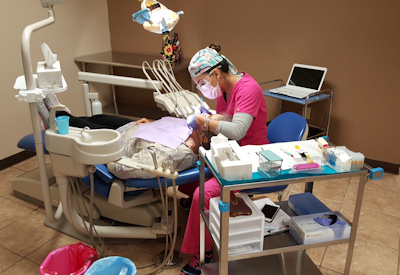
A dentist in Palomas, Mexico, working on a patient. Image courtesy of Beyond Borders Dental.

A dentist in Palomas, Mexico, working on a patient. Image courtesy of Beyond Borders Dental.

What about quality of care?

Don Pardue of Jacksonville, FL, heard about good dental care in Costa Rica during his fishing trips there.

“Americans who lived there raved about dental care and how good it was,” Pardue told DrBicuspid.com. “I had an empty spot and needed an implant on my lower right, which would have cost about $3,000.”

So about 10 years ago, Pardue went to a dentist outside the capital of San Jose

____________________________________________________.

“There are thousands of people who need dental care but can’t afford it or have dental insurance that’s not good enough, and for them this is a very viable alternative.”

— Ralph Grosswald, CEO, Beyond Borders Dental
______________________________________________

“I went to see him initially, and he said it would be no problem and would require two visits,” Pardue said. “He was trained in Miami and spoke English very well. Everything was very clean and very professional.”

The dentist used general anesthesia during the oral surgery to place Pardue’s implant, which cost about $800.

“He put me under with an IV, and there was an anesthesiologist right beside me to monitor it,” he said. “I went fishing the day after the implant.”

Pardue returned to Costa Rica two weeks later for a checkup and had a crown placed on it back home in Florida.

“My U.S. dentist showed me the x-rays and said it was excellent work,” Pardue said. “Every time I go back he says, ‘How’s that Costa Rica implant?’ and takes a look, and there has never been a problem.”

Would he recommend going to Costa Rica for dental work to others?

“Absolutely,” Pardue said.

Nana Lopez, DDS, a dentist with Community Health of South Florida , recounted mixed experiences of patients who went abroad for dental treatment.

When Dr. Lopez was the dental director for Austin, TX, her hygienist and a couple of dental assistants went to Piedras Negras, Mexico, to get treated by a U.S.-trained dentist in 2001.

“He did very inexpensive gold crowns,” Dr. Lopez told DrBicuspid.com. “I examined two of them, and they were good quality.”

The crowns cost about $100 each, she said.

But a Florida Keys patient had a different experience in Nicaragua.

“He needed a bridge where he had lost #4 or #5, and he was from Nicaragua and needed to visit his mother, so he had a cantilever bridge made for about $35,” Dr. Lopez said. “He proudly brought it back for me to see and it was not good — yellow gold with some kind of plastic facing on pontic, bulky margins, open margins. I told him it was not good and why. He was going to return and have them make it better.”

ADA warns about complications

Maria Lopez Howell, DDS, a San Antonio dentist and an ADA spokeswoman, has unique insight into dental tourism: She is one of 13 dentists in her extended family, including nine who practice in Mexico.
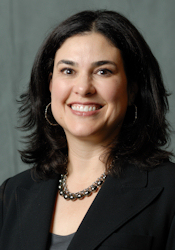
Maria Lopez Howell, DDS.

Maria Lopez Howell, DDS.

 “I started translating for my uncle and aunt’s dental practice in Mexico when I was 4 years old,” Dr. Howell told DrBicuspid.com. “I helped translate for American patients who came to them for dental care.”

She described the dental care some of her patients had in Mexico.

“One woman came back and needed some treatment,” Dr. Howell said. “It was a crown that basically didn’t fit correctly, and I had to replace it.”

Dental technology has advanced greatly, but potential problems also can be greater because many procedures are now more complicated, she said.

“If something happens during treatment where the patient is in a compromised position, what recourse do they have? Is there a ministry of health? Is there a local dental society?” she asked. “You went down there for crowns, because it’s cheaper and now it’s not. You really have to do your research.”

Also, infection control and safety standards in U.S. dental offices are really the gold standard, Dr. Howell noted.

Dentists also have insight into their long-term patients.

“We monitor certain things for our patients that are actually more cost-effective for them over time,” Dr. Howell said. “Whereas someone who doesn’t know the patient will perhaps make a decision to intervene when monitoring may be in the patient’s best interest.”

“It’s not for everyone,” Grosswald said of international dental care. “But there are thousands of people who need dental care but can’t afford it or have dental insurance that’s not good enough, and for them this is a very viable alternative.”

source:  http://www.drbicuspid.com / DrBiCuspid.com / Home / by Donna Domino, Staff Reporter / July 14th, 2016

Reproductive Tourism in India: No Child’s Play

Check the DNA

Check the DNA

The baby you get may not be the baby you sired

American nationals Morgan Newton and his partner were in for a rude shock when they discovered that the twins born through the in-vitro fertilisation arrangement they had opted for at a private clinic in Delhi were genetically not theirs. The gay couple had been swindled by the Surrogacy Center India and ISIS Hospital and IVF Center where they had paid US$20,000 for their bundles of joy.

Newton and his friend depressingly are not alone. They are the victims of an industry that is badly regulated and sometimes peopled with unscrupulous practitioners. For instance another American, Adam Berman, experienced a similar nightmare at the same clinic, handed over a child that was not genetically his own. Both Newton and Berman have now registered criminal cases against the clinic, alleging that its owners and doctors are running a well-organized racket to induce prospective parents to use their services and then cheat them.

Over the last decade, India has become a major global destination for what is variously referred to as “reproductive tourism,” “health tourism” or “pregnancy tourism,” a US$2.5 billion industry to help childless couples, mostly foreigners, become parents through the IVF route.

Driving the demand are India’s unique advantages as a low-cost surrogacy destination, its lax laws, lack of regulation of Assisted Reproductive Techniques (ART) clinics and the easy availability of poor, illiterate surrogates who rent their wombs for a pittance. Most Indian IVF clinics also have a strong internet presence which helps them attract patients from all over the world. Long waiting periods for a surrogate arrangement in western countries are further driving western couples towards India.

The monetary advantage for a childless foreign couple opting for India are spectacular. In India, surrogacy arrangements usually cost around US$$10,000-15,000 as compared to a whopping US$50,000- 70,000 in the West. Moreover, while many western countries have banned commercial surrogacy, it has been legal in India since 2002.

However,  the surrogacy industry has also spawned malpractices which exploit  uneducated surrogates as well as rich, hopeful parents. This is largely because currently there are no laws to govern the practice. What passes off as “law” is a skeletal, 126-page document issued by the Indian Council of Medical Research (ICMR) in 2005, which lays down the National Guidelines for Accreditation, Supervision and Regulation of ART Clinics in India.

But, as analysts point out, the guidelines are legally nonbinding, as they have not yet been ratified by the Indian Parliament. Besides, the council’s rules are ambiguous about vital issues like the rights of the surrogate, her minimum age, details about the contracts drawn up between the parents and surrogates, informed consent and adoption requirements.

“The issue of legal parentage in India has been particularly fraught,” said Prakash Arora, a senior gynecologist with Max Hospital, NOIDA. “Many childless couples have spent whopping sums of money on airfare and surrogacy contracts only to be told at the last minute that they can’t take their baby out of the country till cumbersome paperwork for adoption is completed.”

Lack of a stringent law has also resulted in fatalities. In 2012, a poor surrogate Premila Vaghela, 30, who had rented out her womb to a US couple, died in the eighth month of her pregnancy due to negligence by an IVF clinic in Ahmedabad. Many other such cases have come to light highlighting the grey area under which ART clinics continue operate in the country.

The risk of cancer is also quite high among the donors because of the heavy doses of hormone injections and medication administered to enhance their ovum-producing capabilities. “Most of the fertility specialists in India are gynaecologists,” said Pramit Rajpal, a medical anthropologist. “After a few years of practice, they learn some basic ART methods and set up clinics in metros or smaller cities. Nobody comes to check their licenses.”

The clinics work through an entrenched network of brokers who target villages where poor women consent to become egg donors. The pimps charge hefty sums from rich, childless couples but pay a pittance to the women.

Every day, thousands of socio-economically backward women are tempted into donating their ova for monetary benefit. Medical experts say that 50,000 to 60,000 women face potentially serious health complications due to egg donations done without proper precautionary measures. “When someone is willing to donate semen or eggs, there are a number of procedures to be followed, including medical tests. But none of the clinics follow the guidelines,” Rajpal said.

Acknowledging these infractions, ICMR has said in a report that “Most of the new technologies aimed at taking care of infertility involve handling of the gamete – spermatozoa or the ooctye – outside the body … These technologies not only require expertise, but also open up many avenues for unethical practices that can affect adversely the recipient of the treatment, medically, socially and legally.”

“There’s an urgent need to build in adequate safeguards to protect parents & surrogates, with added checks and balances to prevent exploitation of innocent people,” said Prakash Motwane, a Delhi-based fertility expert, and a consultant with Apollo Hospitals.

In the absence of comprehensive laws to prevent exploitation, contracts between surrogate mothers, and intended parents are often structured in a manner that are difficult to comprehend. There have also been horror stories of multiple embryos being implanted in the surrogate’s womb to ensure a higher chance of success, a dangerous practice that can imperil the surrogate’s health.

Health workers say the passage of the Assisted Reproductive Techniques (Regulation) Bill, 2014 will bring in the requisite transparency into the industry. With 7,000-8,000 surrogacy clinics operating in Delhi alone, and an estimated 50,000 across the country, the stakes are quite high. Many of these clinics operate illegally, catering to 10,000 to 15,000 childless foreign couples who visit India each year.

Last year, the Indian government stated its lack of support for commercial surrogacy — where the surrogate mother is paid a fee, as opposed to being merely reimbursed for expenses, a practice referred to as “altruistic surrogacy” — to the Supreme Court. It had added that only “needy infertile married Indian couples” would be allowed to use altruistic surrogacy. However, the matter is still pending in court.

However, many specialists object to a complete ban on commercial surrogacy, saying that if done right, it can help bolster the economy. Rather than a ban, what is needed is a vibrant legislative structure to regulate the industry, they add.  “We need to build in adequate safeguards to protect surrogates, with added checks and balances to prevent exploitation of foreign couples,” Motwane said.

The government’s latest draft of the Assisted Reproductive Techniques (Regulation) Bill seeks to impose heavy penalties  on erring clinics who cheat clients or jeopardize the life of surrogates, couples who refuse to take custody of a surrogate child born with disabilities, and prioritises the rights of the surrogate mother.

However, experts point out that the bill also differentiates between Indian and foreign parents, which risks driving surrogacy clinics aimed at the more lucrative foreign market underground, further endangering both mother and baby.

The ills notwithstanding, some doctors also feel that it is unfair to tarnish all fertility clinics with the same brush because the good ones are indeed a boon to childless couples. “Surrogacy is one of the well-accepted concepts of assisted reproduction,” said IVF expert Dr Indira Hinduja, who gave the country its first test tube baby in the 1980s. “It benefits patients who can’t conceive or carry a pregnancy to term. Such people can take the help of surrogates to carry their child in the uterus and then hand it over to the genetic parents post delivery.”

Given the complex dynamics, while the proposed bill won’t be a panacea for all ills, there is unanimity that it will at least minimize the damage by sensitizing the stakeholders about their rights while acting as a deterrent for unscrupulous merchants of the trade.

source:  http://www.asiasentinel.com / Asia Sentinel / Home> Trending Topics / by Neeta Lal / July 12th, 2016

12th

11th Jul

10th jul