Gallery

German firms dig into Korea’s medical tourism

This gallery contains 1 photos.

Germany’s leading health care companies participated in the 2015 Korea International Medical and Hospital Equipment Show earlier this month in Seoul, laying the groundwork for joint ventures and research innovation with Korean partners. Fifteen German firms producing specialized medical equipment … Continue reading →

Family’s journey for hair transplant points to Greece as rising medical tourism destination

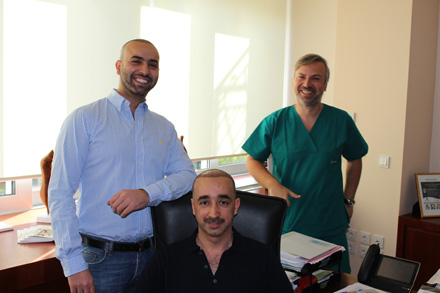
Khaled Al Said (center) poses with his brother Mubarak (left) and plastic surgeon Dr Anastasios Vekris. Khaled had his first hair transplant operation in Athens two years ago and recently returned to Athens accompanied by his sibling.

Khaled Al Said (center) poses with his brother Mubarak (left) and plastic surgeon Dr Anastasios Vekris. Khaled had his first hair transplant operation in Athens two years ago and recently returned to Athens accompanied by his sibling.

By Lina Giannarou

Kuwaiti national Khaled Al Said had his first hair transplant in Athens two years ago, following exhaustive research carried out over a period of four years. Satisfied with the operation’s results, Al Said recently returned to Athens for a supplementary procedure accompanied by his wife and 33-year-old brother Mubarak, who also wanted to undergo the same hair transplant operation.

Describing the story of the two siblings, which illustrates the development of medical tourism in Greece, was Dr Anastasios Vekris, a plastic surgeon specializing in hair transplants. According to Vekris, 24 percent of the patients who visit his clinic are foreign nationals, mainly from the Middle East and Western Europe, who travel to Greece precisely for this reason.

“Foreigners come to Greece because they find high-quality medical services at lower prices, compared to countries like Britain or the United States,” he noted. “For example, the FUE (follicular unit extraction) hair transplant method, which has been gaining ground recently as it less traumatizing and does not leave scars, is successfully used in Greece. Anyone who does their own good research will end up visiting a good doctor who can perform this procedure.”

For Mubarak Al Said, a dentist, lower prices were not the key factor for choosing Greece. “I didn’t come to the country because it’s cheaper, but because I saw the natural result on my brother. Many people opt for Turkey as services are even cheaper there, but when it comes to health matters, cost is not the first thing you look at.”

In all cases an increasing number of people are picking Greece when it comes to medical services. Besides hair transplant procedures, the country is also an international destination for treating infertility as well as plastic surgery. A recent medical conference was told that 360 Romanian couples had traveled to Greece to visit a particular fertility center in the space of one year. Participants at the conference also heard that visits to the country for eye operations, dental care and treatment for kidney problems are also on the up.

The rapid rise of medical tourism around the world is primarily due to the high cost of medical procedures, especially surgery, in a many countries. According to research carried out by Athens University professor Yannis Tountas, Greece’s revenues from medical tourism could reach up to 2 million euros through 400,000 patients in the next decade, if the country makes the right moves.

The country’s private medical sector is already rising to the challenge. Following the Metropolitan Hospital in Neo Faliro, southern Athens, the Athens Medical Group (which includes the Athens Medical Center) has also earned certification from Temos International, an organization specializing in the demands and requirements of patients traveling overseas for treatment. Both the Metropolitan Hospital and the Athens Medical Group have now become members of the Association of Greek Tourism Enterprises (SETE).

In the meantime, medical tourism has not been affected by the European financial crisis. Over the last two years, for instance, hair transplant operations across the continent have risen 39 percent. The case of an economic migrant who currently resides in Greece and recently visited Vekris’s clinic makes the point. “Isfak Ahmed comes from Pakistan. He is 33 years old,” noted the surgeon.

“He wanted to undergo a hair transplant operation, not out of vanity, but out of necessity. He wanted to look good in order to succeed in getting married.”

source: http://www.ekathimerini.com / ekathimerini.com / Home> Community / by Lina Giannarou / Sunday – March 15th, 2015

Arima hospital to get $30m health facility

Arima is expected to benefit from the state-of-the-art Arima Diagnostic Clinic (ADC) and Research Institute at 25-28 Hollis Avenue, close to Arima Velodrome.
The $30 million facility will boast two operating theatres, inpatient facilities, a 24-hour accident and emergency specialist clinic, a healthy eating restaurant and obstetric services.
Rev Dr Margaret Elcock, president/CEO of the Family Focus Broadcasting Network and ISAAC 98.1, paid kudos to hospital CEO Helen Alleyne and her family at the launch and dinner celebration at the banquet hall of Eastern Credit Union, Sorzano Street, Arima, on Saturday night.
Alleyne was also hailed as a pioneer, since she started the first school of ultrasound sciences and several speakers who brought greetings called for Alleyne to be conferred with a national award during Independence celebrations on August 31.
Elcock labelled Alleyne a “visionary”, in the presence of her spouse/managing director Benjamin Alleyne and children Doctor of Engineering (PhD) Ian, medical doctor Ron, hospital manager Megan and University of Trinidad and Tobago (UTT) biomedical engineering student Okon.
The matriarch of the family, Alleyne’s 90-year-old mother Olive Caton, whom she described as “the best business adviser”, also attended the vent.
They were joined by Hamid O’Brien, adviser to Minister of Health Dr Fuad Khan, Justice Lloyd Elcock, Accreditation Council of Trinidad and Tobago (ACTT) executive director Michael Bradshaw, chairperson Nicole Larsen, Newsday editor-in-chief Jones P Madeira, medical doctors Spencer Perkins and Daniel Otajele and Bishop Andrew John, who said the commissioning prayer.
Another highlight of the elegant evening was the presentation of awards to deserving employees.
“The ADC is a vision whose time has come. I am deeply moved because I am witnessing the fulfilment of the vision of Helen, one of my dearest friends. When she shared her dream, we would laugh a lot about these crazy ideas. God opened incredible doors that only he could. Her dreams came to pass,” said Elcock.
“As a visionary, you learn certain principles, people will always be there waiting to help you. If you have no dream or if you do not begin to act on it, the people who are supposed to help you won’t know where to find you,” she added.
Slipping into her motivational speaker role, Elcock imparted kernels of wisdom to the audience.
“Write your vision down. Make it plain and articulate it. Be careful whom you allow to influence you. Your vision can either be encouraged or destroyed by others. People have the potential to create your environment. Your environment determines your mindset, your mindset determines your future. Choose your friends wisely.”
O’Brien said it was important to form public and private partnerships to assist the population. He also spoke about the dialysis programme which Minister Khan had unveiled to improve time and reduce costs.
He also said health tourism can only be successful if Trinidad and Tobago can provide quality health care institutions. He said the Ministry had signed a memorandum of understanding with COSTAAT/Skills Training to develop a nursing programme and arrest the critical demand for nurses.
O’Brien lauded Alleyne for having the vision to establish a diagnostic centre.
During her remarks, Alleyne, a radiographer, said the clinic was born out of a passion for providing health care services, including ultrasound, X-rays and mammograms.
“I was acutely aware of the absence of the imaging sciences, there was no medical science. Little did I know at that time the provision of these basic services would lead to opportunities for providing full medical services,” she said.
Alleyne said her family has learnt to rely upon God’s unchanging love and the grace so freely given through faith in Jesus Christ.

source: http://www.trinidadexpress.com / Trinidad Express Newspapers / Home> News / by Michelle Loubon / March 15th, 2015

Surgical Centers Are Quickly Becoming the Hot New Travel Destination

Americans often move for relief from the high cost of living after they retire and 56 million Americans under age 65 will have trouble paying medical bills. Interstate migration to certain states is high (Arizona, Colorado, Florida, North Carolina, Oregon, and Texas). State and local taxes are one consideration, but health care is a significant consideration for many people. Some foreign countries have made an industry of attracting American expats (Costa Rica, Panama) and even offer low-cost health insurance.

An article in the January issue of Newsweek highlights a growing trend: travelling to undergo major surgery. Americans are flocking to countries such as Costa Rica, Mexico, India, Thailand, and Mexico, as well as European destinations such as Germany, for affordable surgical procedures. Heart bypass surgery, a $113,000 investment in the U.S., costs $10,000 in India and $13,000 in Thailand.

Termed “medical tourism,” this industry is growing. Approximately 16 million Americans will travel abroad for treatment by 2017. This represents $373 billion that will be spent on medical procedures and accommodations on foreign soil. The World Health Organization indicates that procedures that are expensive in the U.S.—hip and knee replacements, back surgery and cosmetic work—are more affordable elsewhere.

The article describes existing medical tourism programs, including German Surgery, an organization that matches patients’ needs to physicians and hospitals that can meet them. This medical concierge service also works with insurers. Frank Rothmaier, general manager of the Munich-based company that owns German Surgery, estimates that a total hip replacement costs 30% to 60% less in Germany than in the US.   Some US health insurers have initiated medical tourism programs for members who enrolled self-funded health plans. Their rationale is that despite airfare and accommodations, savings can be large. Note that the website medicaltourism.com reports that 458 hospitals around the world are Joint Commission International accredited; accreditation is one factor patients desire when they travel to have surgery. This web site advises patients considering traveling for care to select a travel companion carefully. They also note that 70% of patients rate their care as excellent .

source: http://www.hcplive.com / MD> News / by Jeannette Y. Wick, Rph, MBA, FASCP / March 11th, 2015

Why Men Are Flocking to Turkey For Facial Hair Transplants

Hair transplants are nothing new, but now facial hair grafts are all the rage in Turkey.  Allure  dives into the phenomenon behind this new tourism trend.

PopCT12mar2015

Forget Brazilian butt lifts, the newest hot thing in medical tourism? Hair transplants in Turkey — not only for the head, but for lush facial hair. (Not every fella has a natural Selleck ‘stache or Jon Hamm beard!) After getting a travel press release noting that 15,000 people come to Turkey for hair transplantation, we did some digging on this trend to find out if having cosmetic procedures while abroad is a safe option.

The men who are getting these procedures done (and it is mostly dudes) aren’t American; they’re from countries like Italy, Greece, and recently from Saudi Arabia and Kuwait, says Celik Nuri, a plastic surgeon and the International Society for Aesthetic Plastic Surgery’s National Secretary for Turkey. Facial hair transplants are the most popular amongst Arab patients: “Over the last 10 years, all of the male models in fashion magazines have become less feminized and have a ton of facial hair to be more masculine,” he says. He personally is doing a lot more lipo-sculpting on Arab patients to mimic a muscular build. It’s all a part of an overall boom in plastic surgery in Istanbul.

Initially, it was all personal referral: Turkish populations living in other countries would tell their friends about the relatively lower-cost, high-quality medical care in Istanbul, but now companies in European countries organize medical tours to the city. Because of more relaxed vacation policies, Arabic and European patients typically plan to be in Istanbul for a week. They have the surgery and then stay to enjoy the city and get any necessary immediate follow-ups. “You see a lot of men at historic sites around the city who clearly have just had hair transplant surgery,” says Nuri.

In Istanbul, it’s common for foreign and local patients alike to use email and Whatsapp to make appointments and send photos of their progress to their doctors. “Almost 100 percent of my patients communicate with Whatsapp — it’s so visual,” says Nuri, a reconstructive specialist. “I ask for photos every week, and then every month. My hair transplant colleagues ask for weekly updates.” If a patient, now at home, is unsatisfied, docs will tell them to hop on another plane to Istanbul, or if they’re having complications, refer them to a local physician who can attend to them immediately.

Michael Edwards, president of the American Society for Aesthetic Plastic Surgery (ASAPS), says that Europeans and Middle Easterners visiting Turkey for plastic surgery is akin to a Canadian coming to the United States for a medical procedure, and he doesn’t advise Americans to go all the way to Turkey or elsewhere for a hair transplant — or any procedure. “There are wonderfully talented, great doctors around the world, but if you have surgery abroad you’re not going to have the same access to them as you would a closer doctor,” says Edwards. “There are also equally as many, if not more, people that are out to try and capitalize on vanity — and whatever the hot trend in surgery is at the moment. What’s if there’s an issue in wound healing? They’re just going to tell you to go to a local ER.”

If you do see a foreign medical professional who isn’t actually that professional, your options for recourse are limited. Edwards, who practices in Las Vegas, says he sees reconstructive patients who “have gone South of the border for breast or tummy surgery” and now need it corrected. “There was no follow-up,” he says. “They ran a credit card and said ‘Adios’ and ‘Send me your friends.’ It’s important to do your homework on facilities and their practices.”

Nuri heartily agrees. While he hasn’t had any referrals made to him because of medical tourism gone wrong, there are patients going to under — or completely unqualified — practices. “The International Society [of Aesthetic Plastic Surgeons] takes these clinics to court and shuts them down, but often the same people will just open a new clinic,” he says. “It’s the Society’s responsibility to stop this, but it’s also the patients’ responsibility to see proper certification papers — not just a cheap price.”

source: http://www.popsugar.com / Popsugar / Home> PopSugar> Beauty> Hair / by Allure / March 12th, 2015