
India as a Tourist Destination – Jyoti Kapoor, President, Association of Domestic Tour Operators of India (ADTOI)

Tourism is essential to the country’s economic growth.  It has a multiplier effect on the health of the economy, providing employment opportunities both for skilled and unskilled, as well as strengthening national integration and international brotherhood. It rightly supports our Prime Minister’s ideology “Make in India” as tourism encourages entrepreneurship.
JyotiCT21oct2014India has fascinated people from across over the world with her secularism and culture. The diversity of Indian culture, cuisine, and customs does provide a unique opportunity to the visitors to have varied experiences. In fact, diversity is synonymous to India. Being birth place of many religions, India attracts faith-bound tourists from all over the world. The enchanting backwaters, breathtaking Himalayas with plenty of flora and fauna, a long coastline and inviting sand dunes make India a vibrant country. Historical monuments, forts, etc., add to the grandeur of the country, attracting domestic as well foreign tourists round the year.

Domestic Tourism, which has presently recorded over one billion visits, is growing at a steadfast pace.  Travellers are venturing to “less travelled destinations” contributing to the local exchequer.  States are going all out to woo the traveller by showcasing their tourist potential, understanding the long-term benefit of tourism development.

With 29 states, each state desires to brand its product as per its USP, to attract the traveller; however, the need of the hour is to converge the synergy in branding, by creating common parameters i.e. infrastructure, road connectivity, cleanliness and hygiene, safety and security, which is common to all. Brand India is an aggregation of the brands of individual states. The branding objective of each state should align with national branding objective. We all should not strategise in isolation, but have a more integrated approach.

The government’s role is to create the right conditions as tourism is affected by many areas of government responsibility and decision-making like planning, transport, regional development, conservation and environment. Central/state government should support and accord priority to it by declaring it as an industry, and allocate sufficient budget so that the perceptions that the traveller has about Brand India is reflected in reality… infrastructure facilities, cleanliness, safety and security of tourists at destinations on pan India basis. As remarked by Amitabh Kant “political and civic leaders should take ownership of their brand and take it forward.”

The domestic traveller has evolved over the years, and demands offbeat circuits, as well as engaging activities. States need to focus on this demand, which in turn would also help to attract foreign tourists who want to see India beyond the Taj Mahal.

Today India is emerging as most preferred destination for Medical Tourism. We have world-class medical facilities with top class doctors, personalised nursing care, offering specialised treatments at a cost 1/4th that of developed countries. India is the best place to rejuvenate with traditional medical concepts of Ayurveda, Unani and Homeopathy along with complimentary therapies like Yoga, Acupuncture and Aroma assisting in the process of healing.

Tourism being a multi-dimensional activity, and basically a service industry, it is necessary that the Central and state governments, private sector and voluntary organisations become active partners to position India as a brand where perceptions meet reality.

source: http://www.travelbizmonitor.com / TravelBizMonitor.com / Home / Thursday – October 16th, 2014
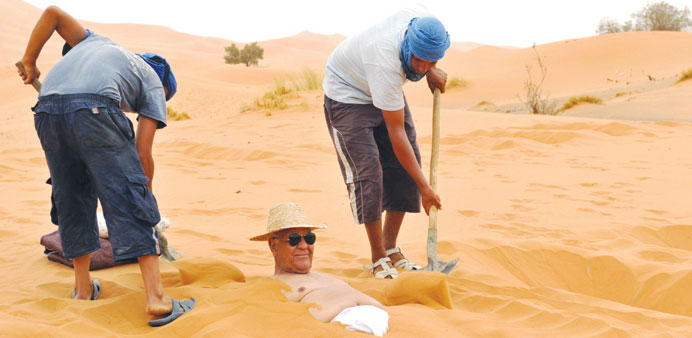
Spa of the desert: Saharan sands offer therapy

A tourist takes a sand bath in the dunes of the Merzouga desert in southeastern Morocco.

A tourist takes a sand bath in the dunes of the Merzouga desert in southeastern Morocco.

As the morning sun rises over the golden dunes of Erg Chebbi in the Sahara, men and women dig holes for tourists who want to bury themselves in the sand.

Decades ago, tribal nomads settled here, living a traditional desert existence that has now had to adapt to changing circumstance.

The dunes of Merzouga tower over the small community in southeastern Morocco, where the Berber Ait Atta tribe now makes a brisk living from tourism.

The formerly nomadic tribesmen have for years been running hotels and restaurants in Merzouga, a key stop on the Moroccan tourist trail on the edge of a sea of sand dunes.

Now they’re even turning to the sands themselves to attract visitors.

For around 10 minutes visitors are buried neck-deep in the hot sand for therapy said to cure those who suffer from rheumatism, lumbago, polyarthritis and some skin disorders.

The therapy has the same effect as a sauna session, helping purge the body of poisonous toxins, according to tribesmen such as Abdessalam Sadoq who now work in wellness tourism.

“We offer every type of tourism here, but especially for health,” he said.  Making a living was not always easy for the descendants of the Ait Atta nomads, and over the decades the sons and daughters of those who roamed the desert on camels have had to attune themselves to more modern ways.

The Ait Atta once accumulated riches from trans-Saharan commerce, but now all that remains of this past is a road sign pointing towards Timbuktu, a mere 52 days away by camel.

Their way of life ended after Morocco became a French protectorate in 1912, with the development of mining in the region, the emergence of urban centres and demarcation of the nearby border with Algeria.

Once-nomadic tribes had to find a new livelihood, and turned to cultivating date palms and tourism in the second half of the past century.

Visitors in search of a cure do not come only from abroad: many Moroccans also firmly believe in the power of the desert.

“I really feel much better, and each year I come back here to spend a week,” said sciatica sufferer Ali Kallamouche from the central town of Beni Mellal.

A sand bath at Merzouga costs up to $13, and when “patients” shake off the sand they are wrapped in hot towels to avoid the shock of a sudden cooling of the body.

Many come not just for the cure but also for the breathtaking sunsets over Merzouga’s shifting sand dunes.

Camel safaris and stays in the desert under canvas with the region’s Berber and Arab tribes are still a tourist staple, but with the economy biting, industry workers had to look elsewhere to attract business.

“People come for sand baths… and to taste the local dishes we make using medicinal plants and herbs,” said Sadoq, who also heads an association to promote tourism in the Sahara.

Tourism is a cornerstone of Morocco’s economy—contributing 10% of gross domestic product.

According to market experts, it is also growing, thanks to the development of wellness tourism.

In September, Morocco hosted the Global Spa and Wellness Summit where industry experts said the sector expanded globally last year by 12.5%, generating almost $500bn.

Morocco topped the Middle East and North Africa list in health tourism, with the industry growing more than 67% since 2007.

In Merzouga, more and more people are signing up for a hot sand soak at the height of summer and other businesses, including those rooted in the recent past, are thriving as a result.

Ali sells camel milk which he insists does wonders for diabetes, anaemia and digestive tract problems.

“People come from all over the world to Merzouga for sand baths, and that helps us promote other products,” he said.

source: http://www.gulf-times.com / Gulf Times / Home> Region / AFP- Merzouga, Morocco / October 10th, 2014

Gallery

Medical tourism Summit to consider competitive aspects

The impacts of medical tourism in Australia will be a focus of the Medical Tourism 2014 Summit 20-21 November in Melbourne , Australia. The two-day event has a strong line up of speakers on a range of topics – including … Continue reading →

EU top court sees no fault in ‘medical tourism’

The EU’s top court, ruling on a so-called “medical tourism” case, said patients seeking treatment in another member state should have the cost covered by their home authorities if local care is not available in “good time.”

Anti-EU parties, which did well in May elections, have picked up on the issue as another example of Brussels’ meddling in member state affairs at the expense of local patients.

They say foreign patients take up hospital beds which should first go to locals, making the issue even more politically sensitive as governments try to balance their budgets and control ballooning healthcare costs.

The European Court of Justice said it found in favour of a woman in Romania who went to Germany for open heart surgery costing 18,000 euros which her local health authority then refused to pay.

“The reimbursement of medical expenses incurred in another member state cannot be refused where a lack of basic medical supplies and infrastructure” means treatment is not available locally “in good time,” it said.

The judgement of time and availability must be made, however, by the hospitals and relevant authorities in the patient’s home country, it said.

source: http://www.medicalxpress.com /Medical Xpress / Home> Health / @AFP / October 09th, 2014

Gallery

World Conference on Spa Tourism in Edipsos

This gallery contains 2 photos.

The Thermae Sylla Spa & Wellness Hotel in Edipos , Greece, will host the world conference on the “Prospects of Tourism-Thermalism in Different Geographical Areas in the framework of the European Health Act” from October 9-11. The conference is being organized by the … Continue reading →