
Category Archives: Medical Tourism/Health Tourism

Promoting medical tourism

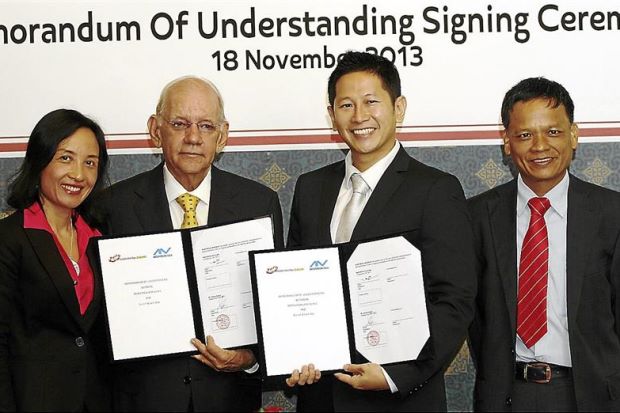
Adams (second from left) and Dr Chen flanked by Huong (left) and Nguyen at a signing ceremony to mark the partnership.

Adams (second from left) and Dr Chen flanked by Huong (left) and Nguyen at a signing ceremony to mark the partnership.

MEDIVIRON UOA   Clinic recently signed a Memorandum of Understanding (MoU) with Vietnam-based Du Lich and Lam Dep to bring in patients seeking aesthetic treatments from Vietnam to have their procedure done at the clinic.

Du Lich and Lam Dep itself is a partnership with Nip and Tuck Solutions Pty Ltod of Australia..

Mediviron founder and aesthetic physician Dr Chen Tai Ho said the partnership was in line with the Government’s efforts to promote medical tourism in the country.

“By working in partnership across national boundaries, we will capitalise on each others capabilities to conduct services that have a global impact and provide aesthetic opportunities that neither of the partners could provide on their own,” said Dr Chen, adding that Mediviron UOA  had a global reputation for aesthetic excellence.

He said Malaysia’s competitive edge lies in quality medical facilities, skilled doctors and affordable pricing, apart from the existence of tourist attractions.

“This would be our first time tapping into the Vietnamese market. Currently, 50% of our clients are Malaysians, while the rest are from the US, Europe, Singapore and the Middle Eastern countries,” said Dr Chen.

He added that the services offered by Mediviron UOA are distinctive from cosmetic surgery, as it is focused on enhancing an individual’s aesthetic goals through non-invasive and minimally invasive procedures.

The partnership is set to bring in its first batch of aesthetic tourist early next year just in time for Visit Malaysia Year 2014.

With that, Dr Chen said the company hopes to achieve 10% to 20% growth from its current revenue.

Meanwhile, Du Lich and Lam Dep marketing representative George Adams said Vietnam was one of Malaysia’s top 15 tourist- generating markets.

“A survey showed more than 90,000 Vietnamese tourists travel to Malaysia every year and with this plan in place, we hope to bring in 20,000 medical tourists to the country in the next couple of years,” said Adams, adding that the number of tourists who sought medical treatment in the country was currently minimal.

“Malaysia has its advantages when compared to other countries like South Korea or Thailand. Its medical and health standards are high and in terms of cost, it is still cheaper compared to Vietnam itself.

“In addition to that, it has all the current and modern up-to-date facilities, apart from impressive five-star hotels and high-end shopping centres located within the vicinity of the clinic,” Adams added.

When asked about other packages that Du Lich would be offering to the patients, Adams said this would depend on their requirements and it would design the packages according to their individual needs.

“Our main focus is to ensure that patients are located within the vicinity of the clinic and that they would stay on during the recovery time,” said Adams.

The signing ceremony was witnessed by Vietnamese ambassador Prof Nguyen Hong Thao  and trade counselor Huong Thi Lien .

Established in 2001, Mediviron UOA Clinic is a premier aesthetic centre licensed and regulated by the Health Ministry , where each treatment can only be carried out by a team of highly-skilled experts.

The team of doctors supported by the industry’s leading technologies and world-class facilities have treated clients from both local and regional markets.

Du Lich and Lam Dep are part of the Nip and Tuck Solutions Company of Australia and a partnership with Thuy Linh Beauty Company Limited  of Hanoi , Vietnam.

source: http://www.thestar.com.my / The Star Online / Home> Business > SME / by S. Puspadevi / Photo by Shaari Chemat / Friday – November 22nd, 2013


Medical tourism has great scope to boost state’s economy: Sukhbir

Deputy Chief Minister (DCM) of Punjab Sukhbir Singh Badal, on Thursday, said Punjab was all set to promote medical tourism as this sector had great scope to boost the state’s economy.

Addressing a gathering while presenting the Human Achievers Awards at CII, Badal said the Medicity at New Chandigarh would be established on 300 acres with world-class hospitals being set up.

He said New Chandigarh had the potential to emerge as the medical hub of North India as Punjab was already equipped with first-class infrastructure in health sector as compared to other states.

The DCM also said that India was the second most populated country, but unfortunately governments had not paid much attention to medical facilities for the needy. Calling NGOs to come forward and save the girl child, Badal said the sex ratio in Punjab had improved due to efforts from NGOs and policies by the Punjab government. The state Industry Minister Madam Mohan Mittal also addressed the gathering where British Deputy High Commissioner in India, David Lelliott, was honoured.

Also present on the occasion was Senorita Issac, Chairperson of the Human Achievers Foundation.

Lifetime Achievement award

* Sufi Singer Hans Raj Hans

* PTC, for best TRP rating in Punjabi channels across the globe

* Actress Jonita Doda

* Rohit Kumar, for his campaign ‘My Earth, My Duty’

* Kavita Choudhary, TV artiste

* Vineet Joshi, media communications

* Param, for Best Anchor

Recipients of Achievers’ Awards

* Dr Ajay Rajan Gupta and Dr Neha Gupta, UHICC, for contribution towards health care initiatives

* Ajay Gupta, owner of Glass Palace, Business Achiever

* Davinder Sharma, International Food Analyst

* Umendra Dutt, Kheti Virasat Mission

* Col B.S Sandhu, CMD of WWICS

source: http://www.indianexpress.com / The Indian Express / Home / Express News Service – Chandigarh / Friday – November 15th, 2013

Russia’s medical tourism up, but domestic industry in need

RussiaCT23nov2013

Rising costs and long waits for quality healthcare are pushing millions of people each year into medical tourism.

In the developed world, healthcare forms a significant part of a country’s economy. According to the U.S. Census Bureau, the annual revenue of that country’s industry in 2012 was roughly $1.688 trillion. World Bank figures show that public health expenditures in the European Union could jump to 14 percent of GDP in 2030, from 8 percent in 2000.

By traveling in search of quality at a lower price, medical tourists seek alternatives to their own countries’ healthcare offerings. Depending on the destination and treatment, a medical vacation can cost 50, 30 or even 10 percent of what patients would pay at home.

The number of wealthy Russians traveling abroad for treatment is making the trend especially noticeable.

“At the moment, there are roughly 200,000 Russians traveling for medical purposes each year, and they leave approximately $2.5 billion during their stays,” said Alexei Kamenev, president of the First All-Russian Association of Private Medical Practitioners, in his opening speech at last week’s Medical and Health Tourism Mart in Moscow.

The meeting is the first-ever direct sales platform set up in the global medical and health tourism industry.

Israel a top location

Israel is Russian health tourists’ favorite destination, Kamenev said, with 50,000 traveling there in 2012 – doubling the amount in 2011 and contributing more than $1 billion to the country’s economy.

He outlined three main groups of people who seek medical treatment abroad. The first strand travels from countries with less developed healthcare systems to more developed ones, for example from Russia to Israel or Germany.

The second strand is citizens of countries with good but expensive healthcare going to places with high quality but more budget-friendly options, such as Americans traveling to Asia. The third strand looks for alternative medicine in locations such as Tibet because mainstream treatments have proven insufficient.

Countries that are just emerging onto Russian tourists’ radar were also present at the event, hoping to crack the Russian market – such as Spain.

Hungary is already popular for some Western European patients, especially for dentistry, plastic surgery and its world-famous thermal baths and spas, but Angelina Strizhkova, the director of the Prestige Haz hotel and spa in the western city of Heviz, lamented that it has little advertising on the Russian market.

“The doctors [in Heviz] are wonderful, they’re all highly skilled professionals and at the same time they charge much less than German or Austrian doctors, but, unfortunately, Hungary lacks advertising and marketing on the Russian market,” she said. “I’d like to see that situation change.”

Profits in the middle

The growing popularity, though, has given rise to several problems, Kamenev told The Moscow News – such as middlemen, who he said are making heavy profits off of Russian patients.

“I met with a very respectable Israeli doctor recently and asked him why the prices our patients are shown are so ridiculous,” Kamenev said. “He said to me, ‘Alexei, these prices are five times higher than what we charge!’ So where’s the money? The profiteers have it all.”

His organization is attempting to make the industry more transparent and consumer-oriented by creating a new international online platform called MedOkey, comprised of some of the most prominent doctors and clinics worldwide. It is set to start work at the end of the year.

A single flow of Russian patients through accredited international agents will help “remove all profiteering and non-medical components from the industry,” Kamenev said, by displaying comprehensive price lists, thus putting middlemen out of business.

MedOkey already has the backing of the World Health Organization and the World Medical Association. Kamenev has also been in negotiations with Israel to allow Russian citizens to use their public healthcare services, reaching agreement on a 10 percent quota that he believes will save thousands of lives.

Care begins at home

Kamenev’s organization has also agreed with Israel on a deal whereby Russian doctors can visit on educational exchanges, to learn about advanced technologies that Russia does not yet have and eventually improve domestic care.

Approximately 90 percent of Russia’s top medical facilities and doctors are located in Moscow, where only 10 percent of the population lives. Russia’s experience with medical tourism, Kamenev believes, will allow it to try to apply international best practices at home.

A glimpse of this future comes from RZD Zdorovye, a subsidiary of state rail monopoly RZD, which has a chain of spas, medical resorts and sanatoriums throughout the country. The company’s Daria Sokolova and Dmitry Mishin said that many of its doctors have trained abroad, including in traditional Chinese medicine, and that its sanatoriums have attracted some patients from Western Europe and North America.

One benefit of domestic medical tourism is lower prices, because they include travel, accommodation and treatments, Mishin said. In Israel, for example, only consultation costs are included.

Even the lack of a language barrier brings the price down, and a cultural sympathy can make treatments more effective.

“Russian doctors understand the specifics of our mentality and our illnesses, so we treat what needs to be treated, avoiding losing things in translation,” Sokolova said.

Denis Berengolts, Deutsche Klinik Allianz, Germany:

“Each year the number of Russian patients coming to our clinics is rising, and currently averages at about 2,000 visits per year. We mostly get patients from Moscow and the bigger regions. Patients are seeking all kinds of medical treatments, but most of the demand is for oncology, orthopedics and cardiology. I think that they come to Germany mainly because it has secured its reputation as one of the strongest countries in terms of medicine and highly advanced technologies. And it’s more affordable than other Western European countries.”

Marina Werbitzkaya, Clinique de Genolier, Switzerland 

“The Russian market is growing and it’s growing fast – there is no slowdown. Russian-speaking patients make up about half of all our foreign patients. Of course, there are other lucrative regions from which European clinics are receiving patients, as well, like China or the Arab countries, but we are now putting significant marketing and advertising efforts into attracting even more people from Russia and the CIS countries….

“Russians are close to Switzerland geographically and culturally. They are affluent and very interested in their health and medicine, and, of course, the Russian patient is a consumer. They like to consume only high-quality services, and they see Switzerland as a country that can give them this…. They [go there] to get what they can’t in Russia.”

source: http://www.themoscownew.com / The Moscow News / Home> Arts & Entertainment > Business / by Maria Stambler / November 21st, 2013

First Successful Adult Lung Transplant in CR

Costa Rica Health News – Costa Rica has cutting edge medical care. Medical tourists come from all over the world to take advantage of the high quality facilities and services at low costs

LungCT20nov2013

This month, health care in Costa Rica took another giant leap forward.

A 26-year-old man received the first adult lung transplant ever performed in the country.

It was done on Monday at the Calderon Guardia Hospital. The hospital director, Luis Paulino Hernandez, reported that the man is recovering well, so far.

The man was suffering from a degenerative respiratory disease and had been waiting for three years to have the transplant. It took a team of five surgeons nine hours to do the procedure.

Lung transplants have been done in Costa Rica before, but only on children. This man became the first adult recipient.

source: http://www.costaricatimes.com / The Costa Rica Times / Home> Costa Rica News / by Kerry La / Monday – November 11th, 2013

Punjab to promote Medical tourism in big way: Sukhbir

Punjab deputy Chief Minister  Sukhbir Singh Badal  today said that the state is all set to promote medical tourism in a big way as this sector has a great scope to boom the state’s economy.

Addressing the gathering while presenting the Human Achievers Awards at CII, Badal said that Medi-City at the New Chandigarh (Mullanpur town) would be established on 300 acres, where hospitals of world class standard would be set up.

He said that New Chandigarh has the potential to emerge as the Medical Hub of North India as the state has already equipped with first-class infrastructure in the health sector comparing to the other states.

source: http://www.business-standard.com / Business Standard / Home> PTI Stories> National> News / by Press Trust of India / Chandigarh – November 14th, 2013