Category Archives: Medical Tourism/Health Tourism

Chinese show keen interest in ‘Gangnam-style medical hallyu’

A Korean medical tourism information session involving 12 hospitals from Seoul’s Gangnam district took place at Yangyuan Hotel in Dalian City, China on Friday. The event brought together more than 300 people, including citizens and officials from local medical tourism agencies, and local hospitals. The participants attentively watched presentations by medical doctors from Korean hospitals, including Samsung Seoul Center, MizMedi Women`s Hospital and BK Plastic Surgery Hospital, who are widely recognized for excellence in their respective fields of medicine. The event was organized to attract Chinese patients who have growing interest in quality medical service amid China’s robust economic growth. Accompanied by chiefs of 12 major medical institutions including general hospitals, medical checkup centers, plastic surgery clinics, skin clinics and gynecological clinics, and their professional interpreters, the Gangnam ward office, which hosted the event, visited Dalian’s Zhongshan ward, a district in sisterhood relationship with the former.

Shin Yeon-hee, chief of the Gangnam ward office, said “Gangnam district is a hub of medical tourism, where visitors can receive diverse medical services, ranging from severe illness to cosmetic plastic surgery, because it is home to more than 2,400 hospitals, including those for plastic surgery, skin care, and spinal surgery as well as general hospitals.”

Jiang Suhua, chief of the Jhongshan ward office who invited Gangnam ward, said, “Among Korea’s medical technology, cosmetic plastic surgery is widely known in China for its excellence.” He added, “I hope to see expanding exchange between Gangnam ward and China, and generation of significant achievements.”

Also notable at the information session were local patients in Dalian City, who visited the event to receive one-on-one counseling with Korean medical doctors. A 75-year-old man requested counseling, saying that he had stomach pain after undergoing rectal cancer surgery. Prof. Park Min-jeong from Seoul National University Hospital’s Gangnam Center inspected treatment records and prescription with a translator’s assistance, to find that improper drug was subscribed, and gave the Chinese patient advice on medicine and dietary habit. Local medical tourism agencies who recruit patients for medical tourism also attended the event and inquired Korean hospital officials about various medical services.

Officials from Korean hospitals expressed strong expectation that such an information session will significantly contribute to boosting the number of medical tourists to Seoul. Noh Seong-il, chairman of MizMedi Women`s Hospital, which is widely known its advanced sterilization surgery among patients in Russia and Central Asian countries, said, “Up until the time when we first visited Russia several years ago, we never expected that sales revenue from Russian patients at my hospital would increase to 4 billion won (3.8 million U.S. dollars) level this year. We should more proactively promote Korea’s medical technology.”

Seeing opportunities in the Chinese medical tourism market, Gangnam ward office has been stepping up efforts to attract Chinese patients by visiting Chinese cities including Beijing and Tianjin in 2010, and Guangzhou and Shanghai in 2011. The number of Chinese patients who visited Gangnam ward has been rising year after year from 5,766 in 2010 to 8,295 in 2012.

source: http://www.english.donga.com / The Dong-A ILBO / Home> Archives / November 11th, 2013

Medical Tourists to Korea Expected to Reach One Million per Year in 2020

Advertisements for Korean plastic surgery clinics crowd the walls of Seoul's subway stations and buildings.

Advertisements for Korean plastic surgery clinics crowd the walls of Seoul’s subway stations and buildings.

The number of medical tourists to Korea is expected to reach about 1 million in 2020, generating 3.5 trillion won (US$3.2 billion) in revenue.

According to the Korea Tourism Organization, the number of tourists who visit Korea for medical treatment is forecast to more than double to 998,000 in 2020 from about 399,000 in 2013.

The tourism organization said tourists’ per-capita medical expenditures in Korea this year will be about 2.53 million won (US$2,358.65) and expect it to reach 3.56 million won (US$3,318.10) in 2020, generating 3.5 trillion won (US$3.3 billion) of revenue in 2020, compared to about 1 trillion won in 2013.

The estimate is made amid the growing popularity of Korea’s high-quality medical services for medical tourists, particularly those from China.

According to the China Daily, 62 percent of 31,000 Chinese tourists to Korea last year came for cosmetic surgery with a 15-day medical tourism visa.

source : http://www.businesskorea.co.kr/ Business Korea / Home / November 13th, 2013

Singapore, Malaysia tough rivals to Thailand’s quest to be medical hub

THAILAND SHOULD prove itself more if it wants to become a regional hub for medical tourism in the long term, competing with arch-rivals Singapore and Malaysia. One major barrier to this quest is politics. If political demonstrations become chaotic to the point of closing airports, this will undermine patients’ confidence, and they might decide to go elsewhere, said Pongsakorn Chindawatana, a professional doctor and also senior director of communication at Bangkok Dusit Medical Services.

So far, there have been no cancellations of trips to the company’s hospitals. The political scenario at present is still considered acceptable. However, the company will have to keep monitoring the situation closely over the next few months, he said.Speaking after a seminar on “Business Power for the Future of Thai Tourism” held by the Department of Tourism, he said Thailand was second to no other country in the region for the quality of its medical services. The country’s medical advancement is also internationally recognised for its high standards. It is essential for the government and private sectors to make a joint effort to promote this service on the global stage.It is already true Thailand is a hub, but only geographically. So far, there is no clear evidence to show that any country in the region, whether Singapore, Malaysia or Thailand, will succeed in the goal of becoming such a hub permanently. All three nations are still scrambling to adopt marketing strategies to publicise their services and claim status as the regional medical-service destination.

Singapore has a competitive edge as a Chinese-speaking nation, which makes it attractive to the large number of affluent mainland Chinese. Also, the island nation has earned a reputation for its medical services founded by Britain during its colonial period, boosting patients’ confidence. Most important, it has marketed these services aggressively.

Also, Singapore is a rich country. Pongsakorn said it was most likely that the country would expand its service regionally, especially into Thailand, by establishing hospital networks or other forms of medical services, after the opening of the Asean Economic Community (AEC) in 2015.

Meanwhile Malaysia, as a Muslim nation, has kept in touch with Arab patients. These two examples, he said, show that cost may not be a key factor for some foreign tourist groups when they decide where to go. They will choose to go to the country where they feel most comfortable, especially in terms of culture and language. But Thailand has its own attractions. The Kingdom is rich in natural tourism resources, from beach to mountainous destinations, where patients can recuperate after their treatments. Friendly service and good hospitality are also magnets.

Beyond Bangkok, provincial choices include Chiang Mai and Phuket.

In terms of cost, Thailand is also 10-15 per cent cheaper than those other two nations. More important, 35 private hospitals here have been certified by The Joint Commission, a US-based accreditation organisation for healthcare services. This will help strengthen confidence among patients, especially from the United States and Europe.

Pongsakorn said Thailand should keep its focus on the Asean market, which shows big potential, especially after the AEC opening. Because of their less advanced medical development, the number of people from Myanmar, Laos and Cambodia coming to Thailand for treatment is on the rise.”We have no need to adjust ourselves much to serve people from Myanmar, Laos and Cambodia because they share similarities with Thai culture,” he said.

source: http://www.nationmultimedia.com / The Nation / Home> Business> Medical Tourism / by Bamrung Amnatcharoenrit / November 04th, 2013

New medical township in Kerala beckons foreign health tourists

KeralaCT11nov2013

A medical township comprising nine superspeciality hospitals – offering the latest state-of-the-art technology to treat a host of diseases including cancer – is coming up in Kochi with an eye to promote Kerala as a top medical health tourism destination.

Aster Medcity, which is being built on what was a huge garbage dumpyard, is to start functioning by March 2014. D.M. Healthcare, a big name in healthcare in Gulf countries, is building the complex on 38 acres of land at Cheranallur in Kochi.

Phase I of the complex, being built at a cost of $150 million, would have on offer 540 beds across the nine hospitals, Harish Pillai, chief executive officer Aster Medcity, told IANS.

The medcity plans to add another 500 beds later in Phase II. The township will have residential quarters, hotels, a convention centre, cafetarias, guest rooms and later also a home for the elderly, said Pillai.

‘We are aiming to attract foreign health tourists to Aster Medcity. We have the latest facilities, including minimally invasive treatment and diagnostic techniques for the diagnosis and treatment of various cancers and heart diseases,’ Pillai told IANS.

India gets 150,000 medical tourists every year, and it is expected to grow by 15 percent annually, he said.

Among the latest technology that Aster will boast of is the ‘True Beam’ that provides radiation treatment in a shorter time and minus most of the usual side-effects of current treatment, said Pillai. The ‘True Beam’ technology is a radio-surgery treatment in which high-energy X-rays are used to destroy tumors.

‘Conventional therapy takes a very long time, but this system delivers concentrated radiation with pinpoint accuracy on the tumor,’ Pillai said.

‘As it is a concentrated high-dose treatment, the process is over in a few minutes for patients,’ he added.

An added advantage of the new system is that it uses 25 percent lower X-ray dosage compared to conventional ones. This reduces greatly the radiation exposure for patients.

‘The conventional radiation therapies are accompanied by various side-effects, but with True Beam the impact of radiation is greatly minimized and it also doesn’t impact the normal tissues,’ Pillai said.

The medcity will also have cardiac cath labs or catheterization laboratories – diagnostic imaging equipment used to visualise the arteries of the heart to detect any abnormalities. The cath labs will have an added advanced technology , called ‘clarity’, to reduce the radiation levels for patients, doctors and lab technicians, said Pillai.

This has been introduced keeping safety and efficiency as the hospital’s top priority, he said.

‘You would be surprised to know that so far there has been no study of how many cardiologists in the country acquire cancer due to long exposure to radiation. So this is the reason the cardiac cath labs with option of ‘clarity’ are being introduced,’ Pillai said.

The ‘clarity’ cardiac cath lab reduces radiation exposure by almost 73 percent.

‘This is the newest technology that is being introduced in India for the first time,’ he said.

Another new technology being introduced is the hybrid byplane cath lab that can convert the imaging and diagnostic device into an operation theatre for any emergency surgery.

‘Besides cardio, this technology would be used in interventional neuro-radiology cases. We will be bringing experts trained overseas for using this technology,’ Pillai said.

The medical township also has a large artificial lake in the complex, which adds to the pleasing environment of the township.

Source: IANS/Shradha Chetri

source: http://www.health.india.com / Health / Home> News / by Agencies / November 07th, 2013

Medical specialist centre gets two outstanding awards

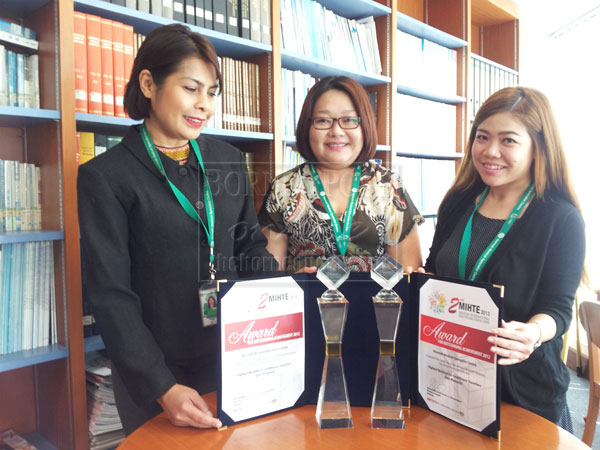
OUTSTANDING: Alina (left) with marketing executives Zafifah Ossman (centre) and Shetila Dris display awards won by Normah Medical Specialist Centre.

OUTSTANDING: Alina (left) with marketing executives Zafifah Ossman (centre) and Shetila Dris display awards won by Normah Medical Specialist Centre.

Kuching :

Normah Medical Specialist Centre received two outstanding awards at the recently concluded 2nd Malaysia International Healthcare Travel Expo in Sunway.

The awards received were for the Highest Number of Healthcare Travellers and Highest Revenue for Healthcare Travellers for East Malaysia 2012.

It was the first time awards were given to healthcare providers.

According to business development manager Alina Ibrahim, the awards were to recognise the contributions of healthcare providers in Malaysia from the perspective of medical tourism.

“The Malaysia Healthcare Travel Council (MHTC) was established in 2005 under the Ministry of Health to promote and position Malaysia as a unique destination for world class healthcare service.

“It is to facilitate collaborations between the public and private sector so issues affecting this industry can be addressed to ensure visitors have seamless experience with Malaysian healthcare service. It builds travellers’ trust and confidence to come to Malaysia,” she told a press conference yesterday.

Alina said as one of the best performing hospitals in East Malaysia, Normah is proud to be given the awards.

“We will continue to be committed to quality and compliance with the highest standard of healthcare services, and be the preferred healthcare provider in the region.

“We will continue to improve all facets of its comprehensive range of services. We believe this accreditation will ensure patients continue to receive the best in healthcare,” she stated.

source: http://www.theborneopost.com / Borneo Post Online / Home> News> Sarawak / by Antonia Chiam,  reporters@borneopost.com / October 31st, 2013