
Category Archives: Medical Tourism/Health Tourism

SFU offers guidelines for medical tourists

For Canadians considering a trip overseas for surgery or other medical care, there are guidelines now available from Simon Fraser University researchers to help make informed decisions.

SFU’s Medical Tourism Research Group recently developed a tool that helps to answer questions related to ethical concerns about the health and safety risks associated with out-of-country health care.

Created by SFU ethicist Jeremy Snyder, with support from a Canadian Institutes of Health Research grant, the one-page information sheet outlines several key points to consider, including unforeseen costs, procedure risks, the potential for contracting diseases and patient rights. It also points to the potentially negative impacts medical tourism could have on local communities where surgeries or health-care is offered.

Snyder is hoping to distribute the guideline across Canada.

For more information, including a list of medical tourism research involving several popular travel destinations, go to www. sfu.ca/medicaltourism/ resources/html.

Sun safety

Summer’s almost here, and with it, longer, sunnier days spent outdoors. While this is a great benefit to boosting people’s moods and stocking up on vitamin D3, there are dangers in getting too much sun exposure as well, even on cloudy days, according to Fraser Health.

“Most people think that as long as they aren’t getting a sun burn, they aren’t damaging their skin, but even if your skin is tanning and not burning, daily exposure to sunlight adds up and over time can cause skin damage and even skin cancer,” said Paul Van Buynder, chief medical health officer with Fraser Health, in a press release. “A tan is visible proof that your skin has been damaged from ultraviolet radiation.”

Skin cancer may be the most serious consequence of too much sun, though it’s not the only harmful effect. Too much sun can cause premature wrinkling, spotting and aging of the skin, as well as eye diseases and weakening of the body’s ability to fight off infections, illness and disease.

Children are especially at risk of developing health problems later in life if they experience sunburn.

To avoid harmful UV rays, Fraser Health recommends seeking shade between 11 a.m. and 4 p.m. when the sun is strongest, wearing long-sleeved shirts and pants as well as a wide-brimmed hat and sunglasses, and applying sunscreen with an SPF of 15 or more.

Sunscreen should be applied 20 minutes before, and again after, sweating or swimming.

For more sun safety tips from Health Canada, visit www.hc-sc.gc.ca/hl-vs/ sun-sol/index-eng.php.

Active kids

Kids across the country will soon have more encouragement to stay off the couch during afterschool hours.

The Public Health Agency of Canada recently announced a $1 million funding initiative aimed at supporting after-school programs that encourage Canadian youth to get moving.

Only seven per cent of Canadian kids get enough physical activity on a daily basis, according to Physical and Health Education Canada, one of the partners developing the project.

Specifically, the project – created by the Canadian Active After School Partnership – will focus on reducing community barriers to active after-school programs; supporting mental health through active after-school programs; engaging home and family to enhance access to after-school programs and; engaging aboriginal children and youth in active after-school programs.

Pilot projects have been launched across Canada in several communities, targeting Aboriginal Peoples, those with a disability, girls and young women.

The project has also included a national survey of parents and guardians to gather data online from across the country.

The project, supported through the Public Health Agency of Canada’s Healthy Living Fund, will be awarded to the various participating organizations over a two-year period.

source: http://www.burnabynow.com /Burnaby Now / Home> News / by Marelle Reid, Burnaby Now / June 14th, 2013
Overseas care a healthy alternative for wealthy

While millions of Chinese tourists seek exotic experiences on foreign shores, some are going overseas for health reasons.

A 46-year-old man from Shanghai going by the pseudonym Wang, was diagnosed with lung cancer in June. He went to Massachusetts General Hospital in the United States for treatment.

The treatment and chemotherapy worked, and Wang is now receiving regular examinations in Shanghai.

“It didn’t require hospitalization, and the side effects from chemotherapy are far less than in China,” he said, adding that he spent $63,000 on his treatment and accommodation in the US.

Cai Qiang, CEO of Saint Lucia Consulting in Beijing, which helped Wang with the treatment, said the company is committed to making the best medical care around the world accessible to Chinese people.

Cai, a physics major, started his business in 2011. He lost partial sight in his left eye as a teenager in China because of what he calls medical negligence. He has lived in Australia for the past 10 years.

Saint Lucia Consulting assists patients in evaluating medical options, choosing specialists, making appointments at top foreign hospitals, completing visa applications, translating medical records and making hotel reservations.

“Our mission is to overcome geographic and linguistic barriers that prevent Chinese from receiving world-class medical care,” said Wang Shun, a medical officer at the company.

So far, the company has dozens of top-tier partner hospitals in the US, Britain, Japan, Singapore and South Korea.

“Saint Lucia aims to provide clients with access to state-of-the-art medical services worldwide,” Cai said.

That, however, comes at a price. Service fees range from 68,000 to 88,000 yuan ($11,000 to $14,300) for at least one month.

Most patients are wealthy businessmen from Beijing and the provinces of Shanxi and Guangdong, and one customer asked if he should send his mother, who had cancer, to the US for treatment by private jet.

According to Cai, rich people in China have easy access within the country to all the trappings of wealth from top brands to restaurants. But medical care is different.

“Before their experience overseas, they had never expected such quality care and services as they received at foreign hospitals,” he said.

To date, they’ve helped send more than 100 patients for treatment abroad.

According to Wang in Shanghai, hospitals in the US are like cozy hotels, and each doctor consultation usually lasts more than an hour. “There were no crowds, long lines or impatient doctors,” he said.

Potential cultural clashes might arise, however. In one case, the family of a late stage cancer patient asked the doctor in Britain to hide the condition from the patient. “That breaks the law there,” Cai said. To prevent such problems, his company will inform patients.

At present, Saint Lucia Consulting has more than 20 full-time employees on the mainland and three bureaus in the US, Britain and Germany.

To appeal to Chinese customers, world-famous medical institutions like the MD Anderson Cancer Center in the US began to have Chinese language information on its website. They have also set up teams to help foreign patients, including the Chinese, with doctor appointments and visas.

However, Cai said he does not consider that a challenge to his business.

“I couldn’t be happier than to see more Chinese patients getting the best medical treatment worldwide,” he said. “I hope Chinese doctors improve their capacity and then help the majority who cannot afford medical tourism with better treatment.”

But some medical experts expressed caution over medical tourism, estimated to generate at least $60 billion worldwide.

“Given that medical tourism will probably stay in a regulatory void for a while, patients should be extremely careful choosing the right agency and consult Chinese specialists before making any decision,” said Qiu Renzong, a leading bio-ethicist with the Chinese Academy of Social Sciences.

Chen Wanqing, deputy director of the National Central Cancer Registry and a senior cancer specialist, said he has seen more outbound tourism for cancer treatment among Chinese in recent years.

But he expressed doubt over the necessity of doing this.

For cancer treatment in terms of both surgery and internal medicine, “China could be neck and neck with most developed countries”, he said.

However, “overseas hospitals might excel in hospital environment and patient services compared with the usually crowded Chinese hospitals”, he said.

Those who can afford it, however, could try overseas, he said.

But “the patient should be careful with the long travel,” he added.

shanjuan@chinadaily.com.cn / China Daily USA 06/14/2013 page2)

source: http://www.usa.chinadaily.com / China Daily USA / Home> E-Paper> China Digest / by Shan Juan (CD) / June 14th, 2013

Latvian e-health and health tourism professionals meet foreign chambers of commerce

Thursday, June 6, the Irish Latvian Chamber of Commerce in collaboration with the British Chamber of Commerce, Norwegian Chamber of Commerce and the Latvian IT Cluster will host business breakfast dedicated to e-health and health tourism developments in Latvia.

During the event, the Ministry of Health and representatives from hospital, health tourism and IT companies will share their experience and discuss the current e-health and health tourism issues – how to develop health tourism in today’s Latvian economy and how to foster greater cooperation between health institutions and the IT industry .

During the event e-health systems developed by the Latvian IT Custer members, as well as planned health care quality improvements due to the wide application of these systems in the health sector will be presented as well.

In addition the Scandinavian countries’ experience in the hospital sector in the Baltic States will be discussed within informal atmosphere.

The event will take place in RIGA IT DEMO center.

More information on e-health systems in Latvia you can find at: www.itbaltic.com/e-health/

source: http://www.itbaltic.com /Latvian IT Cluster / Thursday – June 06th, 2013

Medical-tourism, EB-5 initiatives near launch

DaveCT11jun2013

Puerto Rico to finally enter medical-tourism field, aggressively court foreign investors.

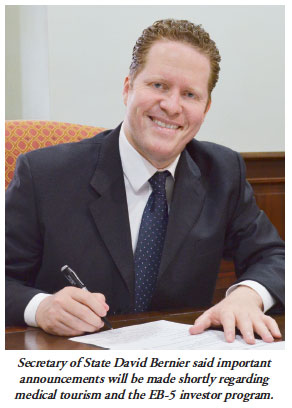
The government is getting close to announcing new initiatives aimed at making Puerto Rico a world leader in medical tourism and the island an attractive destination for foreign investors, Secretary of State David Bernier told CARIBBEAN BUSINESS.

Both efforts are being propelled by a new public policy of the administration of Gov. Alejandro García Padilla that calls for increased coordination between different government agencies.

“We’ve been hearing about medical tourism for years. Now we are finally going to have it,” Bernier said. “I anticipate that in a very short time Puerto Rico will be positioned as a leader in the field of medical tourism without doubt.”

The Economic Development & Commerce (DDEC by its Spanish acronym), State and Health departments, and the Tourism Co. are involved in the effort.

“This effort is being mapped out, and we will see results,” he said.

Currently, government and private sector officials are defining a “process mechanism” that will carry out a sustained marketing push for medical tourism, Bernier said. He declined to release more details saying an announcement on the plan was expected shortly.

The effort will create the environment for new projects, including hotels, aimed at the sector and new medical-tourism facilities to be developed. Bernier confirmed that there is a proposal to redevelop the former Normandie Hotel in Puerto Rico into a medical-tourism hotel.

Meanwhile, the government is also finishing up plans to formally request becoming a regional center in the U.S. government’s EB-5 (Employment-Based, Fifth-Preference Category) Immigrant Investor Pilot Program. Begun in 1992, it grants U.S. residency to foreigners who make investments and create jobs in the U.S.

Rural areas with low population density or depressed urban areas where the unemployment rate exceeds 150% of the national average, can also qualify to host EB-5 regional centers, which allows for greater flexibility and gives destinations priority in receiving visas.

Puerto Rico is looking at a model used in the state of Vermont, distinguished by the participation of the state government, which is one of the most successful in the country.

“There are multiple proposals being considered. We are analyzing with the DDEC, what model will be best for Puerto Rico,” Bernier said.

Bernier confirmed that the government is analyzing creating an “open-ended” regional center that would be run in conjunction with the government and private investors. The idea would be to create a venture capital fund run by the Government Development Bank to fund projects selected by the DDEC.

CARIBBEAN BUSINESS sources have indicated that the target is to attract 10,000 investors from Latin America, raising $5 billion. One proposed use of those funds would be to set up a real-estate investment trust to buy bad loans from local banks, which have an estimated $7 billion on their books. Other potential projects include renewable-energy plants, tourism developments and infrastructure works.

DDEC Secretary Alberto Bacó Bagué told CARIBBEAN BUSINESS the government would be seeking “expedited” approval from federal officials because of the program’s success in other jurisdictions.

Within a regional center, foreign investors must invest at least $500,000 and their investment must create 10 or more direct or indirect jobs, with an economic analysis to back up the claims. The EB-5 program currently makes 10,000 EB-5 visas available annually, with 3,000 reserved for designated regional centers. There are currently 210 approved designated regional centers operating in 37 states and other U.S. jurisdictions.

Private entities on their own can also pursue EB-5 regional center status. Omega Puerto Rico Regional Center was approved last month by the U.S. Citizenship & Immigration Services (USCIS) for a project involving 350 units of assisted living, memory care and skilled nursing for elderly residents. At least two other projects have requested becoming a regional center from the USCIS and are waiting for a decision, according to sources.

source: http://www.caribbeanbusinesspr.com / Caribbean Business / Home> This Week / by John Marino  marino@caribbeanbusinesspr.com / Vol.41, No. 20 / May 30th, 2013

Medical tourism counter proposed at airport

Ahmedabad :

The Airport Authority of India (AAI) has issued a tender for opening a medical tourism counter  – a first of its kind – at the Sardar Vallabhbhai Patel International Airport to facilitate the international tourists get the best medical care in the city.

“The aim is to improve facilities for passenger and not to earn money,” said R K Singh, airport director . AAI will provide 10 sq m of space at the arrival area of the international terminal to the highest bidder.

The space will be provided at Rs 3,500/sq m/month which is much less than what AAI charges for other counters like food and hotels. “We usually charge Rs 6,500/sq m/month but for medical tourism counter, we are offering a subsidized rate,” said Singh.

The counter is aimed at providing the necessary information regarding the procedures, monetary transaction and international code of treatment. On being asked why will patients come to medical tourism counter at airport when they already have a tie-up with the hospital concerned, Singh said, “People always seek better facilities. The counter will help them find the best option available for them.”

“If you go to a hospital, you will have to wait for your turn for long. The plan aims to do away with this waiting time. AAI has consulted with Apollo Hospitals , Shalby Hospitals and Vasan eye care for the medical tourism counter,” he added.

Ahmedabad being one of the fastest growing cities is aspiring to be one of the best healthcare providers in the state as well as India. The growth of 33 per cent has been registered in the number of medical tourists in the state while the country has registered growth of 20 per cent.

The city hospitals are seen as hot destination for medical tourism from all over the world. This has pushed the city hospitals to upgrade their technology, infrastructure and bring them to the level of developed countries.

source: http://www.timesofindia.indiatimes.com / The Times of India / Home> City> Ahmedabad / by Piyush Mishra, TNN / June 10th, 2013