Category Archives: Medical Tourism/Health Tourism

Envelope, please!… Singapore’s top 5 medical tourists by nationality are ….

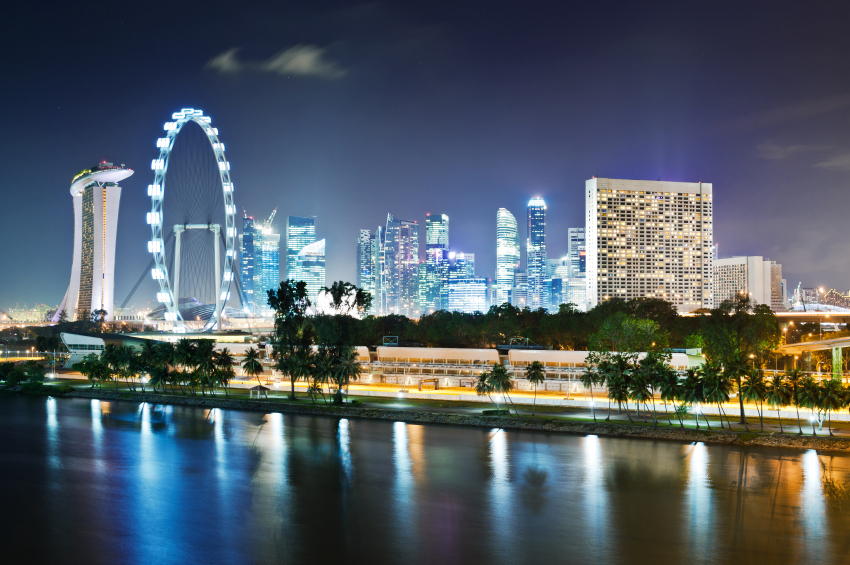
singaporeCT02apr2013

Usually travelers are hoping to stay out of the hospital when they’re on holiday, but nowadays, as we know, there are huge numbers of people who are combining the two: travel and treatment together.  There has been a rapid expansion of the medical tourism industry over the past decade, but what has contributed to this boom?  The main reasons are the convenience and affordability of air travel, skyrocketing healthcare costs plus long and often unpredictable wait times for care in the West, and an ageing global population.

You may also know that Asia is leading the way as the preferred destination for safe healthcare abroad .  People are heading overseas for everything from open-heart surgery or total hip replacement, to dental work or cosmetic procedures like face lifts and boob jobs, and even weight-loss surgery .  And they’re doing it in droves.  According to most figures, medical travel is a nearly $15 billion business (USD), and accounts for roughly 5 million patients.  In 2012 an estimated 1.6 million Americans traveled outside their country for care, and they headed to India, Thailand, and Singapore about 90% of the time when considering medical tourism in Asia.  Just breaking down the numbers a bit further, it has been reported that 19 million tourists visited Thailand in 2011, and 500,000 of them were there for medical treatment.  In Singapore, 10.2 million tourists spun the turn-styles at Changi International Airport and a robust 200,000 were seeking healthcare.

Given Thailand’s well-earned reputation as doting and graceful hosts, its array of top-notch medical facilities and services , and the exotic experience it provides tourists in the traditional sense, it’s easy to see why Bangkok is becoming somewhat of a hub for medical travelers.  So what about Singapore?  Singapore is a medical tourism heavyweight in its own right, due to its expertise in certain specialized fields such as oncology and stem-cell therapies, plus their highly-ranked and accredited hospitals, high percentage of English-speaking healthcare professionals, and the fact that the island is and built to standards that make westerners comfortable.

So we know why patients are crossing international borders for medical care, what they’re going for, and where they’re going…..but who are they?  Are they all from the US and the UK?  Hardly.

Just looking at health and medical tourism in Singapore as an example, the most common visitors for a healthcare holiday there are Indonesians who account for almost half the foreign patients the city-state sees each year.  So Americans must be second, right?  Nope.  In fact, Americans and Brits, who at one time were 1-2 in terms of the most common nationalities heading to Singapore for medical care, aren’t even among the top five.  Now, after Indonesia, the most are from Malaysia and then, maybe surprisingly, Vietnam, Myanmar, and Bangladesh.

Healthcare experts attribute this increase of visitors from traditionally less affluent countries to a variety of factors.  For one thing, as India, Thailand and Malaysia have become increasingly competitive, patients in the US and Briton have more options.  Plus, citizens in these other Asian locations are becoming more and more upwardly mobile themselves, affording them opportunities to go abroad for improved, more convenient treatment as rapid population growth in their home economies has surpassed developments in medicine.  It’s not just Western patients who are done in by long wait-times at hospitals and clinics.

So if the demographics of medical tourism can change from predominantly Western patients to a more diverse mix for Singapore, it can change for other hotspots too, and has probably already begun to.  India, Thailand: get ready!

source: http://www.mymedholiday.com / Home> Medical Tourists News and Views / March 26th, 2013
US group plans medical centre in Abu Dhabi

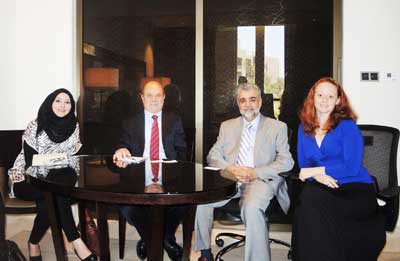
AbuDhabiCT01apr2013

A landmark medical treatment centre providing various medical services including recreation as well as treatment of senility and chronic diseases will be launched on Saadiyat Island in Abu Dhabi on May 14, according to its operators.

To be based at St Regis resort on the island, the DNA Integrative Medicine and Wellness Centre could turn the UAE into a key curative tourism destination, said a senior official.

“Abu Dhabi represents a key aspect of our strategy…we share many values and we aim to contribute to efforts to turn the emirate into a major recuperation and treatment destination for tourists,” remarked Dr Nasim Ashraf, DNA Health Corp chairman and CEO.

“We look forward to building bridges of cooperation with tour operators in the UAE and other countries, mainly India, Russia, China and South Korea…these countries are considered key tourist exporters to the UAE,” he added.

He said German tour operators had already included DNA’s medical products in their promotion brochures for 2013-2014, adding that Germany already is one of the largest tourist providers to Abu Dhabi and other UAE emirates.

“We believe that market is ready to accept our package which involves treatment, relaxation and recuperation as well as Golf games, free tickets to Monte Carlo beach club and stay in our partnership hotels and resorts,” Ashraf stated

According to him, Saadiyat was picked as an ideal venue for the DNA centre given its beautiful nature, pure water and clean sandy beaches stretching over nine km.

He said a team of medical experts and scientists would manage the centre, adding that it presents a “new concept for curative tourism and alternative medicine in the region.”

He said the team includes experienced personnel trained in the US and that Dr Kristy Higgs, an international expert in functional and integrative medicine, has been appointed as senior consultant at the centre, noting that Dr Kristy has been assistant manager at the US Institute for Functional Medicine.

Another well known medical expert, Dr Jack Kornberg has also been named medical director of the DNA centre on Saadiyat, Dr Ashraf said.

A successful US-board certified surgeon with over 30 years of US-based practitioner experience, Dr Kornberg is a renowned and passionate advocate of functional medicine and the benefits of an integrative approach to the treatment of chronic disease on the global health and wellness seminar circuit.

Another veteran doctor to join the centre is Dr Joshua Berka, a holder of dual degrees in both Naturopathic Medicine and Classical Chinese Medicine.

Dr Berka’s focus is primarily in family medicine, including advanced approaches for the care of acute and chronic disease as well as alternative and complementary cancer treatments.

Other experts to join the centre include Dr Amir Qarshi, who has13 years of experience and practices in Physical Medicine & Rehabilitation.

Also joining the centre is Dr Lisa Portera-Perry, a passionate advocate of Functional Medicine Based Nutrition providing a new paradigm for assessing and treating complex and chronic illness. Dr Lisa, a Nutritionist and Chiropractor, will be contributing her 25 years of clinical experience to the centre.

Lifestyle Coach and Functional Medicine Nutritionist, Elizabeth DiMeo, will further augment the DNA centre’s holistic approach to providing client guests with tailored, individual programmes to support their journey to wellness.

Adding a fourth dimension to the centre, in addition to its clinical and preventive offerings, is its dedicated bio-aesthetics division, which will be headed by renowned bio-aesthetician to the Hollywood stars and US television celebrity, Jamie Sherrill.

Jamie is a registered nurse and co-owner of Santa Monica’s Beauty Park Medical Spa, and will be bringing her exclusive treatments, products and expertise for the first time to the region. She will be joined by fellow bio-aesthetician, Dorrie Emrick.

A first-of-its-kind in the region, the centre will provide a series of 21st century integrative medicine and wellness modalities in a singular luxurious state-of-the-art facility in The Collection retail complex. It will offer four dimensions of wellness – clinical, preventive, alternative and bio-aesthetics – based on the highest level of US healthcare and Functional Medicine protocols for the treatment of chronic disease, lifestyle management and healthy aging.

“We are offering a four-day package covering the evaluation of the clients’ medical condition and analyzing their DNA before determining a treatment programme and lifestyle management,” Dr Higgs said.

In recent comments, a DNA official said she expected the establishment of the centre to turn Abu Dhabi into a major destination for tourists seeking medical treatment.

Kelly Smith, director of marketing and communications at DNA, paid tributes to the Abu Dhabi Tourism Authority for its role in promoting this centre within the UAE, the other Gulf Cooperation Council members and worldwide, adding that the centre is planning promotional campaigns in Saudi Arabia and Russia.

DNA operations manager Dr Ahsan Malik said the centre has already announced treatment packages, adding that he expected strong demand from clients in the UAE, other GCC countries, Russia and other CIS states.

“We expect high demand for our services from those countries…this will largely contribute to bolstering Abu Dhabi’s position on the medical tourism map,” he said.

“We believe that our advanced equipment, good location and qualified personnel will allow us to create a new concept in health services in the region,” he added.

source: http://www.tradearabia.com / Trade Arabia News Service / Home> Health & Environment> Story / Abu Dhabi / March 31st, 2013

MYMEDholiday.com adds Msia to its list of healthcare destinations

New Delhi :
Malaysia is now listed as a medical tourism destination on MyMEDholiday.com, a portal that provides a robust bundle of features to anyone considering a trip overseas for healthcare.
The comprehensive medical tourism portal and ratings site with offices in San Francisco and Bangkok has detailed profiles of over 400 healthcare providers in Asian countries known for their advanced medical care centres such as Thailand, India, Singapore, and now, Malaysia.
In addition to the profiles of various doctors, hospitals and clinics spanning all fields of medicine, the site includes an interactive tool with which patients can access facilities directly, said a statement.
Information pertaining to the countries represented on the site can be accessed easily through a drop-down tab called, appropriately, “Destinations”.
There is also a brief summary of each country’s medical tourism capabilities, a synopsis of the overall healthcare system there and listings of the most popular cities for medical tourism.
One high-ranking member of the company’s Asian-operations team says, “Asian countries such as Singapore, India and Thailand have established themselves as heavyweights in the multi-billion dollar health and medical tourism market by offering patients from abroad the chance to receive convenient, high-quality, and affordable healthcare that they can’t get at home.
“At this point in time, it makes sense to include Malaysia as it starts to emerge as a serious player as well.”
The “Destinations” page featuring myMEDholiday.com’s newest location includes a summary touting Malaysia’s new-found prominence as a medical tourism haven and its new and internationally-recognised hospitals and clinics.
It also contains information on the highly qualified doctors and specialists who practise there, and looks at some of Malaysia’s better-known fields of expertise such as cardiology, oncology, orthopaedics, infertility treatment and reconstructive surgery.
It also cites Malaysia’s reputation as a premier vacation destination due to the balmy tropical climate and warm hospitality.
Like the other Asian leaders, Malaysia claims to satisfy both halves of the healthcare travel equation with a successful “medical” infrastructure and a thriving “tourism” industry.
Each facility listed in the medical travel “Destinations” pages is qualified and up-to-date with the latest in healthcare technology and trends, and has met myMEDholiday.com’s strict membership criteria before having their profiles listed free of charge, said the statement. – BERNAMA
source:  http://www.nst.com.my / New Straits Times / Home / March 30th, 2013

Philippines Joins Medical Tourism Parade

The Doctor will see you now

The Philippines, having become a major player in the business process outsourcing, is preparing to take on other countries across Asia in a new field ? medical tourism, a plan that makes sense since the country is a major supplier of medical personnel to the west.

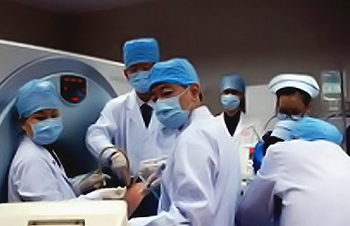
doctorsCT30mar2013

Maybe we get to stay home

In February, Tourism Secretary Ramon Jimenez held a briefing to announce that his department is cooperating with the Department of Health to identify what medical services could be offered. In doing so, Jimenez and other officials are betting into such well-established health providers as Thailand, Singapore, India and Malaysia, hoping to combine access to Filipino beaches as well as hospital services.

There is huge demand for orthodontics or dentistry, cancer and retirement, cataract laser surgery and other medical procedures at costs a fraction of those overseas, Jimenez said, adding that medical services are among the tourism products the Philippine government wants to promote.

Despite well-trained medical staffs and first-rate facilities, the Philippines is well behind other countries in the region in trying to draw health tourists. The government says it is seeking to counter that lag by working on bilateral government-to-government agreements focusing on medical health exchanges and hospital-to-hospital partnerships with foreign institutions as well as working with foreign referral companies and doctors to draw patients,. Its target market is overseas Filipinos in the US and Canada, the Australian market, the island states, Japanese and Koreans, of whom nearly 1 million are already in the country.

Despite the drawbacks, the plan dovetails with a sense that the Philippines is finally getting moving after the years of paralysis from a long series of crooked or ineffective administrations. The government of Benigno S. Aquino III has taken on the Catholic Church and pushed through a birth control program that the church is nonetheless still fighting furiously and has “put in place what we consider its greatest economic achievement, the most sweeping changes in public procurement procedures in the last 50 years, if not longer,” according to a report on the country by the Hong Kong-based Asianomics financial analysis firm. ” This anti-corruption, anti-graft focus has transformed public expenditure in the Philippines, as well as the participation in the procurement bidding process by some of the most efficient and cleanest companies in the country.”

The competition for health dollars is keen. Given the cost of health care in the advanced countries, more than 50 countries across the planet have identified various forms of health tourism as a national industry, unfortunately with widely varying standards of accreditation and health quality. It is a lucrative field, both for health care and tourism as many patients combine the two. India and Thailand in the region have been identified particularly as destinations ? Thailand for its beaches and other attractions as much as for its medical care, which is deemed to be first-rate. India has been in the medical tourism game for more than a decade and at last count had welcomed 150,000 people to the country. The industry, growing 30 percent annually is expected to bring in US$2 billion a year by 2015.

Thailand is equally if not more advanced than India, particularly in cosmetic surgery including nose jobs and breast augmentations. One hospital alone took in 150,000 patients in 2006 and the industry has grown rapidly since.

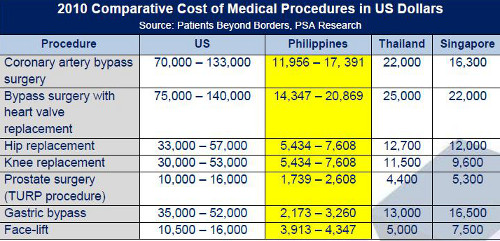
Prospective patients are usually seeking elective surgeries including joint replacement such s hips or knees, prostate surgery or coronary bypasses (see chart). The Philippines is strongly competitive in most of these, with dramatic differences in cost with the United States, the world’s most expensive place for medical care, far above at the top of the list.

graphCT30mar2013

Source: PSA

GRAPH
The campaign to attract medical tourists “comes at a time when Filipino doctors and medical facilities are gaining greater recognition for providing health care services that are on par with international standards, according to a report by Pacific Strategies and Assessments, a country risk firm headquartered in Manila. Many of the basic components needed to expand medical tourism are already thus in place. The Philippines, according to the PSA report, “boasts several state-of-the-art medical centers that provide advanced medical procedures such as stem-cell therapy by western-educated Filipino doctors.”

The drawbacks, according to the PSA report, are rooted in many problems that traditionally have plagued the Philippines; shambolic infrastructure, a hostile climate to foreign investment, a rigid labor structure and inability to put in place government policy to accommodate western interests. Medical centers in India, Thailand and Singapore in particular have lucrative partnerships with international insurance companies that find it in their interest to act as clearing houses for the treatment of policyholders, allowing them to save significant amounts of money for payouts to medical providers.

In the Philippines, however, “Partly due to the country’s lack of accreditation with larger insurers, experts on medical tourism say that the dearth of international private insurance in the Philippines is intentionally designed to protect the local insurance industry.” That puts roadblocks in the way of international insurance companies trying to save money on medical care, and denies the Philippines a lucrative and relatively prestigious source of income as well as populating its beaches with foreigners recuperating from their nose jobs and breast implants and eager to show them off.

The other problem is that while the Philippines trains vast numbers of doctors and nurses, they often depart for the west, where salaries are so much better than an individual trained as a physician at a Filipino medical school can make more money as a nurse in the United States than he can as a doctor in his own country. The hospitals in the United States, particularly in California, are filled with huge numbers of Filipino medical personnel, not to mention Indians and residents of many other countries. A prosperous medical industry in the Philippines would go a long way toward keeping its diaspora at home.

source: http://www.asiasentinel.com / Home> Economics/Business> Philippines / by Asia Sentinel’s Correspondent / Wednesday, March 13th, 2013

Seoul-medical tourism

Seoul , March 13 (Yonhap):

The Seoul Metropolitan Government plans to unveil region-specified medical tourism programs reserved for foreigners as part of efforts to meet growing demand for such programs and further spur the industry, officials said Wednesday.

The municipal government is devising tour programs that integrate the medical services that certain city districts are well-known for along with famous tourist attractions, and is planning to start them as early as next month, according to the officials.

The city has been in consultation with the districts since last year, with five ward offices — Gangnam, Secho, Seodaemun, Gangseo and Jung — agreeing to promote their medical services such as plastic surgery, skin care, oriental medicine and cancer treatments, they added.

“For example, visitors would be able to get acupuncture, enjoy a cup of tea and food made of oriental herb, and then visit a traditional Hanok village all in one swoop in Jung-gu,” said city official Kim Ki-hyun in charge of tourism businesses.

“Currently, each borough office promotes its own medical services, which often turn out to be ineffective. We expect this integrated program will create synergy effects,” he added.

Separately, the city said it will earmark 100 million won (US$91,240) to promote oriental medicine to foreign tourists by, for example, creating places where one can receive physical therapy and acupuncture.

Last year, some 80,000 foreigners visited  South Korea for medical purposes, up more than 20 percent from a year earlier, according to government data.

All rights reserved by Yonhap News Agency

http://www.globalpost.com/ Home> Yonhap News Agency / March 12th, 2013