Category Archives: Reports,Features, Statistics

Health tourism as an attraction in city

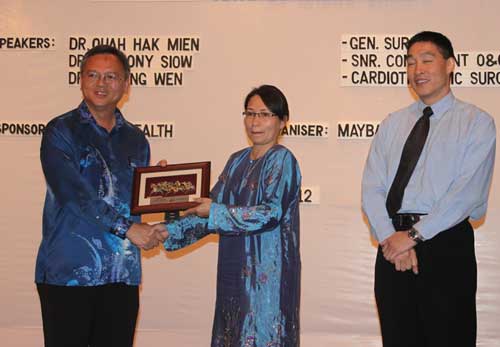
FOR YOU: Connie (centre) presents a souvenir to Lo.

Kuching:

Kuching can include health tourism as one of its attractions through the collaboration of hospitals with Singapore-based Parkway Pantai Limited (PPL).

Padawan Municipal Council chairman Lo Khere Chiang said health tourism was a lucrative business in many countries.

He said there is market for health tourism in Kuching as many Indonesians come here for treatment.

“If there is collaboration between experts in Singapore and Kuching with more seminars and dialogues held, I believe it will be an advancement for medical tourism,” Lo said at the opening of the Public Health Seminar yesterday.

The seminar was organised by Maybank Berhad Pending Branch and sponsored by Parkway Health.

Topics presented were ‘Colorectal Cancer: Early Detection and Treatment’ by Gleneagles Medical Centre Singapore general surgeon Dr Quah Hak Mien; ‘Abnormal Menstruation: Diagnosis & Treatment’ by Gleneagles Medical Centre Singapore senior O&G Dr Anthony Siow and ‘Advance Treatment in Lung Cancer’ by cardiothoracic surgeon Dr Su Jang Wen.

Lo commended those who turned up for the seminar as it shows the people are aware of the importance of health.

PPL is one of Asia’s largest healthcare providers with branches in Singapore, Malaysia, China, Hong Kong, India, Vietnam and Brunei.

In Singapore, PPL is the largest private healthcare provider with over 1,200 specialist doctors. In addition to four hospitals in Singapore, PPL also has a large network of medical centres, clinics and numerous research organisations.

In Malaysia, PPL is the second largest private healthcare provider in terms of the number of licensed hospital beds. It owns and operates 11 hospitals across Malaysia.

PPL also has a huge presence in China, India, Hong Kong, Vietnam and Brunei and has achieved big strides in terms of creating public health awareness at home and abroad.  These and other projects represent a significant commitment and contribution from PPL to the healthcare of the people in these countries, he said.

Also present were Parkway Health Corp Marketing assistant vice-president Samuel Tan and Parkway Health regional office manager (Sarawak) Connie Tan.

source: http://theborneopost.com / Home> News> Local /bu Irene C / August 27th, 2012

Malaysia: Investing in health

Investment in human capital has been identifi ed as a key driver in boosting the quality of Malaysia’s health care standards while seeing growing economic returns from the industry.

However, underinvestment in health services continues to pose a risk.

Under its Economic Transformation Programme (ETP), unveiled in September 2010, the government aims to transform the country into a high-income economy bracket by 2020, with the health sector targeted as central to this plan.

As one of the 12 national key economic areas (NKEAs), health care is targeted to become a significant economic enabler by generating revenue through health tourism, as well as manufacturing drugs and equipment.

The sector also aims to create 180,000 new positions in health care and attract up to one million overseas health tourists annually by the beginning of the next decade.

To achieve that goal, however, spending in the sector will need a significant boost.

Currently, Malaysia dedicates the equivalent of 4.7 per cent gross domestic product (GDP) on health services.

This is lower than most middle-income nations’ spend, which averages 6.5 per cent, according to the World Health Organisation.

One of the core areas for that increased investment is human capital.

The Health Ministry has set a series of targets to increase the ratios of health sciences professionals to the general public.

Once the ETP has completed its term by 2020, offi cials believe Malaysia will have one doctor for every 400 citizens, compared with the present rate of around 1:800, and one nurse for every 200 people, up from the current level of 1:384.

To achieve this, Malaysia is boosting its health education training schemes.

In late July, Muhyiddin Yassin, the Deputy Prime Minister, said the government was planning to increase the number of higher education institutions in the fi eld of health science to 150,000 by 2020, up from the present 55,000.

According to Muhyiddin, who is also Malaysia’s Education Minister, “I believe Malaysia can play a central role in answering the need for more health professionals in the region.

As such, health sciences students, who are considered highly skilled and employable, can expect a brighter future in this field.” On July 14, in a speech delivered on her behalf at a graduation ceremony at a health training institute in Sabah, Rosnah Abdul Rashid Shirlin, the Deputy Health Minister, said the government was moving to accelerate the pace of improvements in sectoral education.

The ministry was committed to ensuring that graduates have the knowledge and skills required, as well as providing training institutions equipped with modern facilities and qualified teaching staff.

“If we see the development of global health at present, the world needs specialists to develop public health,” Rosnah said.

The Minister of Health, Liow Tiong Lai, recently acknowledged that the task of increasing the number of specialists was a difficult one.

Health education is a rapidly evolving segment, meaning the health sector and educators must move quickly to keep pace with needs of the industry.

“Although the system has been quite successful, we must not rest on our laurels but work tirelessly to ensure that our medical staff will be able to meet the demands of the market, which can change quite rapidly,” Liow said at an international health care conference in Kuala Lumpur on July 17.

“However, quantity alone is no longer sufficient because quality also matters in the industry to achieve the excellence in not only curing but also caring.” There are many challenges that Malaysia’s heath sector faces, including rising costs and more demanding and knowledgeable consumers, Liow said.

One of the answers to these challenges will be the industry’s ability to train, attract and retain qualified personnel.

The issue of retention was a vital one, according to Dr Ismail Merican, the former director-general of health, as was the ongoing process of improving the skills base of those already in the system.

In particular, Merican told local media, the government needed to step up investments in the public health care sector, strengthen its teaching role and ensure professionals were better compensated to keep them within the local system.

If Malaysia is to achieve its goals, it will need a strong health sector to underpin growth, both to ensure the wellness of society but also as a foundation for sectoral expansion.

Increased spending, as well as further encouraging the already active private health services sector to ramp up investments along the training and development chain, will be required.

source: http://www.theborneopost.com / Home> BizHive  / Sunday, August 19th, 2012

Tourism and good health: Medical Tourism

by Dr. Peter Tarlow, President of TOURISM & MORE, INC., Special to ETN | JUL 31, 2012

Tourism and health has taken on two new meanings. Health tourism can be broken down into two components, people who travel to a particular spot for medical reasons, such as cancer centers or for specific operations such a coronary bypass, and people who travel to a location for medicinal reasons such as rest and relaxation. Medicinal tourism caters not to the sick but to those who seek new levels of wellness. Examples of medicinal tourism are spa or centers that cater to non-essential cosmetic re-makes such a weight loss. Medical tourism of the hospital variety differs from medicinal tourism (the spa variety) in that it aims to serve those who are accompanying an ill person and often does not seek repeat business. Medicinal tourism on the other hand seeks repeat business and hopes that its clients will return on a regular basis.

Spa tourism has been around for thousands of years. In ancient times places such as northern Israel and Rome attracted visitors from the much of the known world. Across the millennia then spa tourism has provided visitors with non-invasive therapies, opportunities to improve physical fitness. In the modern world spas also provide their guests with weight-loss treatments, special cleansing diets and a variety of mineral and thermal skin treatments. Many spas also often massage and yoga classes as other ways to improve health and to de-stress.

Both of these separate phenomena are often classified as “medical tourism” and although their raisons d’être are very different, they also share many tourism similarities. Medical tourism also has the added advantage that it can provide essential services to the local population at the same time that it is helping the local economy. To help you consider if medical tourism is a good choice for your community consider some of the following ideas.

  • Determine what health factors make your community unique. Saleable health factors can include exceptionally clean air, unique waters with minerals, quiet settings, or any other natural phenomenon that would provide the person with a form of health benefits that are unique to your community.
  • Make sure that your medical personnel understand the importance of good bedside manner. In the world of medical tourism physicians, nurses, and therapists are more than medical professionals. They are also part of the tourism industry and their patients are also “clients”. That means that it is imperative to train medical tourism workers not only in their particular medical field, but also provide them with a clear understanding of customer service and the tourism product. How they treat their patients may well determine a patient’s willingness to return.

Merge your tourism offerings with the local ambiance. Medical tourism is about creating psychological and physical harmony. Make sure to offer a wide variety of options, but at the same time, be careful to honor the place in which your tourism is located and integrate local culture and foods into your medical tourism site.

Make your hospitals tourism friendly. Hospitals are often seen as places in which to get sick rather than to get well. Hospital tourism means integrating not only the patient with the local community but also the whole family. During the patient’s recovery phase, provide the patient’s family with day trips that stay connected to the hospital in case of emergency. Develop special brochures for out-of-towners who are visiting sick friends and relatives. Remember that these are people who are in your community due to a love one’s illness. They need excellent customer service, ways to relieve tension and still feel that they are close to loved ones.

Make sure that your medical tourism meets industry standards. Medical tourism is in an existential sense different from many other forms of tourism in that involves the health and well-being of a guest. Make sure to meet all standards, do not advertise what you cannot deliver and make sure that people understand the risks involved. The bottom line is that while foreseeability is essential in all forms of tourism it is especially important in the area of medical tourism.

Take the time to get your medical tourism right! Terms such as medical tourism, spa tourism and wellness tourism are often used so loosely that no one is sure what these terms mean. Be truthful in your advertizing; say what you offer and what you do not offer so that the customer is absolutely clear about the experience s/he is purchasing. Also be certain that resources, such as water, (as used in spas) are tested on a regular basis so as not to turn a medicinal tourism experience into an illness acquired experience.

If doing medical tourism; make sure that you create partner agencies. One of the problems in the area of medical tourism is what does a patient do after s/he has returned home and has a problem. Good medical tourism centers can provide 24 hour/7 day a week medical hot lines, but often a patient needs more than a phone. Make sure that medical records are sent home in the local language or in a language that the local doctor can read. Establish partner hospitals around the world and make sure that medical prescriptions can be filled in the customer’s country.

Deal with the insurance problems before not after. Many visitors in both medical and medicinal tourism may want to use a local insurance plan. Be sure to list in your literature payment structures and whose insurance your institutions can accept. There is nothing less pleasant than having a fight over money when it comes to health and these disputes often cause visitors to have a negative reaction to the host community and not just the health provider. Make sure that health providers understand that they are an essential part of the community’s economic health and what they do or fail to do reflects on the whole community.

source: http://www.theihcc.com / The Institute for Health Care Consumerism  / Home> Communities Health Access Alternative / July 31st, 2012

Govt plans to stop out-of-country medical tourism by 2013

WORRIED by the billions of naira the country loses yearly due to overseas medical treatment by most Nigerians, the Federal Government plans to focus its 2013 health budget on improving the quality of services at the tertiary levels to curb medical tourism.

Minister of Health, Prof. Onyebuchi Chukwu, disclosed this on Monday while briefing the press after his presentation on the key performance indicators of the health sector in 2012 and proposed budget for the next fiscal year, at the State House, Abuja.

According to a statement signed by the Special Assistant to the Health Minister on Media and Communications, Dan Nwomeh, Chukwu said to achieve the goal, the Federal Government will intensify efforts to restore public confidence in the quality of tertiary health care system, while more public private partnerships will be pursued and realised.

He said the government will complete outstanding priority projects including the National Centre for Disease Control, the National Diagnostic Centre, new trauma centres in six orthopaedic and specialist hospitals across the country and continued rehabilitation and upgrade of teaching hospitals, while expressing the hope that these steps will foster efficiency and create more jobs in the health sector.

Chukwu listed other targets for 2013 such as the prioritisation of health in national development instruments including the Vision 20:20, the transformation agenda and the Subsidy Reinvestment and Empowerment Programme (SURE-P), passage of the National Health Bill into law, mainstreaming the health sector into all areas of national development and renewed commitment towards attaining universal health coverage.

On the key performance indicators in the health sector under the 2012 budget, the minister said a number of federal tertiary healthcare facilities were upgraded, just as there were increases in numbers of resident doctors trained overseas, centres screening for cancer nationwide, use of insecticide treated nets by pregnant women and health facilities providing specialised care for multi drug resistant (MDR) tuberculosis.

He also said significant improvements were recorded in emergency preparedness and response to epidemics such as measles, yellow and Lassa fevers, guinea worm, lead poisoning, Human Immunodeficiency Virus (HIV)/Acquired Immune Deficiency Syndrome (AIDS), malaria and other communicable diseases.

He said: “There has been a phenomenal increase in medical tourism by Nigerians, which is hinged on a number of factors like the lack of appropriate and modern facilities in our tertiary centres.”

source: http://www.ngrguardiannews.com / The Guardian Nigeria / Home> Features> Science / by Chukwuma Muanya / Thursday, August 02nd, 2012

Longer UK Wait Lists Create More Medical Tourists

More medical tourists from the U.K. may be forced to go outside the country for cataract surgeries, weight loss surgery, and hip and knee operations.

Nearly all of U.K.’s health care regions have purposely made waiting lists longer by restricting the number of procedures they perform.

9 out of 10 National Health Service Trusts said they have placed limits on many procedures they perform, making longer waiting lists for these procedures.

These growing waiting lists were recently was exposed through a “freedom of information” request in the U.K.

Non-urgent rationing encourages medical travel

The NHS Trusts claim they have reduced the number of these surgeries because they need to save money. By labeling these essential treatments as “non-urgent” or “of low clinical value,” they are able to divert financial resources to more urgent care needs.

Whenever financial resources are taken away from a group of treatments, patients turn to  medical tourism to provide options in other countries.

British Health Minister Simon Burns was forced to respond to the news, stating that rationing treatment on grounds of cost was “totally unacceptable” and decisions to treat patients should be made on clinical grounds alone.

At the same time, Burns acknowledged decisions need to be made to limit or reduce certain types of treatment. This will help improve the bottom lines of budgets, re-allocate manpower or re-purpose physical space.

The NHS must find £20 billion (about US$30 billion) worth of efficiency savings by 2015 while it is still staggering from a failed central computer project that has ended up costing over £12 billion (almost $19 billion).

Canada makes wait times public

In Canada, the province of Ontario maintains a website that publicly lists the wait times not only for surgery but also for diagnostic imaging or emergency room care. Wait list information is searchable by procedure, hospital name or location.

The Ontario list is remarkably similar to that of the U.K. – listing procedures more in demand in aging populations.

Currently, reducing wait times for hip and knee replacements, cataract surgery, radiation oncology and cardiac services are a priority for the Ontario Ministry of Health and Long-Term Care, reducing the need for medical travel.

But weight loss surgery in Ontario has a wait list of 3 years, and is not included in the public list – apparently not an immediate concern of the Ontario government. Weight loss surgery travel by Canadians will continue.

Bed shortages

A different shortage, of patient beds, is the justification for another practice in the U.K. that was also recently made known.

UK doctors are putting tens of thousands of elderly hospital patients to death prematurely because they are difficult to manage or to free up beds, contends Professor Patrick Pullicino, a consultant neurologist and professor of clinical neurosciences.

Denying care to elderly

Speaking to the Royal Society of Medicine in London, he described a “death pathway,” known as the Liverpool Care Pathway (LCP), as a treatment protocol approved by the NHS and National Institute for Health and Clinical Excellence.

LCP, a method of looking after terminally ill patients, is used in hospitals across the U.K., and may include withdrawal of treatment including all nourishment and water. On average, LCP leads to death within 3 days.

Similar protocols exist in the U.S., Canada and other countries, for withdrawing treatment from terminally ill patients who are often in hospice and have very little time left to live. Nourishment and all medical treatment are withdrawn, and high levels of pain medication, often morphine, is given.

Pullicino said doctors had turned the use of this controversial ‘death pathway,’ meant for use when doctors believe when death is imminent, into the equivalent of euthanasia of the elderly. He claims it has become an assisted death pathway rather than a care pathway.

There are around 450,000 deaths in Britain each year of people who are in hospital or under NHS care. Around 29 per cent – 130,000 – are of patients who were on the LCP.

source: http://www.mtqua.org / Medical Travel Quality Alliance / by Julie Munro / July 22nd, 2012