Category Archives: Reports,Features, Statistics

Medical tourism takes root at home

Fed up with the high cost of health care, some companies are giving incentives to employees to travel across town or across the country to get the surgeries they need.

The Los Angeles Times reports that smaller newspaper publisher Stephens Media and mega-employers like Kroger and Wal-Mart either are now or will soon offer airfare and a waiver of out-of-pocket expenses for their employees to travel to medical centers around the U.S. In some cases, they’re even paying for your family to stay in a hotel wherever you are as you’re going in for your surgery.

Not very long ago, it seemed people were fleeing our borders looking for cheaper health care in Mexico, Costa Rica, Thailand, or Hungary, among other places. The savings can be extraordinary — up to 75 percent. The big question was, “What kind of care do you get overseas?”

The answer turned out to be very good care, but that was still not enough to make most of us take the chance on medical tourism. But this latest trend The Los Angeles Times is noting repatriates medical care from offshoring and gives hope that you can save a buck without having to leave the country.

source: http://www.darkhoward.com / Home> Insurance / Monday, December 19th, 2012

Cosmetic surgery common reason for medical tourism

New York:

Nearly a third of people surveyed across the globe say they’re open to traveling abroad to undergo surgical procedures at a lower cost.

The survey, conducted by independent market research company Ipsos on behalf of Reuters News, may reflect the perception of superior medical care in other countries, Nicolas Boyon, senior vice president of Ipsos Public Affairs, told Reuters .

A report from the  Organization for Economic Co-operation and Development (OECD), which ranked cosmetic surgery among the most common reasons for medical travel, cites the trend as being driven by the lower cost of treatments available in less-developed countries combined with cheaper flights and a steady rise in Web-based services and travel brokers.

Thirty-eight percent of Americans said they would consider medical tourism and 66 percent of respondents from Italy said they would definitely or probably consider medical tourism. In Canada, 48 percent of those surveyed would consider traveling for surgery, while 41 percent in Canada said the same.

The Ipsos poll  also noted that adults under age 35 and those ages 35 to 49 were more likely (34 percent collectively) than patients ages 50 to 64 (15 percent) to travel for medical purposes. Men (19 percent) were slightly more likely than women (17 percent) to travel for procedures.

The survey included respondents from Argentina, Australia, Belgium, Brazil, Canada, China, France, Germany, Great Britain, Hungary, India, Indonesia, Italy, Japan, Mexico, Poland, Russia, Saudi Arabia, South Africa, South Korea, Spain, Sweden, Turkey and the United States.

source: http://www.modernmedicine.com / Home / by Heather Onorati / Cosmetic Surgery Times eNews Newsletter

Medical tourism booms in Costa Rica

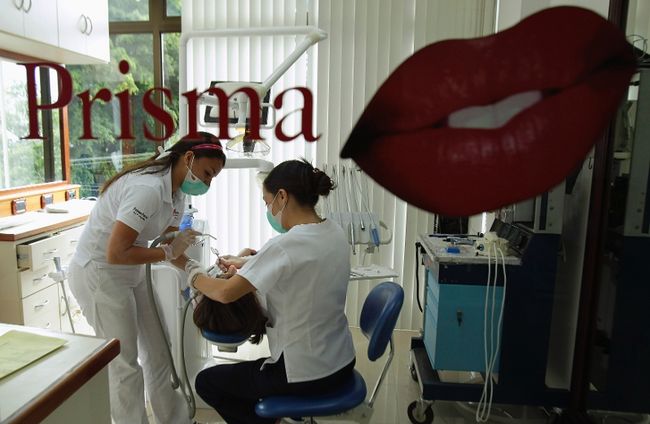
Two dentists work on a U.S. patient at a dental clinic in San Jose, November 1, 2012. Around 40,000 medical tourists visited Costa Rica last year, compared to 36,000 in 2010 and 30,000 in 2009. Most of them are American and Canadian, according to the country’s tourism institute, ICT. REUTERS/Juan Carlos Ulate

Costa Rican health officials are grappling with booming demand as it is.

When Canadian house cleaner Marlene Trithardt needed a tooth replaced, she drove past her local dentist’s office in Alberta and flew to the beach paradise of Costa Rica – to save money.

Trithardt is one of a growing number of North Americans who turn south for medical care lured by lower prices, contributing close to 0.8 percent of Costa Rica’s gross domestic product.

“I chose to come here because I find in Alberta the prices are about 80 percent higher than in Costa Rica,” says Trithardt, 57, who makes $30,000 a year.

Her treatment will cost $4,000. But even including airfare, hotels and meals for two weeks, the total amount is lower than the $10,000 she said she was expecting to pay for the dental care alone in Canada.

In the bargain, Trithardt got to take a few days to visit Costa Rica’s national parks.

Around 40,000 medical tourists visited Costa Rica last year, compared to 36,000 in 2010 and 30,000 in 2009. Most of them are American and Canadian, according to the country’s tourism institute, I C T.

Of that number, almost 15,000 of them travelled for dental care, said Massimo Manzi, director at Promed, the council for international promotion of medicine in Costa Rica.

Manzi estimates that medical tourism brought in $196 million to Costa Rica’s health industry in 2011, with patients spending an additional $84 million in hotels, meals, travel and shopping. That makes for a total of $280 million spent on medical tourism in 2011, compared to $252 million in 2010.

Costa Rica competes for medical tourists with the likes of India, Brazil, Panama and Mexico, and its proximity to the United States gives it an advantage over Asian and South American destinations.

And while some doctors in the United States discourage travelling abroad for cheaper treatment – saying the quality may not be vetted and that follow-up care is lacking – technologyechnology and care standards in the private sector are perceived by the medical community and patients alike to be high.

The dental tourism niche is booming in Costa Rica, a country of 4.5 million people best known for its white sand beaches and lush rainforests. Now accounting for 36 percent of all medical tourism, that figure is seen rising to 50 percent over the next two years, said Promed’s Manzi.

Trithardt’s doctor, 32-year-old Costa Rican Ignacio Vargas, says tourists represent 70 percent of his business.

SOUGHT BY THE UNINSURED

Virtually all medical tourists are uninsured and pay their own way, said Brad Cooke, head of Medical Tours Costa Rica, a travel agency that works exclusively with patients.

As a result, healthcare reform passed in the United States that will require Americans to get basic insurance by 2014 could reduce demand. However that reform does not cover dental care.

“We had a gentleman, for example, who was interested in coming in for a knee procedure about six months ago and then he decided not to come. He said he’d rather wait and see if Obamacare would cover it”, said Cooke.

A few insurance companies in the U.S. like Cigna Corp (CI.N), Satori and Blue Cross Blue Shield are already expanding their supplier network to include overseas clinics and facilities to help cut costs.

“What we’re hoping, and it would be an important step, is that these insurance companies offer an incentive to those who choose the international option,” Manzi said.

“We are learning how to handle this demand so that we don’t get to a point where we are facing waiting periods which would turn patients away from Costa Rica,” said Health Minister Daisy Corrales.

To help ensure that demand can be met, Promed works as a guide for investors looking to build new clinics and hospitals that can welcome tourist-patients.

source: http://www.Ifpress.com / IFP Press /  Home> Health> Food> Travel — Life Travel / by Isabella Lota, Reuters / Saturday, December 01st, 2012

Kerala Toursim campaign to promote medical tourism with Ayurveda

Tourism Minister A.P. Anil Kumar said on Thursday that the Kerala Tourism campaign will focus on Ayurveda to promote medical tourism — drawing maximum advantage from the mega biodiversity region of Western Ghats.

The campaign, the minister said, would focus on Ayurveda owing to the rich medicinal plants’ reserve in the Western Ghats, which is among the ‘hottest biodiversity hotspots in the world’.

‘Kerala is naturally blessed to be the flag bearer of Ayurveda because of the state’s rich ecosystem in the Western Ghats,’ Kumar said.

‘A large number of foreign and domestic tourists come to Kerala for Ayurvedic treatment. As many as 900 species of medicinal herbs are found in Kerala,’ he said.

Agasthyakoodam peak in the Western Ghats, about 70 km from Thiruvananthapuram, is home to some of the rarest medicinal plants.

Kerala received about 94 lakh domestic visitors last year while about eight lakh foreign tourists visited the state during the same time, according to a tourism department official. A majority of foreign tourists from Germany, the Middle East and Australia joined the state’s Ayurveda wellness programmes, the official said.

Kerala Tourism Secretary Suman Billa said Ayurveda treatment in the state was aimed at providing vigour and health to visitors. ‘That is what the tourists are looking for. Lifestyle changes and urban pressures are increasingly affecting the people,’ he added.

The Ayurveda-focussed tourism campaign aims at lengthening the average stay of foreign tourists to 18 days per person from the present average of 16.2 days. Kerala also plans to bring about a convergence of different systems of medicine.

Besides, the tourism department will also add new tourism destinations and diversify its tourism portfolio by including adventure activities like rock climbing and paragliding.

Source: IANS

Source: http://www.health.india.com  / Home> News / November 30th, 2012

Health tourism will cure all that ails

The Health Ministry and Tourism and Creative Economy Ministry signed an agreement on Thursday for the development of health tourism, now considered as one of prime motors for economic growth in the Asia Pacific.

Under the agreement signed by Health Minister Nafsiah Mboi and Tourism and Creative Economy Minister Mari Elka Pangestu, the government will work with its public and private stakeholders, including hospital representatives, spa providers, and health associations, to create the Indonesia Wellness and Healthcare Tourism (IWHT) working team which will jointly design a work plan to follow up the agreement.

Medical tourism and wellness tourism are two core components of the health tourism industry Indonesia is now focusing on.

Health Minister Nafsiah Mboi said that wellness such as spa treatments was one of traditional healthcare services which had a huge potential to boost the health tourism industry in the country. Two well-known spa treatment methods from Indonesia, namely Java spa and Bali spa, were actually the most commonly used spa methods throughout the world.

“Unfortunately, it is still quite difficult to compete on a global level,” she told journalists after the signing of the agreement on the sidelines of 2012 International Health Tourism Conference which continues until Saturday.

In 2012, 4,500 spa therapists have received certification from the Education and Culture Ministry. However, many skilled spa therapists from Indonesia are now working in wellness centers in countries throughout Asia, Europe and America.

Five private hospitals – Premier Hospital in Bintaro, Premier Hospital in Jatinegara, Eka Hospital BSD, Siloam Hospital in South Tangerang, and Sentosa Hospital in Bandung, West Java – are currently accredited internationally.

Meanwhile, two public hospitals, Cipto Mangunkusumo General Hospital (RSCM) in Jakarta and Sanglah in Bali, are also in the process of getting international accreditation which will allow them to deliver the most attractive offers for medical tourists.

“We will keep improving the quality of hospital care particularly on its competency on specific treatment,” said Nafsiah.

The number of health tourists from Indonesia has reached 600,000 in 2012, up from 350,000 in 2006. The total spending of health tourists from the country reached US$1.4 billion this year, compared to $500,000 in 2006.

A study from Klynfeld Pear Marwick Goerdeller International shows that globally, the people’s spending for health tourism has reached $100 billion in 2012, up in between 20-30 percent from $78.5 billion in 2010.

“I think we have to take a look at some of the ways our business in health sector run in order to increase our market share,” said Tourism and Creative Economy Minister Mari Elka Pangestu.

source: http://www.TheJakartaPost.com / Home> National / by Elly Burhaini Faizal, The Jakarta Post, Jakarta / National / Thursday, November 29th, 2012