
Renovated Eden Gardens Wellness Resort and Spa opens

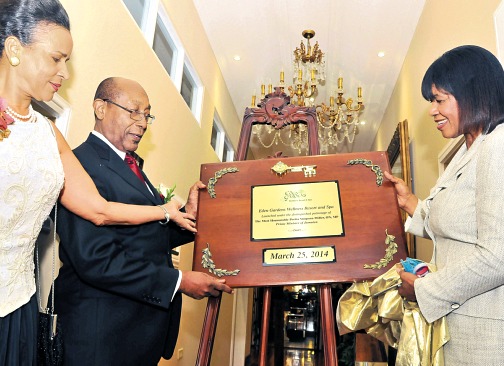
Prime Minister Portia Simpson Miller (right) joined Dr Henry Lowe and wife Janet to unveil the plaque signifying the opening of the new and improved Eden Gardens Wellness Centre and Spa in Kingston, Tuesday evening. (PHOTO: KARL MCLARTY)

Prime Minister Portia Simpson Miller (right) joined Dr Henry Lowe and wife Janet to unveil the plaque signifying the opening of the new and improved Eden Gardens Wellness Centre and Spa in Kingston, Tuesday evening. (PHOTO: KARL MCLARTY)

THE new and improved Kingston-based Eden Gardens Wellness Resort and Spa was opened on Tuesday to great fanfare.

The launch saw the attendance of Prime Minister Portia Simpson Miller, five members of her cabinet, overseas dignitaries and movers and several business magnates.

Eden Gardens Wellness Resort and Spa is a member of the EHF Group of Companies and is operated by Eden Gardens Wellness & Lifestyle Limited.

In his remarks, EHF Executive Chairman Dr Henry Lowe said that the aim was to make the $550-million ‘green’ facility a major tourism attraction in Kingston and a centre of excellence for wellness tourism.

“Eden Gardens was conceptualised as a wellness oasis in which all its offerings would unite to provide holistic wellness for the body, mind and spirit,” said Lowe, noting that before the overhaul, there had been a diversion from that original concept.

“However, the new Eden Gardens is back and exceedingly better than before, as in addition to recapturing its original purpose, we have now infused cutting-edge technology and state-of-the-art amenities into the new facility which we are launching…,” Lowe said of the 20-plus suite facility situated along Lady Musgrave Road in the posh section of the Corporate Area called the Golden Triangle.

Wellness and lifestyle services provided at the facility include a range of professional services that cater to health-conscious individuals and businesses seeking to improve mental, physical and spiritual health to enhance the quality of their lives and workplaces.

Services include a therapeutic spa, fitness club, health food restaurant with a salad, juice and smoothie bar, nutrition centre in addition to massage therapy, reflexology, yoga and activities for stress management.

“I’ve been to spas in Miami and Napa (California) and they have nothing on this spa,” Becky Stockhausen, executive director of the American Chambers of Commerce, said in her remarks.

Meanwhile, Tourism Minister Wykeham McNeil said the place exemplifies the Government’s mandate to diversify tourism and for the island to tap into the booming health and wellness market.

For her part Prime Minister Simpson Miller said that Eden Gardens Wellness Resort and Spa is an “excellent addition to our tourism product”.

source: http://www.jamaicaobserver.com / Jamaica Observer / Home> News / Thursday – March 27th, 2014
Medical tourism plan studied by lawmakers

Tallahassee, Fla. (AP)

Alongside Walt Disney World  ,  Kennedy Space Center , South Beach and the Florida Keys, Sen.  Aaron Bean wants to give visitors another reason to come to the state: to get some doctoring.

Bean has proposed legislation to require Visit Florida, the public-private partnership charged with attracting tourism to the state, to market Florida as a health care destination.

The measure would require that a minimum of $5 million annually, including $1.5 million in matching grants, be used from Visit Florida funds and suggests travel packages that would include transportation, food and hotel.

For more than a decade, U.S. residents have been pitched on the merits of overseas medical procedures, starting with lower costs that dovetail into a family vacation at a specially developed medical resort in a tropical climate.

Exotic locales including Istanbul, Bahrain, Bangkok and Curacao actively pursue patients from all over the globe. Print ads for a clinic in Okinawa, Japan, promote coral reefs, marine animals and a “dreamlike world.”

Bean thinks palm trees and beaches, as well as prime medical facilities, could pull in patients and families from South Dakota to St. Lucia.

“We want to attract visitors both domestic and overseas,” said Bean, R-Jacksonville. “That’s part of what can be decided in the marketing plan, and we want them to do whatever works. It would become part of the mission of Visit Florida.”

The measure has cleared two Senate committees and has one left.

Bean noted that the plan is finite: four years, and then a re-evaluation of its performance. If a success, the endeavor could see more state tourism funding, mirroring the support found in governments in other countries and a couple of U.S. cities.

“Some of these other places have dedicated a lot of money toward promoting their areas,” said Renee-Marie Stephano , president of the Medical Tourism Association , a trade group based in Palm Beach Gardens.

The association has worked with local convention and visitor bureaus in several U.S. cities, including Las Vegas and Seattle, where public dollars have been matched by private money, Stephano said.

Although Florida has a reputation as a medical destination in some areas, particularly Europe, Canada and South America, “no other states have had any legislation that would create a tourism effort,” Stephano said.

A bolstered marketing campaign for medical tourism would benefit the state’s newest model for upscale health care, the former Metropolitan Hospital of Miami . It was purchased earlier this year by Nueterra Healthcare, a Kansas-based consulting and management firm and member of the Medical Tourism Association.

“Nueterra has international referral centers and specializes in building infrastructure for these kinds of facilities,” Stephano said.

Nueterra did not return a phone call seeking comment.

Several private operators seek to bring foreign citizens into the U.S. for treatment, usually relying on the country’s reputation for ministering to advanced health problems, from cancer to organ transplants.

“When people think of specialty care, that’s where we come in,” said Rosanna Moreno , a Houston-based attorney and consultant who is part of an effort to connect the city’s esteemed cancer treatment facilities with foreign patients. They don’t use public dollars, she noted, “although if there were money delegated to do so, it would be a big help.”

But turning to public funding can bring in regulators, which has a reputation for driving up costs.

“You have these two overarching sets of issues, which are how risk is managed and what the role of regulators is,” said Paul Keckley , a health care consultant and former executive director of the Deloitte Center for Health Solutions .

Keckley noted that the private market is starting to crank up its effort to import medical tourists, citing the larger esteemed hospital groups like Mayo Clinic  and Johns Hopkins Medicine , which have drawn international patients for years.

“They’ve done it themselves though, and when you bring government in, you invite scrutiny,” Keckley said. “Any time you draw attention to yourself, someone will translate that into an opportunity.”

source: http://www.seattlepi.com / Seattlepi / Home / by Steve Miller, Associated Press / Thursday – March 27th, 2014

Pharaon looks to broaden tourism

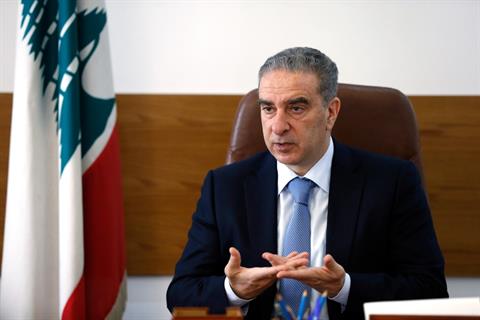
Tourism Minister Michel Pharaon speaks during an interview with The Daily Star in Beirut, Friday, March 21, 2014. (The Daily Star/Mohammad Azakir)

Tourism Minister Michel Pharaon speaks during an interview with The Daily Star in Beirut, Friday, March 21, 2014. (The Daily Star/Mohammad Azakir)

Beirut :

As Lebanon’s tourism industry faces a third dismal season in a row in the face of regional and local turmoil, the new tourism minister is looking to expand beyond the traditional Gulf tourists.

Among Michel Pharaon’s wide-range of plans to give a needed boost to a sector that is estimated to make up 20 percent of the Lebanese economy is to focus on drawing in a new class of travelers: medical tourists.

“In Lebanon, we have professionals in the health care industry that can bring in tourists from Yemen, Iraq, Libya and Algeria,” the minister said.

“We have a committee working hard on that, and there is a conference that will take place soon on this subject matter, but we are currently working on bringing all actors together,” he added.

“A good number of Iraqis are coming to Lebanon for medical reasons,” he said.

“Health tourism has good potential for the country.”

The need to attract tourists from beyond the traditional Gulf markets is especially important GCC states maintain their travel warnings on Lebanon, which Pharaon is working to get removed in the coming months.

“We are working hard on lifting the travel ban to Lebanon imposed by the GCC countries on their nationals and we are trying to get positive results on this matter,” Pharaon told The Daily Star.

“But the outcome will become clear in a few weeks.”

Tourism in Lebanon has been hit as travel warnings over possible abductions and other security threats has kept Gulf tourists away for the past several years.

Warnings from several GCC states were issued in 2012, and the United Arab Emirates and Kuwait gave similar advice again in 2013.

The minister said the travel advisories were political in nature, attributable to the stance of the previous administration on regional conflicts, including the Syrian war.

“Some of the political stances taken by the Foreign Ministry and the previous government are related to this ban,” he said. “The ban is also due to security issues.”

However, Pharaon is optimistic about the positive effect of the new Cabinet formation on the security situation, and its eventual contribution to rebuilding tourism.

“The government provides a cover for the security forces to do their jobs,” he said.

“There is also a better coordination between security forces and the Army in addition to a better coordination with Arab and foreign allies which had some dialogue problems with the previous government,” he added.

Despite the security situation in the country, rocked over the last year by a series of bombings related to the ongoing conflict in neighboring Syria, Pharaon seeks to highlight the relative safety throughout much of Lebanon.

“We would like to remind everybody that around 70 percent of areas in Lebanon have not witnessed a gunshot for the past 20 years,” he said.

The demographics of the tourists in Lebanon have changed in the last several years, and Pharaon sees room for growth by targeting less traditional markets for advertising.

The number of tourists to Lebanon dropped by 6.69 percent in 2013 compared with 2012, while European visitors topped the list ahead of Arabs for the first time in years.

While the number tourists from the Gulf dropped, Pharaon says that other Arab markets are ripe with potential.

“We are currently zooming in on Jordanians, Iranians, Egyptians and Iraqi tourists by studying ticket fares to attract tourists from these destinations to Lebanon,” he said.

“We are trying to see how the Middle East Airlines can assist us on this matter, but we will definitely start with this before the beginning of the summer.”

Pharaon added that the ministry was also working closely with non-governmental organizations to promote new touristic areas in Lebanon.

A version of this article appeared in the print edition of The Daily Star on March 22, 2014, on page 4.

source: http://www.dailystar.com.lb / The Daily Star, Lebanon / Home> Lebanon / by Dana Halawi / March 22nd, 2014

Medical tourism picks up in Aurangabad

Aurangabad :

The availability of super-speciality medical services is drawing more and more foreigners at city hospitals, giving a boost to the medical tourism sector. The latest patient was from Yemen, who underwent a coronary angioplasty at a super-speciality hospital in the city.

Zubaree Mohammad, mayor of Aden, underwent the operation a couple of days back at the Mahatma Gandhi Memorial Hospital, Aurangabad. He has now been discharged and is planning to visit the world heritage sites of Ajanta, Ellora on Friday. He is likely to fly back to Aden by this weekend.

Mohammad told TOI he had done extensive search over the internet to check the medical treatment and facilities available at various hospitals in India, before selecting the medical institute in Aurangabad. “I realised that I would not only get quality treatment on par with other countries but it was more economical here compared to US or other countries,” he said.

MGM hospital chief executive officer Pravin Suryawanshi said Mohammad underwent surgery for Hemorrhoids. During his hospitalisation, cardiologist Afzal Noor Khan performed the cardiac evaluation along with coronary angiogram, which revealed he was also suffering from coronary artery disease.

“Coronary angioplasty was performed using the latest technology and an absorbable stent was inserted in the narrowed artery. This stent will dissolve in a span of two years,” said Khan.

The MGM hospital is among the many medical institutes in the city that have received patients from across the world for the modern and affordable health services.

“In Aurangabad, the charges of medical facilities are very economical when compared to metro cities. If a laparoscopic gall bladder removal surgery had to be done, it costs Rs one lakh in Mumbai, in Pune Rs 50,000-60,000 and in Aurangabad it costs just Rs 35, 000,” said Suryavanshi.

A few months back, a professional National Basketball Association (NBA) player flew down from USA to a city hospital to get a knee surgery done. The player from Texas approached joint replacement surgeon Shivkumar Santpure at Kamalnayan Bajaj hospital. The treatment cost him one fourth that of USA, including the travel costs.

Santpure has treated as many as 200 patients from the Middle East and Africa. “At Aurangabad, you receive affordable orthopaedic surgery and treatment at a world-class healthcare facility. The hospital has expert doctors and patient-friendly staff with state-of-art infrastructure.”

“The hospital provides them a range of accommodation packages that include accommodation, certain meals, transportation to airport and medical with assistance and support, from which they can choose. Moreover, during their stay in Aurangabad, we help them make the most of their trip by introducing them to suitable sight-seeing and tourism options,” he said.

Agreeing that medical tourism is picking up in the city, “connectivity is a big challenge,” said administrator of Seth Nandlal Dhoot hospital, Himanshu Gupta (dental surgeon).

“In last one year, we have treated and operated upon at least 30 foreign patients,” said Gupta.

source: http://www.timesofindia.indiatimes.com / The Times of India / Home> City> Aurangabad / by Ranjana Diggikar, TNN / March 21st, 2014

Dubai rolls out medical tourism strategy

Russia, South Asia, GCC states targeted with special packages to be introduced for patients

Image Credit: Francois Nel/Gulf News Archives / Heart operation at the Dubai Hospital. This operation is a first in the UAE.

Image Credit: Francois Nel/Gulf News Archives /
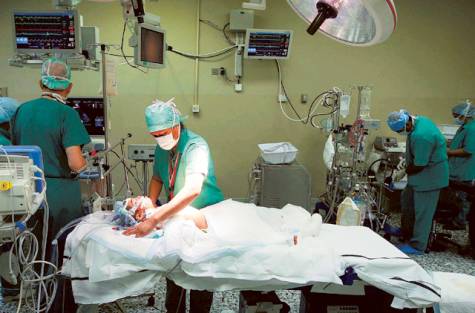
Heart operation at the Dubai Hospital. This operation is a first in the UAE.

Dubai:

Dubai plans to attract thousands of medical tourists from Russia, CIS (Commonwealth of Independent States) countries, South Asia and GCC states and has earmarked seven specialities that will bring patients for treatment to the emirate.

The Dubai Health Authority (DHA) yesterday rolled out the initiative that will bring in Dh1.2 billion in revenue from patients and their families and make Dubai one of the top medical tourism destinations around the world.

By the end of this year, special packages will be rolled out for patients that will include the cost of treatment, the visa cost, air ticket, and leisure activities for patients’ families. The DHA is working with the Department of Tourism and Commerce Marketing to “lock in” the prices and with the General Directorate of Residency and Foreigners Affairs to make the visa process easier for those coming here for treatment.

“Dubai already has several elements that make it a favourable destination for medical tourism. Developing a strategy helps ensure the complete process from the time a patient visits Dubai for medical tourism right through the discharge and follow-up stage is smooth, “said Eisa Al Maidour, Director-General of DHA, announcing the plan to the media.

Dubai already attracts medical tourists from diverse countries such as Nigeria, the US, Pakistan and India for treatment for fertility to heart operations.

“We are relying on Dubai’s strengths by building a health system that supports excellence in health care with a focus on health-care professionals, health investment and excellence in services across a diversified range of medical specialities,” Al Maidour said.

The specialities range from plastic surgery and dental care to preventive health checks and wellness.

The DHA will launch a special portal for medical tourism and launch medical tourism packages that will be promoted in a target market, said Dr Ramadan Ebrahim, director of health regulation at the DHA and director of the Medical Tourism Project.

He said the hospitals are internationally accredited and the emirate has more than 25,800 health professionals in the private sector who speak more than 40 languages. “All these factors will help drive the medical tourism initiative,” he said.

He added that 107,000 medical tourists visited Dubai in 2012 and the revenues generated totalled Dh652.7 million. He said in four years’ time, by 2016, there will be a 15 per cent jump, bringing the total number of tourists to 170,000 and revenues to Dh1.2 billion. By 2020 Dubai will attract 500,000 tourists, shooting up the revenues to Dh2,6 billion.

source: http://www.gulfnews.com /  GulfNews.com / Home> UAE> Health / by Mahmood Saberi, Senior Reporter / March 24th, 2014