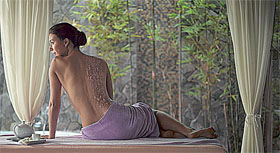
A woman poses at Mövenpick Hotel Mactan Island Cebu’s Spa del Mar. (Photo courtesy of Mövenpick Hotel Mactan Island Cebu)
I REMEMBER it was warm, desert warm. Warm outside. Warm inside. I remember hands—warm, gentle and sure. I remember reassurance and safety, acceptance and encouragement. I remember locks unlocking and light coming in.
Leaving Mii amo, a little spa nestled in the red rocksoutside Sedona, Arizona, was like leaving the womb. A rebirth. And today, whenever I think I may be hitting bottom, when I think my soul has been squashed as flat as a runover cartoon character, I think about Mii amo. I think I can go there and be resuscitated. And then some.
When I visited Mii amo, about a decade ago, most people would have consider it a kind of out there, woo-woo place—crystals, meditation labyrinths, chakras, ancient Ayurveda oils. Today, though, it’s not so strange. Today a lot of travelers are off to Mii amo’s of their own. A vacation where they can revive, regroup and be healthy.
It’s been officially dubbed “wellness tourism,” and it’s one of the fastest-growing trends in travel these days. One of the factors fueling its popularity is, in fact, a reaction to all the unhealthy aspects of mainstream travel these days, from the hassles of airports to the high-season crowds to the rudeness and overscheduling and worry and exertion.
Not to mention the basic concept of vacations, which, for many, is to go a little excessive: overeating, drinking, partying all night, etc. All of which leaves a lot of people reporting back with the familiar “need a vacation from my vacation” coda.
At the same time, more of us are making lifestyle changes and living healthier. Failing medical systems, the rising cost of health care and the stress of modern multitasking lives have led people to take on more responsibility for maintaining their own health.
And, of course, the population is aging.
Add to this the greater awareness of, well, awareness—mindfulness, meditation and other once-woo-woo ways—and wellness tourism was a niche market just waiting to be noticed.
In 2013 SRI International, a nonprofit independent research and innovation center, did the first-ever study to quantify the wellness-tourism market, and the numbers it came up with were attention-getters. Wellness tourism represents 14 percent of total global tourism revenue of $3.2 trillion. The market has been growing more than 9 percent annually—twice the rate of global tourism, overall—and that’s expected to continue in the next five years.
The study included two types of wellness travelers: those whose primary purpose was to focus on their health—say, at a destination spa or a yoga retreat or a weight-loss boot camp—and those who engaged in some form of wellness activity or took advantage of healthier options while on vacation, which range from anything from taking exercise classes on a cruise to dining at vegetarian restaurants or booking an allergy-free room at a hotel.
Wellness tourism includes aspects of all areas of travel, from resorts with exercise programs to active adventure trips, a day at hot springs or hotels that offer healthy-lifestyle dining or snack options.
Spas account for about 41 percent of all wellness-travel activities, according to the SRI study. The awareness—of wellness—heck, the proliferation of the word itself—has led to changes all across the travel industry. Wellness is the new “green.” It’s au courant, and it sells.
Consider:
Travel agents are getting crash courses in wellness travel. Very few know the ins and outs and what’s available. Some agents, who have long been interested in the field, quickly established themselves as specialists: Well Traveled Co., for instance, opened just last year. Others, like Wellbeing Travel (wellbeingtravel.com), not only arrange trips, but also hire out as consultants. SpaFinder—the veteran of the pack, with 20 years under its very cinched belt—recently added a tagline to its name: it’s now SpaFinder Wellness 365, reflecting the company’s broader bailiwick. In its list of travel trends earlier this year, Wellness Tourism Worldwide, a consulting team involved in education, promotion and branding wellness travel—and itself an outgrowth of this growing area of the tourism business—predicted that wellness agents would be one of the hot trends of the year.
Hotels—at least some—are adding healthy components to their programs, from exercise classes to restaurant upgrades. But a few are investing big time. The MGM Grand in Las Vegas refurbished 42 of its 5,000 rooms last year into so-called Stay Well accommodations, with features including “wake-up light therapy”; vitamin C-infused shower water, high-tech air-purification and water-filtration systems; and a photocatalytic coating on bathroom surfaces, which breaks down bacteria. The rooms were in such demand that the hotel has added another 130.
InterContinental Hotels Group has gone even further, introducing an entirely new hotel brand that targets the wellness market. The Even Hotels will have elaborate gyms; all-natural amenities; in-room yoga balls and mats; and a selection of fresh-squeezed juices at its quick-service counters.
Joining the world of specialized hotel groups is the new Healing Hotels of the World, a collection of some 90 hotels worldwide.
Cruising, once the playground for overindulgence, has fattened up its healthier offerings. Norwegian Cruise Line has partnered with New York’s revolutionary, high-energy indoor cycling studio, Flywheel Sports, to open studios on its newest ships. Its new Norwegian Getaway, which launches next month, will offer not only a state-of-the-art fitness center and large spa area, but a thermal suite and a cutting-edge therapeutic room.
On Uniworld cruises, all guests staying in suites receive a free in-suite spa service, along with personal training lessons and yoga throughout their cruise. And on Paul Gauguin Cruises in the South Pacific, a specially designed retractable watersports platform gives guests access to sea level, where they can hop aboard a windsurfer or paddleboard, launch a kayak, or learn how to scuba dive.
Airports, ground zero for traveler freak-outs, seem to be slowly shaping up. San Francisco was the first to open a yoga studio in its newly remodeled Terminal 2; Dallas/Fort Worth (DFW); Burlington, Vermont; and Chicago O’Hare have followed suit. Chicago also has two spas in the same terminal, and outside the yoga room, an urban garden growing vegetables that supply many of the restaurants inside the airport. DFW actually has a whole wellness campaign; in 2012 it opened its LiveWell Walking Path inside Terminal D; its “Eat Healthy at DFW” marketing campaign soon followed.
OK, this isn’t widespread, but at least one airline, Qatar Airways, is going out of its way to become healthy. Working with Deepak Chopra, Qatar, in 2009 created Fly Healthy, Fly Fit, a four-page guide of travel tips for the long-haul flier, with information on massage, seated yoga and meditation.
Wellness poobahs are the newest tourism-related staff additions. Las Vegas, it turns out, is one of the biggest wellness destinations in the world, with 45 spas within four square miles—only appropriate, then, that since 2012 the Las Vegas Convention and Visitors Authority has had a medical and wellness-tourism manager on staff.
The Benjamin hotel in Manhattan has a “sleep concierge,” and a staff that will give you a go-to-sleep call to get you to unplug.
There are now Digital Detox vacation packages to pry your fingers from technology. Via Yoga, which leads yoga retreats in Central America, gives a discount to travelers who agree to give up their iPhones during their stay.
So you see, a lot has been going on the wellness tourism front.
What else is the future for the stressed and decrepit-feeling?
Spafinder Wellness 365 released its 11th annual trends report of the top 10 spa and wellness trends last month. Fueling all those trends, according to SpaFinder, is “mindfulness”—attentiveness to the present moment. This new awareness, a sort of be here now for the new millennium, has been popularized by everyone from the Dalai Lama to Steve Jobs, and Susie Ellis, president of SpaFinder, says it is one of the biggest movements the wellness industry has ever seen. Here are SpaFinder’s predictions, including examples—some offered by Spafinder, some our own finds.
Healthy hotels 2.0: It’s not just about adding something healthy for marketing purposes anymore. More hotels are going all in for health and well-being this year.
Example: Trump Hotels and TRYP by Wyndham are among the chains that have added in-room workout equipment, provide workout clothes, offer jogging routes and, in the case of Trump, even provide an iPod with music for your run or workout. Omni Hotels now has Get Fit Kits and Get Fit Rooms at some locations.
Wired wellness: While our addiction to technology is often part of the problem when it comes to stress and unhealthy lifestyles, technology also has its wellness applications—literally. Spas, hotels and destinations will take advantage of wellness apps, as well as customizable content, to create healthy experiences for their guests.
Example: The Four Seasons Hotel Los Angeles at Beverly Hills is about to begin what it calls “the world’s first digital, customized in-room fitness program,” created by celebrity trainer Rick Hagaman. Guests fill out a short survey, and Hagaman will provide virtual personal training through his workout videos. Guests can work out in the privacy of their rooms, playing the videos on their own devices or on the iPads that are standard issue in all Four Seasons LA rooms. The simple workouts require no special equipment other than items like elastic bands and workout mats, which are provided in the Fitness Kits supplied to all guests.
Hot springs heat up: Natural “healing waters” are nothing new, but they’re being given a new look, literally and figuratively. Traditional thermal baths, like those found in Europe, are being upgraded and new developments are creating wellness opportunities in more exotic locations. Because hot springs exist in virtually every country, governments, as well as private developers, are funding hundreds of new projects in scenic settings around the world.
Example: Royal Teton Ranch Hot Springs, near Yellowstone National Park, will feature a luxury RV resort, restaurant and cabins around an assortment of pools featuring geothermal water. China’s Mission Hills Resort, in the volcanic region of exotic Hainan Island, boasts the biggest spa in the world, with 168 thermal pools.
Suspending gravity: Zero gravity, floating, whatever the label, the sensation is the same—disconnecting from what keeps us pinned down to the earth. Spas and gyms are investing in flotation tanks, chambers and float pools. The newest additions to fitness classes are aerial and antigravity exercise classes and yoga workouts, using suspension rigs and antigravity treadmills.
Example: The new Amangiri’s Aman Spa in Utah has a vast flotation chamber built into a canyon cave, the water is packed with Dead Sea salts and color therapy adds yet another dimension to the wellness experience.
Ferocious fitness: High-intensity interval training with shorter time frames for exertion has become popular. Grueling boot camps and survival courses are in vogue, thanks to reality TV.
Example: Gwinganna Lifestyle Retreat in Australia has added high-intensity training via boxing.
‘Natural’ beauty meets social media: Forget the makeup sessions and salon blowouts. Today, when Instagram and other social media require us to post our photos anytime, anywhere, we need to look good 24/7, no preparation needed. The key is the natural look, which comes with a healthy lifestyle and the help of noninvasive and nonchemical treatments.
Example: Check out Bastien Gonzalez’s Pedi:Mani:Cure studios in places like France, Singapore, Turkey and India. These upscale treatments are as much about reflexology and revitalization as they are about beauty.
Aromatherapy: Scent with intent: Spas are moving away from the basic use of generic aromatherapy oils in treatments and tapping into the specific healing uses of different plants and minerals. They are working with botanists to develop extensive lines of oils and changing their approach to aromatherapy and scent therapies to provide more specific and effective treatments, depending on the spa-goer. Look for customized scents, with input from the guest.
Example: Spa Matilda at Hotel Matilda in San Miguel de Allende, Mexico, involves guests in the selection of ingredients for their aromatherapy treatments with the spa’s apothecary concierge.
Wellness retreats rise…urbanize: After many years of recession, when spas maintained the status quo, several high-end destination spas are expanding and establishing new facilities. A distinct subtrend is the urban-close wellness retreat. Destination spas will locate close enough to big cities to be accessible to more wellness-seekers, especially in the northeast US.
Example: The highly regarded destination spa Miraval, long an institution in Tucson, Arizona, will unveil its first new property in 2015 with Miraval at Natirar, in Somerset County. Set on a 500-acre estate, it will feature a vast spa, wellness pavilion and yoga center, along with the Ninety Acres Culinary Center, which marries a culinary school to a celebrated farm-to-table restaurant.
Death and spas: Thriving during life’s transitions: Spas, long a source of psychological, as well as physical comfort in times of stress, are seeing the stresses that come with an aging population. Today they are helping clients tackle the changes and challenges that come with growing older and dying.
Example: The Connecticut Spa at Norwich Inn has partnered with The Echo Cancer Foundation to create a “fragile client” treatment menu that includes wellness massage therapy, a relaxation facial and a hydrating body antidote.
Top 10 surprising spa and wellness destinations: Spa-goers are looking for new destinations and indigenous experiences. At the same time, many small, remote and exotic locations are perfect for quiet and inspiring nature retreats. Many of the emerging wellness destinations have histories marked by political unrest and war; governments are investing in new developments that can bring in dollars and provide a makeover for their country’s image.
The 10: Bhutan, Colombia, Croatia, Ghana, Lithuania, Morocco, Nicaragua, Portugal, Saudi Arabia and Vietnam.
It’s obvious the possibilities are vast, and the wellness traveler—who spends three times that of the average traveler—is worth wooing. So here’s my addition to the list of trends: Look for the word “wellness” to be used to the point of uselessness. While most of those in the business certainly have the best of intentions, brace yourself for those deceptive cases of well-washing. You know, like green-washing, but having to do with your health, not the planet’s.
MCT
source: http://www.businessmirror.com.ph / Business Mirror / Home> Lifestyle> Tourism> Wellness Tourism / by Jill Schensul / The Record / March 02nd, 2014