Category Archives: Reports,Features, Statistics

Korea4Health Offers World-Class Medical Services of Korea for Global Patients Seeking High-Quality, Cost-Effective Treatments

To learn more about Korea’s highly skilled medical professionals, state-of-the art medical equipment, and solid medical infrastructure visit www.korea4health.org

New York : 

Korea4Health , providing internationally renowned Korean healthcare services, announces today the launch of its new website and services, featuring the best medical procedures of select Korean hospitals operating in the US and Korea, with some hospitals offering overseas US offices. Individuals seeking high-quality, affordable procedures – including cancer treatment, heart surgery, infertility treatment, organ transplant, neurosurgery, joint replacement, spinal surgery and alternative care – will find that it costs only 20 to 30 percent of the cost in US hospitals.

“The strength of Korean healthcare lies in its highly trained physicians and staff, high-end medical equipment, and well-established medical infrastructure,” says Dr. DoHyun Cho, Executive Director of Medical Korea Council in America. “The number of foreign patients seeking advanced medical treatment in Korea has increased by an average 50 percent annually. Medical doctors from countries all over the world are visiting Korea to be trained in workshops, fellowship programs and seminars from Korea’s highly respected hospitals.”

While Korea’s tourism numbers are gradually increasing, according to CNN, the number of foreign patients visiting Korea for treatments is also significantly increasing. Ministry of Health and Welfare recently publicly announced that the number of foreign patients visiting Korea has reached 155,673 in 2012. In the meantime, there are 91 overseas Korean medical facilities operating all over the world serving global patients. These overseas Korean medical facilities allow foreign patients to experience Korea’s excellent medical services without traveling to Korea. Korea4Health offers detailed information about Korean healthcare providers operating in the US as well.

Additionally, safety and quality of Korean medical services are inspected consistently by the government through accreditation and strict evaluation programs. Information featured in Korea4Health is also accredited by KHIDI USA, Korean Government agency under the Ministry of Health and Welfare.

Dr. Cho concludes, “Korea’s status as a medical and healthcare leader in the global arena has risen greatly. With growing awareness of the opportunities we offer patients, we foresee a large influx of US patients to our network of hospitals in the US and Korea seeking the best possible treatment at cost-effective prices.”

About Korea4Health

Korea4Health is the gateway to the internationally renowned Korean healthcare services prepared for the US patients exploring the most advanced and affordable healthcare solutions. Initiated by the public-private partnership, it is operated by KHIDI USA, Korean Government agency under the Ministry of Health and Welfare featuring the best medical procedures of the selected Korean hospitals operating in the US and Korea. Visit: http://korea4health.org / Facebook, and Twitter

source: http://www,heraldonline.com / Home> Business Wire> Site Services / May 22nd, 2013

Uganda: Museveni Invites Investors in Medical Services

Kampala :

Uganda’s President Yoweri Museveni has suggested investors go into provision of high quality health services to limit medical tourism.

Currently, India is the leading provider of these services.

“You should also consider investing in specialized medical facilities to stop medical tourism,” Museveni said recently while meeting potential tourism investors in London.

He said many wealthy people are opting to travel abroad for medical treatment, saying the country spends over $85million in foreign exchange to cover these costs.

‘We need between three to four specialized hospitals. We also need discipline among our people to save the hemorrhage of our money. With high class facilities, the labour costs are low and our people don’t need to spend on tickets and welfare abroad which are the highest costs,” he said.

Museveni said Uganda’s vision is to become an upper middle income country with an average income of $1500. He said the country is working towards attaining urbanization as part of its reorganization process.

“We need more urbanization as part of reorganization of society were we shall have less people in the rural areas and more in the towns so that the rural land is liberated for modern agro production,” he said.

Museveni said Uganda’s population is growing rapidly, “Iif we don’t shift the people from the rural areas, to industries, this will damage the environment. He said Uganda is losing over 40 billon cubic metres of wood per annum for wood fuel and that it is important to industrialize by providing cheap electricity.

“We have established now that to push Uganda up to a middle income country in the next 17 years, we need about $200 billon. There are opportunities for investments especially in infrastructure development. We have some surplus money in our pension fund, but because of careful management of the economy we can’t over borrow,” he said.

source: http://www.allafrica.com / All Africa / East African Business Week (Kampala) / by Paul Tentena / May 21st, 2013

Selection of Andhra hospital for ‘best medical tourism facility award’ by tourism ministry kicks up a controversy


Apollo Hospitals, Hyderabad, had not applied for the award.

Apollo Hospitals, Hyderabad, had not applied for the award.

The selection of Apollo Hospitals, Hyderabad, for the “best medical tourism facility” award, as part of the National Tourism Awards 2011-12 by the Union ministry of tourism, has kicked up a controversy.

The awards were presented by President Pranab Mukherjee in the presence of Tourism Minister K. Chiranjeevi at a function in New Delhi on March 18. Andhra Pradesh, Chiranjeevi’s home state, bagged as many as seven awards, including the best state award for “comprehensive development of tourism in the rest of India”.

The “best medical tourism facility” award to Apollo Hospitals, Hyderabad, has raised many an eyebrow as promoters of the hospital are closely related to the tourism minister. Chiranjeevi’s son and popular Telugu film hero Ram Charan Teja (who is now set to make his Bollywood debut with Zanjeer remake) is married to Upasana, granddaughter of Apollo Hospitals chairman Pratap C. Reddy. Upasana is now heading the charity initiatives of Apollo Hospitals group.

An RTI query posed by Rakesh Reddy Dubbudu, a Warangalbased activist, with the tourism ministry has revealed that the Apollo Hospitals management did not apply for the award, but the state government did it on its behalf. The four other applications for the award, however, were sent by the managements of various hospitals.

“The RTI reply has revealed that senior IAS officer Chandana Khan, special chief secretary (tourism and culture), applied for the award on behalf of the Apollo Hospitals. On the other hand, the four other entries were sent by the managements of Ruby Hall Clinic, Pune, Somatheertham Ayurvedic Hospital and Yoga Centre Pvt Ltd, Thiruvananthapuram, Leo Juventa Centre for Integrated Medicine, Hyderabad, and Medi Connect India Division of Indian Holiday Pvt Ltd, New Delhi,” Rakesh said.

“The question is why should the state government recommend only one hospital?” he asked.

source: http://www.indiatoday.intoday.in / India Today / India Today> India> South> Story / by A. Srinivasa Rao / Hyderabad – May 21st, 2013

Healthcare in Lebanon : Medical tourism keeps growing

Medical tourism continues to grow, despite travel warnings

Medical tourism continues to grow, despite travel warnings

The phrase “medical tourism in Lebanon” conjures for many the idea of visitors from the Gulf sitting in cafés and waiting for nose jobs. In reality, plastic surgery makes up only a small percentage of the country’s international patients’ needs.

Eighty-five percent of foreigners who seek treatment in Lebanon do so for other medical reasons, according to Mounes Kalaawi, partner and chief executive of Clemenceau Medical Center (CMC).

Despite the declining number of tourists visiting Lebanon, the country remains a regional healthcare destination because when it comes to one’s life, travel warnings and political turmoil become surmountable obstacles.

Driven by necessity

International patients account for roughly 20 percent of the total number of patients in the hospitals interviewed. Those patients are mainly from the region — 80 percent of Clemenceau Medical Center’s international patients are Arab — and feel that their countries cannot provide a competitive level of healthcare. “I was a consultant for some hospitals in the Gulf, and I can tell you that their level of treatment is not as advanced as ours,” says Dia Hassan, president and CEO of Bellevue Medical Center (BMC).

Mohamad Sayegh, dean of the Faculty of Medicine and vice president of Medical Affairs at the American University of Beirut Medical Center (AUBMC), says that international patients are drawn to the highly specialized healthcare services at AUBMC. He says that the majority of cases that the center sees are serious and complicated and have been referred to them.

Lebanon’s hospitals are especially reputable in the fields of oncology and digestive, cardiac and brain surgeries.

“The Iraqis don’t have a lot of good resources for radiation therapy…, so they tend to come here for those purposes,” says Sayegh. The number of Iraqis who come to AUBMC for treatment, mainly for cancer cases, has risen from 39 percent of the 2,297 international patients in 2010 to 58 percent of the 2,497 international patients in 2012. Both AUBMC and CMC plan to establish cancer centers in the coming years to keep up with the growing demand for such treatment.

CMC also introduced robotic surgery to the region, which is in high demand by international patients due to its noninvasive nature.

Affordable & accessible

Medical procedures in Lebanon cost less than they do in Europe or the United States, says Kalaawi of CMC.

BMC’s Hassan explains that most Gulf governments subsidize treatment abroad for their nationals. They choose Lebanon because the country is close to them — not only in distance but also in language and culture.

The unstable political climate of summer 2012 did impact medical tourism: demand for elective surgery from international patients decreased, and hospitals that depended on that saw their business decrease. “The Gulf countries simply stopped sending their nationals to Lebanon for healthcare and we… felt their absence,” says Hassan. The most performed operations in BMC are plastic surgeries.

But those who could not afford to go elsewhere for pathological services still came to Lebanon. AUBMC reported a 5 percent growth in the number of its international patients in 2012.

“We have a steady flow of international patients but this flow goes up and down according to the regional stability. The events of 2012 saw a reduction of international patients by 50 percent from certain nationalities but they were replaced by patients from other countries who were not affected by [travel] bans,” says Kalaawi, adding that if it were not for these regional disturbances, medical tourism would be a very important factor in the Lebanese economy.

The number of patients from Syria is increasing as well. “The war in Syria obviously had an impact on the medical centers there and people who have complicated illnesses are forced to seek healthcare elsewhere and some come to Lebanon,” says AUBMC’s Sayegh, who adds that the massive influx of Syrian refugees augments this number.

Travel outside one’s country for healthcare is not a new or unique situation, and while Lebanon remains a key destination for medical tourism in the region for the moment, instabilities in the country may drive some potential business away and allow other countries to catch up with us in this field.

source: http://www.executive-magazine.com / Home> Special Report / by Nabila Rahhal / May 17th, 2013

New center to promote health tourism in India

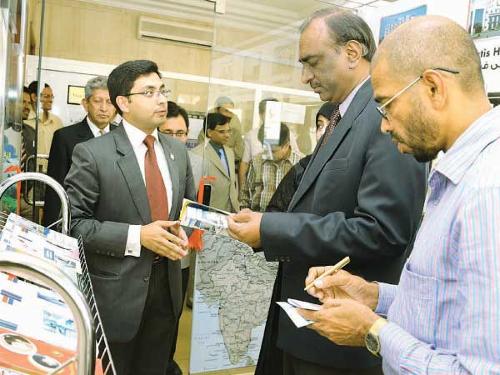
Mohammad Raghib Qureshi, head of chancery at the Indian Consulate, browses a brochure after launching the Healthcare Tourism Information Center in Jeddah on Sunday. — SG photo

Mohammad Raghib Qureshi, head of chancery at the Indian Consulate, browses a brochure after launching the Healthcare Tourism Information Center in Jeddah on Sunday. — SG photo

Jeddah:

India on Sunday launched an information center in Jeddah to provide guidance and assistance to people seeking healthcare in the country.

To be operated by TIARAIAM on the premises of the Consulate General of India, the Healthcare Tourism Information Center (HTIC) will be open to all Saudi residents looking for treatment in India.

The center will make available informative materials about various treatment facilities, including Ayurvedic, naturopathy and yoga centers spread across India.

Mohammad Raghib Qureshi, head of chancery at the consulate, formally inaugurated the HTIC.

Speaking on the occasion, Qureshi said, “India has one of the best healthcare facilities in the world and so many patients from all over the Gulf seek treatment in the country. It’s good if they are provided specific information about various hospitals and institutions,” he said, adding that the project is expected to boost the volume of healthcare tourism traffic to the country.

“We want to give more and more facilities as well as information to them. The medical expenditure in India is a fraction of the cost of having medical treatment in the Western countries, and I am sure (with the right information available) more and more people will go to India for treatment,” said Qureshi.

Around 850,000 tourists visited India in 2011 for treatment, which increased to 1.1 million in 2012. This is a clear indication that India is becoming the most sought-after Asian destination for healthcare tourism. Industry estimates peg the growth of India’s healthcare tourism market at almost 25 percent annually.

Fareed Sardar Khan, managing director of TIARAIAM, said: “India provides value for money and the cost of treatment is lower than many other countries. We will coordinate with the patients in Saudi Arabia and send their medical reports to the best hospitals and other healthcare setups, and source the advice from the best team of doctors free of charge. This cuts down the burden on the already suffering patient.”

Services provided by the HTIC include recommendation of the best doctors, hospitals, and Ayurvedic, naturopathy and yoga centers for different types of diseases, consultation from abroad, post-treatment follow-up, and many more.

“When the patient decides to visit India, we provide assistance with regard to visa formalities, airport pickups, ambulance service and translators, as well as guidance and advice on leisure tourism. The best thing is all these services are provided at no cost at all,” added Khan.

source: http://www.saudigazette.com.sa / Saudi Gazette / Home> Kingdom / by Syeda Amtul, Saudi Gazette / Monday – May 20th, 2013